It’s late July. At the spring board meeting, the superintendent said the district would “bring AI education to every student” this fall. The curriculum director now has a folder of vendor demos, three teachers who volunteered, and a start date circled on the calendar.
She doesn’t yet have answers to the questions that decide whether this becomes a program or a one-time event.
Most problems with AI curriculum implementation don’t appear in the first lesson. They appear in year two. Sixth graders arrive having “done AI” in fourth grade, and nobody can say what they actually learned. Or they appear in May, when the board asks what students can now do, and the only evidence is that they used a chatbot.
The decisions below aren’t exciting. But once a unit is running, they’re the hardest things to change.
1. Decide what you are actually launching
Before choosing materials, write one sentence that describes success. Compare these two:
“Students will use AI tools in class.”
“By the end of eighth grade, students can explain how a language model produces text and why it can sound confident while being wrong.”
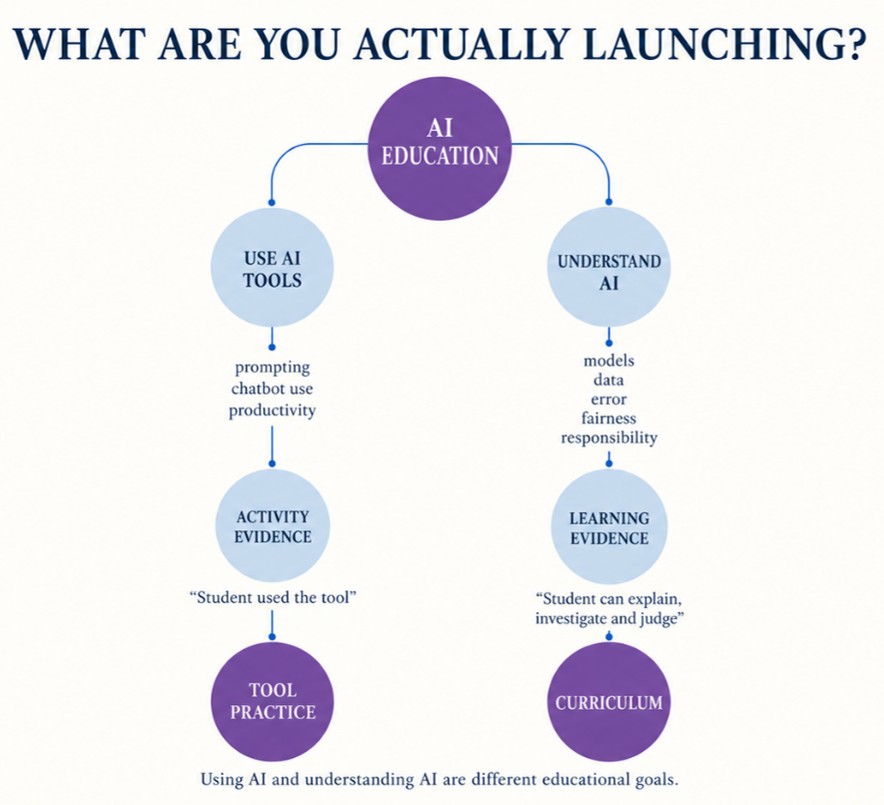
The first describes an activity. The second describes understanding. Both are fair goals, but they need different plans, different budgets and different owners.
Teaching students to use AI tools well usually belongs in staff training and your acceptable use policy. Teaching students how AI works, where it fails and who is responsible for it belongs in the curriculum. When the two get mixed together, the curriculum tends to shrink into tool practice. That is why it helps to place the AI curriculum inside a whole-school AI strategy before the first unit is scheduled.
2. Decide where AI lives in the schedule, and who owns it
Will AI be a dedicated unit in an elementary specials rotation? Part of a middle school STEM block? A high school elective? Spread across science, ELA and math?
Each option can work. The option that rarely works is “a bit everywhere, owned by no one.” When AI activities are scattered across subjects with no single owner, each teacher starts from zero, and students meet the same introductory idea three years in a row.
So name an owner. That could be a department, a coordinator or a curriculum lead. It must be someone who can see the whole K-12 picture. Then decide how much time each grade gets. A small, protected block every year often does more than a large block once, because ideas can return and deepen. Whether one AI unit a year is enough depends on whether each unit builds on the one before it.
If no one in your district can explain what a seventh grader should understand about AI that a fourth grader does not, what exactly are you launching?
3. Decide who teaches it, and what they need before day one
Most schools won’t have an AI specialist. The teachers who end up teaching AI are elementary classroom teachers, library media specialists, technology coaches, and science or computer science teachers who are already stretched thin.
That’s workable, but only if support arrives before the first lesson, not halfway through the unit. Non-specialist teachers rarely need a lecture on how neural networks work. They need to know what to say when a student asks “Is the AI alive?” and how to spot the most common misconception of the week. They also need a chance to rehearse a lesson before they teach it. These needs are discussed in more detail in what non-specialist teachers need to teach AI confidently.
Put protected planning time on the calendar now. A great curriculum taught by an unprepared teacher will look like a weak curriculum.
4. Decide which grades need devices, accounts and student data
This is where many US districts get stuck in August. Your 1:1 Chromebooks may be ready, but the AI tool in the lesson plan may not be approved. Many AI services set minimum ages in their terms of use. Any tool that collects student information also has to pass your district’s privacy review under FERPA and COPPA.
Make these decisions early:
- Which grades actually need to log in to anything
- Which tools have signed data privacy agreements
- What happens when a tool is blocked on the network
Many core AI ideas (examples, labels, patterns, classification, fairness) can be taught well with paper, cards and discussion, especially in the early grades. An honest look at your infrastructure is part of assessing school readiness to teach AI. It’s better to find a gap in July than in the second week of the unit.
5. Decide what counts as evidence of learning
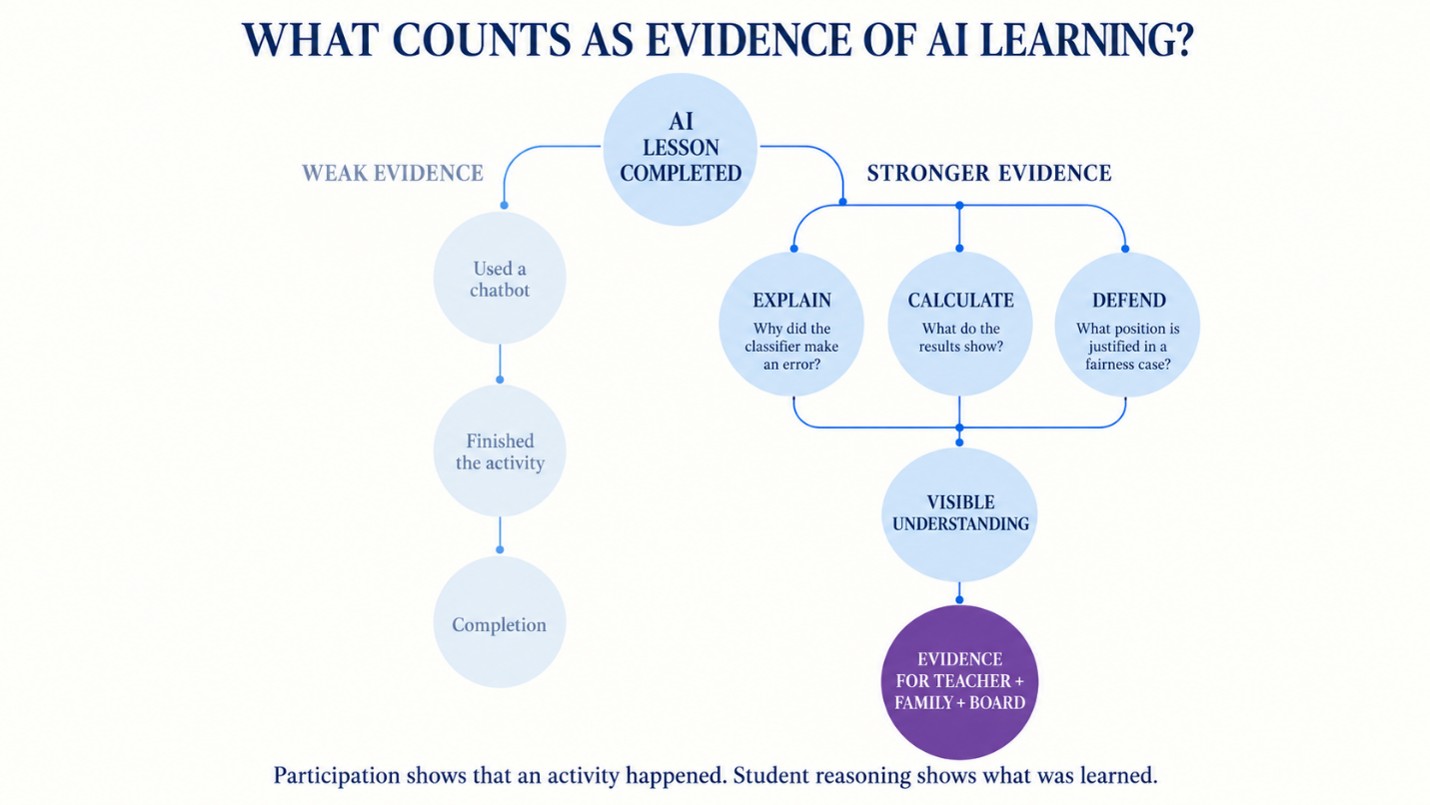
Agree on what students will produce before the first unit, not after. What will a teacher see at the end of a lesson that shows a student understood the idea, not just finished the activity? What will you report to families and to the board?
Good evidence in AI education is usually concrete. A student explains why a classifier got an example wrong. A student calculates accuracy from real results. A student takes a position on a fairness case and defends it. “Students completed the activity” is not evidence of understanding.
If the only proof of learning is that students used an AI tool, what will you show the board in June?
6. Decide how standards will be used
US districts will expect the curriculum to connect to frameworks they already know, such as the CSTA K-12 Computer Science Standards, the ISTE Standards for Students, NGSS engineering practices and the Common Core. That’s reasonable. But be clear about what a standards map does and doesn’t prove.
A lesson mapped to a CSTA standard is a design claim. It is not evidence that a student met that standard. Ask vendors to show where a standard is taught, where it is practiced and where it is assessed. That question belongs in your process for evaluating a school AI curriculum before adoption, not after the contract is signed.
7. Decide whether to launch everywhere or in phases
Starting K-12 all at once is tempting. But in year one, a ninth grader starting a ninth-grade unit has missed every earlier grade. Your high school teachers will need bridging lessons, or a launch plan that begins with a few grade bands and expands each year.
Phasing also protects your teachers. A pilot band shows where training, devices and pacing break down, while the stakes are still low. A phased roadmap for implementing an AI curriculum gives you a way to grow the program without overwhelming staff in the first semester.
The first unit is the easy part
Launching an AI curriculum isn’t mainly about choosing an engaging first lesson. It’s about deciding, ahead of time, what students should understand, who protects the time, who teaches it, what they need, and how you will know it worked. Schools that settle these questions early have something to build on in year two. Schools that skip them often end up starting over.
FAQs
What should a school decide before launching an AI curriculum?
A school should decide what students are meant to understand, where AI fits in the schedule, and who owns it. It should also settle how teachers will be prepared, which grades need devices and accounts, what counts as evidence of learning, and how standards will be used. Making these decisions before the first unit prevents most year-two problems.
How much time does a K-12 AI curriculum need each year?
There is no single right number. A small, protected block every year usually works better than one large block, because concepts can return and deepen each year. What matters most is that each grade’s unit builds on the one before.
Do teachers need a computer science background to teach AI?
No. Most schools teach AI with non-specialist teachers. What those teachers need is clear lesson guidance, a list of likely student misconceptions with ways to respond, and time to rehearse before teaching.
Do students need devices or AI tool accounts to learn about AI?
Not in every grade. Many foundational AI ideas, such as patterns, labels, classification and fairness, can be taught without devices. Where online tools are used, districts should check age limits and complete privacy reviews under FERPA and COPPA before the unit starts.
Should a district launch an AI curriculum in every grade at once?
Not always. In year one, older students will have missed the earlier grades, so they may need bridging lessons. Many districts start with one or two grade bands and expand each year.
Does standards alignment mean students have met CSTA or ISTE standards?
No. Alignment shows that a lesson was designed to address a standard. Evidence that students met it comes from assessment. Districts should ask where each standard is taught, practiced and assessed.