Picture a Grade 8 student who gets a chatbot to write a neat paragraph in ten seconds. Now ask her why the same chatbot made up a source. The room goes quiet. She has used AI. She has not yet learned about it.
That gap is the main question for any AI curriculum for schools. Using AI and understanding AI are not the same educational objective.
Tools change. Ideas last.
Tools change every term. The ideas underneath change slowly: how data teaches a model, what a model cannot do, and who is responsible when it gets things wrong. Curriculum time is limited, so it should go to what lasts. This is also why a good K-12 AI curriculum needs its own definition of AI literacy and AI skills.
What students should actually learn
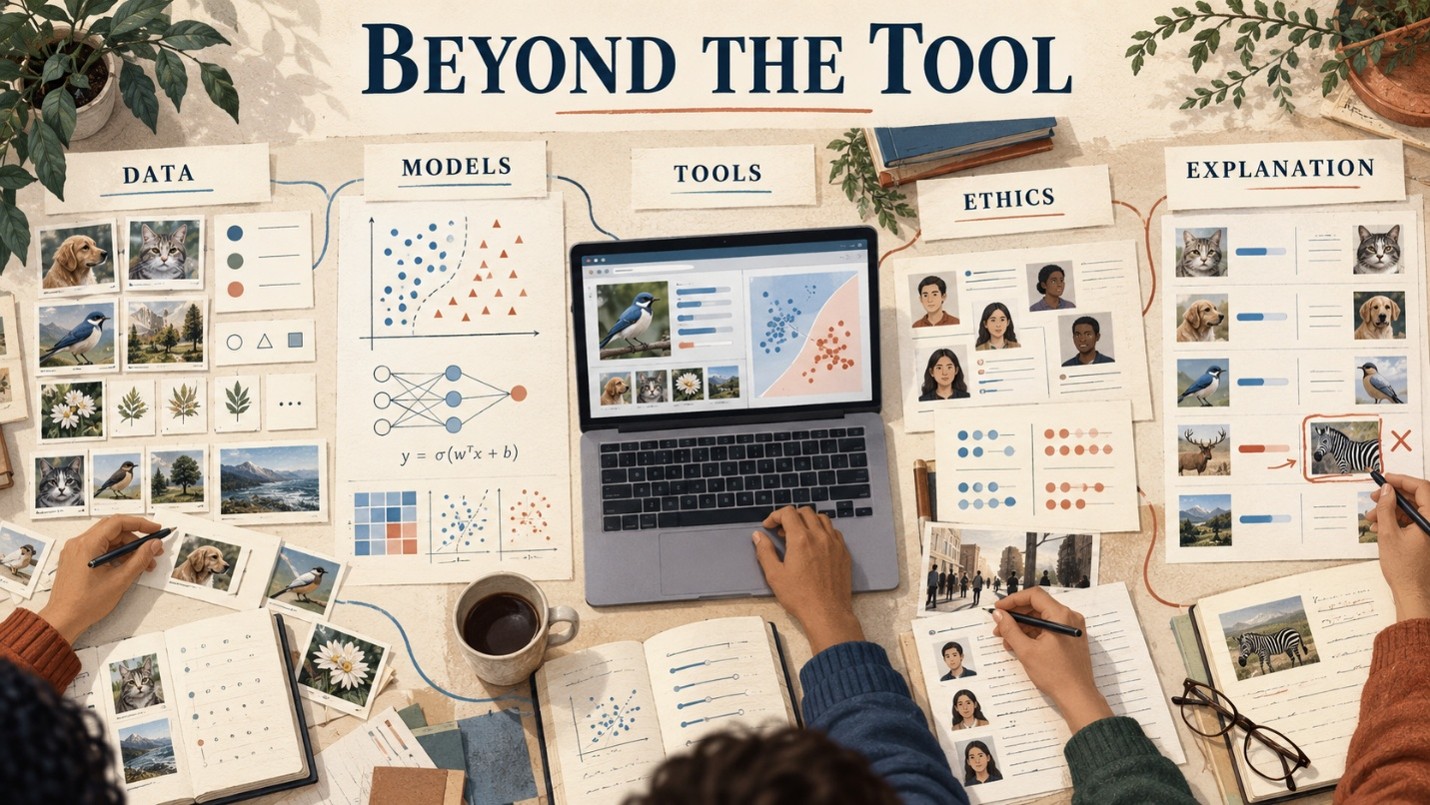
A good AI curriculum starts with how AI learns from data. Students should sort labelled examples and test a model on new cases, not just watch a demo. From there, they should learn how a model makes a decision. That means working through a small model by hand and reading its errors, rather than only typing prompts. They also need to learn where AI fails and why. Being told that “AI can be wrong” is not enough. They should find a real failure and trace its cause. Fairness and responsibility belong in the same lessons. When students trace an unfair result back to the data and to the people who chose it, the idea sticks in a way a single ethics lesson never does. Finally, students should be able to explain AI to others. Writing or presenting how a system reached a result shows real understanding, while repeating definitions does not.
Ideas should return, and go deeper
A common weakness in AI education is exposure without progression. Students meet “machine learning” in Grade 4 and again in Grade 9, and the second lesson is the first lesson with a newer tool.
A better plan lets the same ideas come back at higher difficulty. Data starts as “examples and labels” and later becomes class balance and augmentation. If you want the detail, see how AI understanding deepens across school years and the design principles for a K-12 AI curriculum.
Here is a test for any curriculum:
If a Grade 10 AI lesson could comfortably be taught in Grade 6, is the curriculum actually progressing?
Ethics belongs inside the lessons
If responsible AI sits in one unit, students will meet ethical questions everywhere else without any practice. It works better when ethics appears in the same lesson as the mechanism. Bias, for example, makes more sense after students have seen where training data comes from.
Questions to ask before you choose one
- Does each grade return to earlier ideas at greater depth?
- Can students explain why a model fails, not just that it did?
- Does ethics appear in more than one unit?
- Can a teacher who is not an AI specialist teach it?
For a fuller checklist, see evaluating a school AI curriculum before adoption.
FAQs
What is an AI curriculum for schools?
It is a planned sequence of learning about AI itself: how it learns, how it decides, where it fails and how it affects people. It is different from a list of AI tools students may use.
Should an AI curriculum teach coding?
Not at the start. Students can understand data, classification and fairness before they write code. Coding can be added in stages as ideas become more technical.
When should AI education begin?
Many programmes can start in the early years with simple ideas, such as noticing smart machines and learning from examples. The activities need to match the age group. Scholario APEX AI starts in Kindergarten.
How do we know if a curriculum goes beyond tool use?
Look at the outcomes. If students are asked to explain, test, compare and question AI, and not only to operate it, the curriculum is going beyond tools.