
A Year 9 science teacher lets students use a chatbot to summarise a research paper. Next door, a computing teacher asks students to explain why a spam filter marked a real message as junk. Both lessons involve AI. Only one is a lesson about AI. Many school plans cover the first and assume they have covered both.
Two different jobs
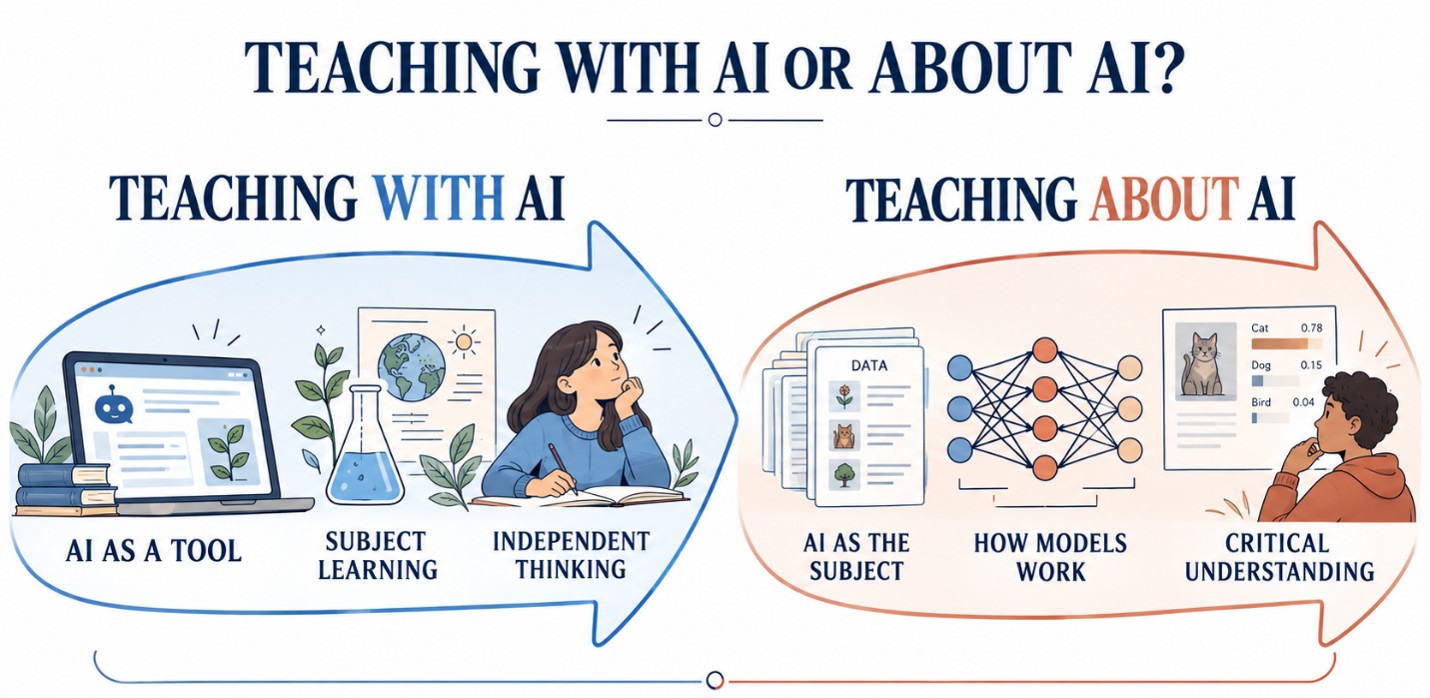
- Teaching with AI: AI is a means. Students use it to learn history, write code or practise a language.
- Teaching about AI: AI is the subject. Students learn how it works, where it fails and what it means for people.
The goals, the teachers, the evidence and the risks are different.
| Objective | Teaching with AI | Teaching about AI |
| Goal | Better learning in a subject | Understanding AI itself |
| AI is | A tool or tutor | The subject |
| Who leads | Every subject teacher | A trained AI teacher or specialist |
| Good evidence | The student can do it without the tool | The student can explain how it works and where it fails |
| Main risk | Answers replace thinking | Tool demos replace understanding |
| What the school needs | Classroom rules, well-designed tasks | A sequenced curriculum, teacher support |
What recent research says about “with”
What the source says. The OECD Digital Education Outlook 2026, published on 19 January 2026, reports that when students depend too heavily on generative AI, “metacognitive engagement… drops.” It describes “a misalignment between task performance and genuine learning.” It also says that “hybrid systems that combine GenAI with explicit pedagogical models… show more promise than general-purpose chatbots.”
Our reading. A good result on the page does not prove learning happened. Teaching with AI needs design: a clear task, a clear rule and a check that students can do the work without the tool. It is a teaching decision, not just a tool decision.
The OECD and European Commission AI Literacy Framework also keeps the two ideas together. It includes “Engage with AI” and “Create with AI” next to “Manage AI” and “Shape AI.” Our reading is that using AI is one part of a wider literacy, not a substitute for it.
What a school plan can look like
- Name both. Write a short statement for each. See defining both AI literacy and AI skills.
- Give each an owner. Teaching with AI belongs to subject departments, guided by school policy. Teaching about AI needs timetable time and a sequence of units.
- Check them separately. For “with,” ask whether students can do the task without the tool. For “about,” ask whether they can explain the mechanism and its limits.
If a school’s AI plan is only a list of approved tools, who is teaching students how those tools work?
For classroom detail, see classroom AI use that students can explain and evaluate and generative AI lessons that build understanding beyond prompting. For the wider argument, read the distinction schools keep missing.
FAQs
Is teaching with AI enough to make students AI literate?
No. Using a tool builds skill with that tool. Understanding how AI works needs planned teaching, and it does not appear on its own from regular use.
Who should teach about AI?
Teachers who are not AI specialists can teach it if the materials and training are good. Ask any programme how it supports them.
Does a school AI policy cover both?
A policy mostly governs teaching with AI: what is allowed, when and how. The curriculum covers teaching about AI. Schools need both documents.
How do we check that students learned without the tool?
Set a task where AI is not available, or ask students to explain their work. If they cannot, the tool did the thinking.