
A leadership team meets to decide whether the school can start teaching AI next year. The IT manager brings the audit: number of laptops, Wi-Fi speed, which platforms are licensed. Everything looks good, so the team says yes.
Six weeks into the first term, the unit has stalled. The Wi-Fi is fine. The problem is elsewhere. The Grade 5 teacher can run the activity but cannot explain why the class model keeps calling cats dogs. The timetable slot has been given to exam revision. And nobody agreed how anyone would know whether students were learning.
This happens often. Schools tend to check AI readiness the same way they check readiness for new software. But teaching AI as a subject is a curriculum decision, so the readiness check has to be about the curriculum too.
Why AI readiness for schools is often measured the wrong way
A device audit answers one question: can students reach the tools? That matters, but it is the easy part. Teaching AI as a subject asks students to understand how systems learn from data, why they make mistakes, and who is responsible when they do. Whether that happens depends far more on people, time and structure than on hardware.
Readiness is not a device count.
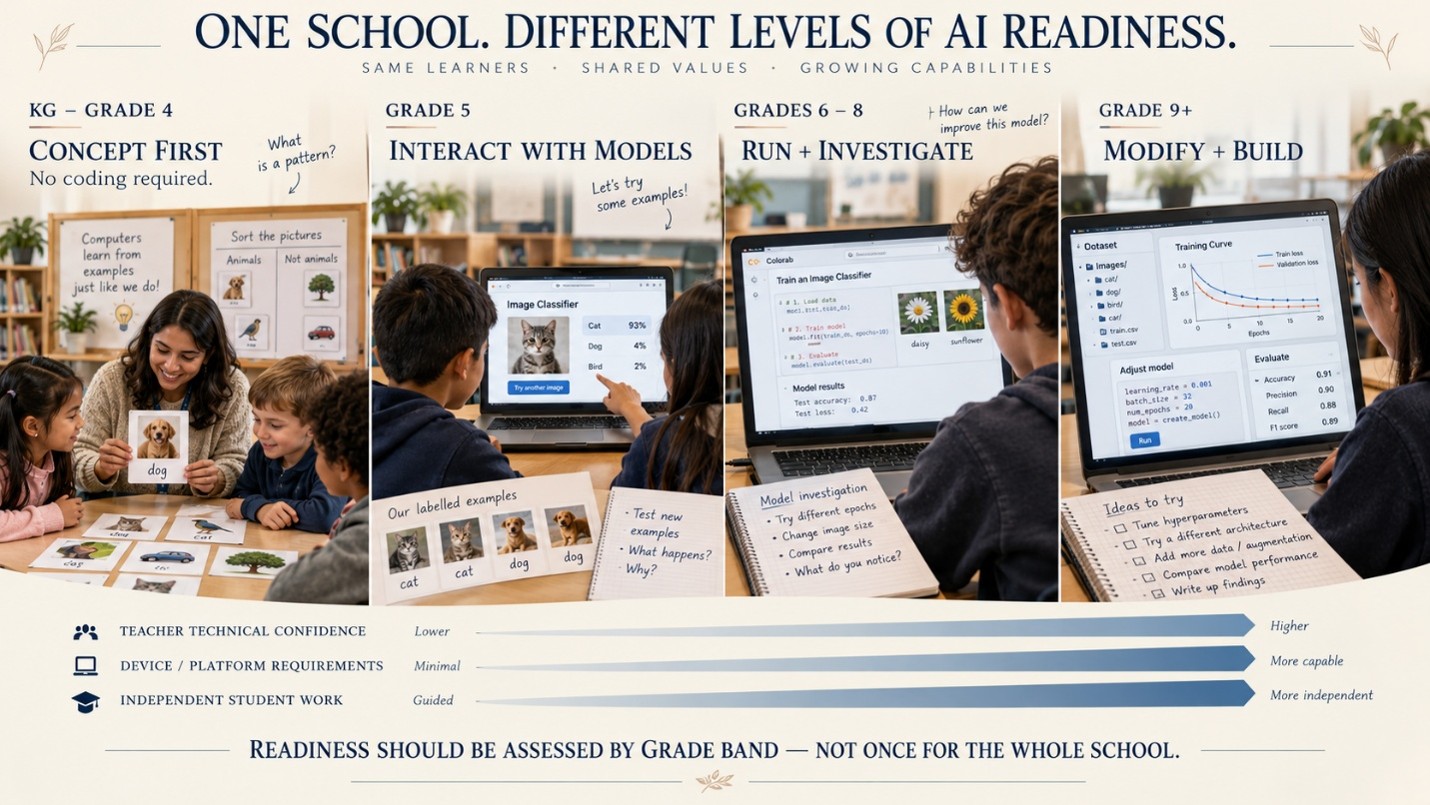
There is a second problem. Many audits give one yes-or-no answer for the whole school, yet AI education asks for very different things at different ages. A Kindergarten class learning that machines learn from examples needs a confident adult and some picture cards. A Grade 9 class fine-tuning an image model needs reliable browser access and a teacher who can read a training curve. A school can be fully ready for the first and not yet ready for the second.
So the better question is not “Are we ready?” It is “Ready for which grades, and ready to do what?”
Five areas to check before the first unit
1. Can your teachers explain the ideas, not just run the activity?
Most schools will not have an AI specialist in every year group, and that is normal. What matters is whether the teachers delivering the unit can become confident with the core ideas: data, training, testing, error and fairness. They do not need to be programmers. They do need to explain why a model got something wrong without guessing.
Here is a simple test. Ask a teacher to explain, in two sentences, why a model trained only on photos of brown dogs might fail on a white dog. If that feels hard, you have found a training need, not a weakness. Plan time for preparing non-specialist teachers before term starts, and give them materials that predict where students will get confused.
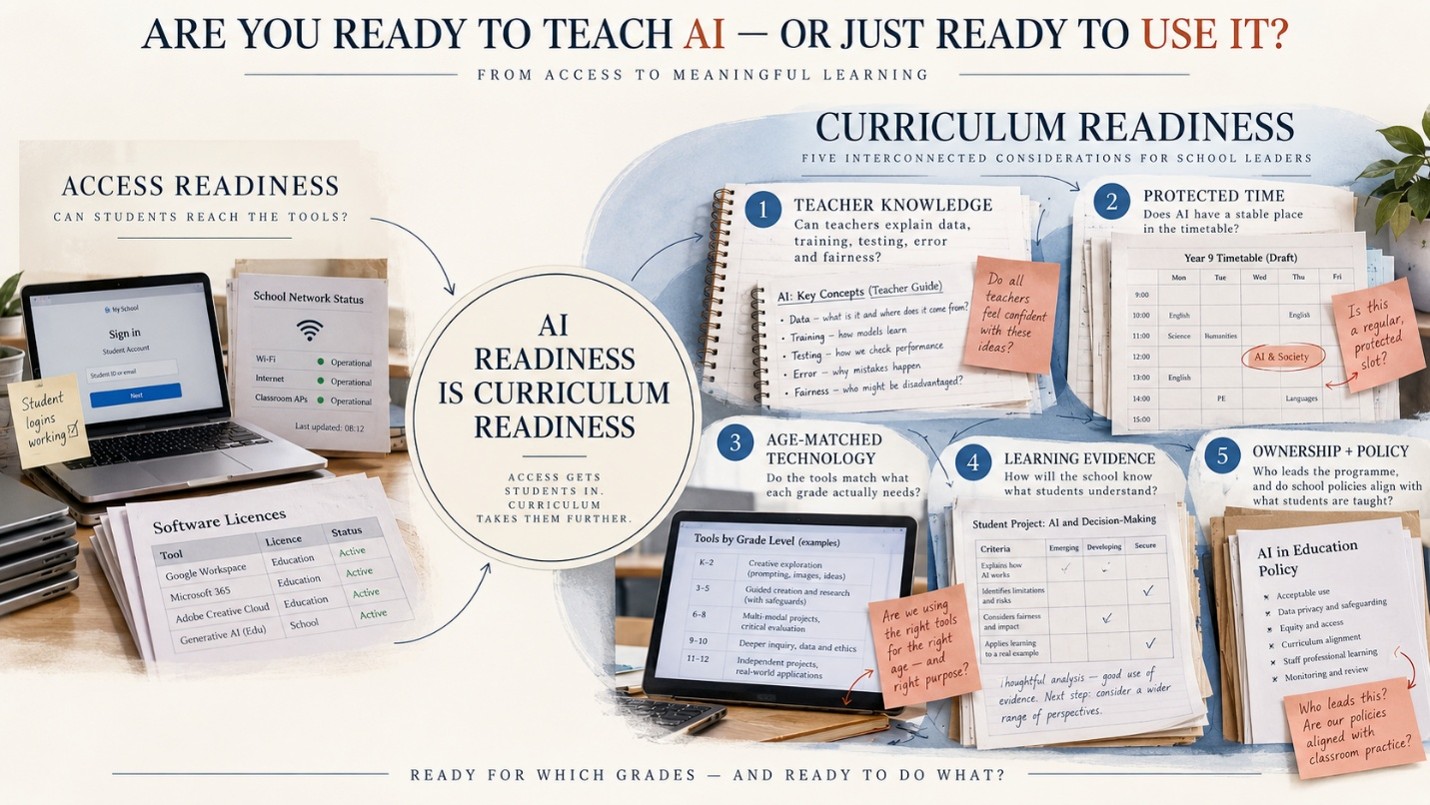
2. Does AI have a protected place on the timetable?
AI understanding builds over years. An idea like training data should come back each year with more depth: a story in the early years, an experiment in primary school, a design problem in secondary. That only works if the subject has a stable home on the timetable.
If AI is the first thing cut when exams come close, the progression breaks and students meet the same introductory ideas again and again. Check whether there is a named slot for next year and the year after, and who is responsible for protecting it.
3. Does your technology match each grade band?
Hardware still matters, but it should match what each stage actually needs. In the early years and lower primary, a lot of strong AI learning happens with sorting cards, drawings, role play and teacher demonstrations. Unplugged approaches for limited devices can carry real conceptual depth at this stage. Upper primary may need simple browser tools. Secondary students who run notebooks or train models need dependable devices, working logins, and a network that does not block the tools they need.
The practical step is to map technology needs grade by grade, not for the whole school at once. A school with limited devices can often start in the lower grades while access improves higher up. Also check the less visible items: whether activities run in your learning management system, whether students can create accounts on external tools, and what your data protection rules allow.
4. How will you see learning?
If a school cannot tell whether students understand AI, it cannot tell whether the programme is working. Before launch, decide what counts as evidence: short checks during lessons, notebook work, or a final task where students build something and explain it. Decide who looks at that evidence and what happens when a class is struggling.
If students finish the year able to use an AI tool but unable to explain why it makes mistakes, would your current assessment plan even notice?
5. Who owns it, and does it match your policy?
AI education needs a clear owner. That might be the computing department, a STEM lead or the digital learning team, but it has to be someone. Without a named owner, decisions drift and nobody notices the gaps.
The subject also has to fit your wider rules on AI use. If students learn in class that AI tools can produce confident but false answers, your academic integrity and acceptable use policies should reflect the same understanding. Otherwise students get mixed messages. This is why AI teaching should sit inside a whole-school AI strategy, not next to it.
Readiness is a plan, not a pass mark
The aim of a readiness check is not a perfect score. Few schools would get one. The aim is to know exactly where the gaps are and what you will do about them.
A school might be ready for Kindergarten to Grade 4 now, ready for Grades 5 to 8 after one term of teacher training, and ready for upper secondary once device access improves. That is still a readiness answer, and a useful one, because it becomes a phased start. It also shapes the decisions before launching an AI curriculum, from which grades go first to what support teachers need in the first term.
If your readiness check would give the same answer for Kindergarten and Grade 10, is it really measuring readiness to teach AI?
A practical way to start: bring together a small group of a curriculum lead, one teacher from each phase, someone from IT and whoever writes school policy. Work through the five areas above for each grade band. Write down what is ready, what is nearly ready and what is not. That single page will tell you more than any device audit.
FAQs
What does AI readiness mean for schools?
It means the school has what it needs to teach AI well, not only to give students access to AI tools. That includes confident teachers, protected timetable time, technology suited to each grade, a way to check learning, and clear ownership. Readiness often differs from one grade band to another.
Do teachers need a computer science background to teach AI as a subject?
No. Most AI concepts that students learn at school can be taught by non-specialist teachers with good training and clear lesson support. What teachers need is confidence with the core ideas, such as how models learn from data and why they make mistakes, rather than programming skills.
Can a school teach AI with limited devices?
Yes, especially in the early years and primary grades. Many core ideas, like patterns, examples, labels and fairness, can be taught through unplugged activities. Device needs grow in secondary school, so schools with limited access can start with younger grades while they improve infrastructure.
How much time does teaching AI as a subject need?
There is no single right number, but the time should be regular and protected. A short unit every year, kept in place, builds more understanding than a one-off project. What matters most is that AI comes back each year so ideas can deepen.
Who should lead an AI readiness assessment in a school?
It works best as a small team effort. Include a curriculum lead, teachers from different phases, IT staff and someone responsible for school policy. Each sees gaps the others might miss.
Should a school wait until it is fully ready before starting?
Usually not. Most schools will be more ready in some grades than others. A phased start, beginning where readiness is strongest and building elsewhere, is often more practical than waiting for everything to be in place.