
Picture a curriculum document written in early 2023. One outcome reads: “Students will use ChatGPT to draft a short essay.” Two years later the tool has a new look, a new price and three rivals. The outcome is out of date. The learning it was meant to describe is not, but nobody can say what that learning was. The tool’s name is sitting where the idea should be.
Why tool-based outcomes age so fast
An outcome should say what a student will understand or be able to do. A tool name only says what the student will click. When the two get mixed, three things go wrong:
- The outcome can’t be assessed once the tool changes.
- Teachers end up teaching the interface.
- Leaders can’t compare results across years or across schools.
What the 2026 framework says
In June 2026 the European Commission and the OECD published Empowering Learners for the Age of AI, an AI literacy framework for primary and secondary education. It describes AI literacy as a set of knowledge, skills and attitudes. These let learners understand AI systems, judge their outputs critically, use them ethically, and weigh opportunities against risks. It is organized around four domains: engage with AI, create with AI, manage AI and shape AI. The framework’s own materials say it is built around competences that should stay relevant as AI changes, not around particular tools.
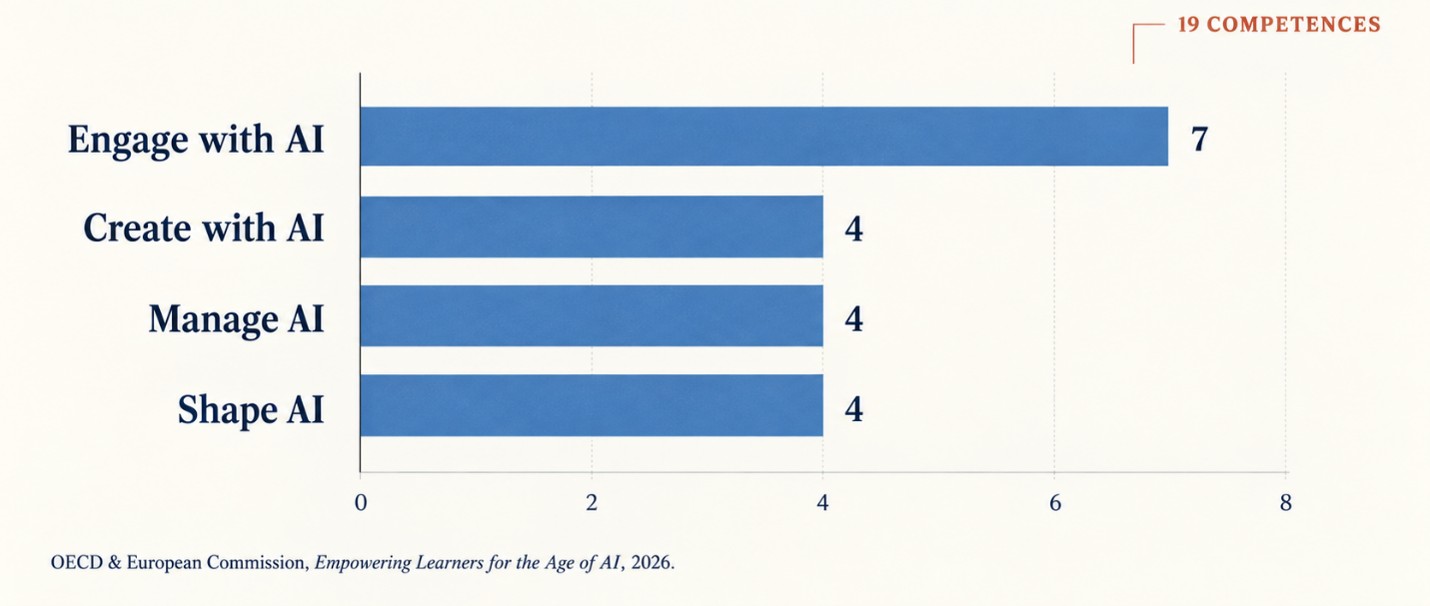
that is the level school outcomes should sit at. Ideas and judgement, not products. This is why a serious AI learning outcomes framework should be written before any tool list.
The swap test
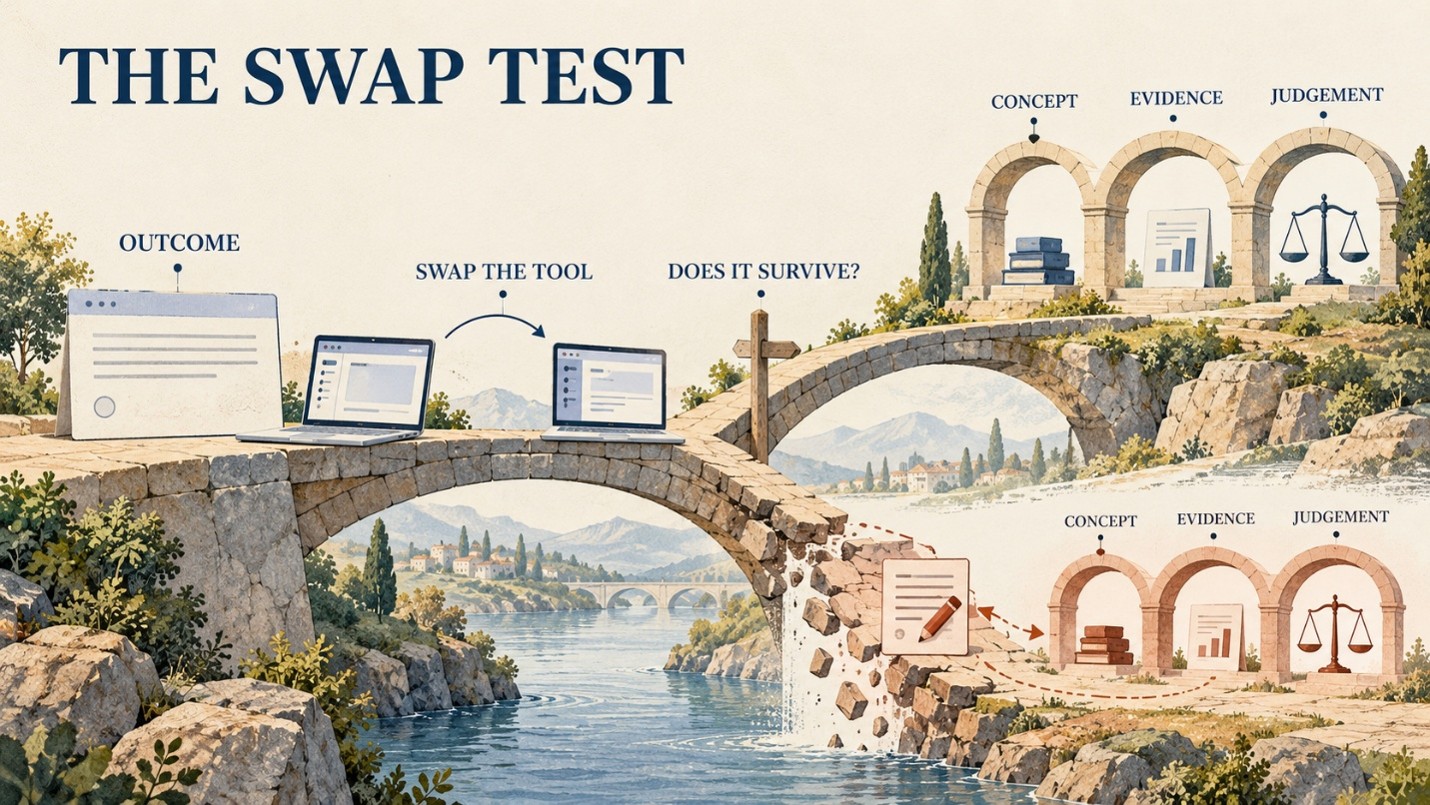
Here is a simple way to check any AI learning outcome. Take the outcome and replace the tool with another tool of the same kind. If the outcome still makes sense and can still be assessed, keep it. If it falls apart, the tool was carrying the meaning, and the outcome needs rewriting.
Once the tool is out of the way, write each outcome with three parts. The first is the concept, which is what the student understands. The second is the evidence, which is what they do or make. The third is the judgement, which is what they can decide or explain.
Take an outcome like “Use a chatbot to summaries an article”. This tests whether a student can use an interface, not whether they understand anything. A better version is “Compare an AI-generated summary with the source and identify what was left out or invented”. The same goes for “Build an image classifier on an online training website”. It is tied to one website and says nothing about why classifiers fail. A stronger outcome is “Train a classifier, test it on new examples, and explain how the training examples affected its errors”.
“Write effective prompts for a chatbot” has the same problem, because prompt tricks change with every release. Try “Explain how a language model produces text from patterns in data, and predict where it is likely to fail”. Even “Know the school’s approved AI tools” ages quickly, since the list changes every term. A lasting version is “Describe what data an AI tool collects and decide whether a task is suitable to share with it”.
If an outcome has to be rewritten every time a product updates, was it ever describing learning?
Where tools still belong
Tools belong in the activity. Sometimes a skill really is tied to a tool, such as running a notebook. Then keep that as a separate skills line, so the concept outcome can stand alone. Once outcomes are stable, checking whether students understand AI becomes much easier, because you are always checking the same idea.
FAQs
Q: Should an outcome ever name a tool?
Only when the skill truly depends on it. Even then, pair it with a concept outcome that would still hold if the tool changed.
Q: How many outcomes should a unit have?
Fewer than you think. Four or five that you can really assess beat fifteen you can’t. The APEX unit listings in the source document use four or five per unit.
Q: How do outcomes connect to a framework like the OECD–EC one?
Use the framework to check coverage, not as a template. Turning it into lessons is a separate job: turning a framework into a teachable programme.