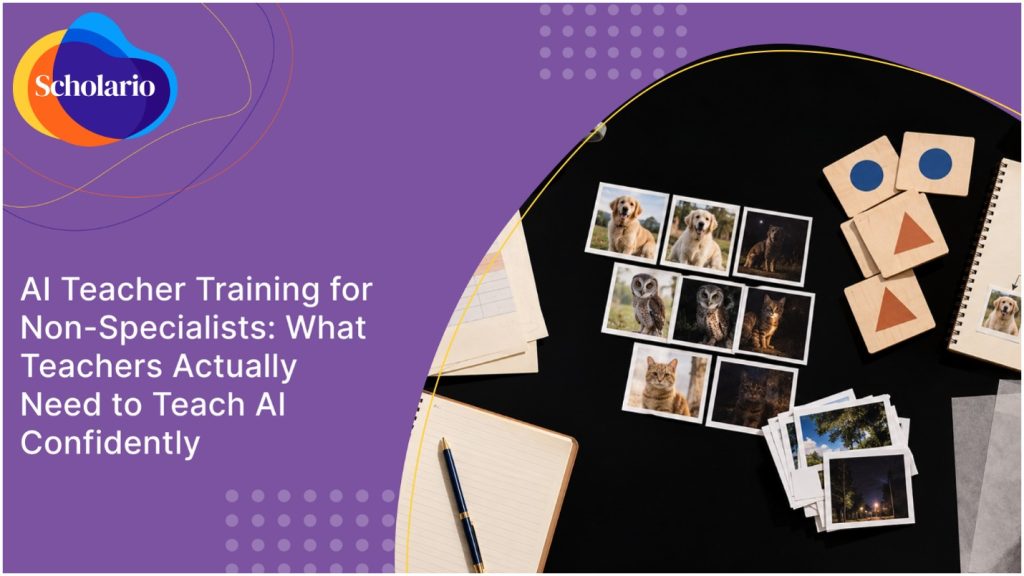
It’s a Tuesday in October. A seventh-grade science teacher has just finished her district’s AI workshop. She can now use a chatbot to draft a rubric and to rewrite a reading passage at three levels. Next week, the school’s new AI unit asks her to explain why an image model trained mostly on daytime photos fails on pictures taken at night.
Nothing in the workshop covered that.
She isn’t short on effort or ability. She was trained for a different job. That gap sits at the center of AI teacher training in US schools right now, and it is the gap curriculum leaders most need to close before the first AI lesson is taught.
AI teacher training is growing fast. But training for what?
The best recent evidence comes from RAND’s American School District Panel. In its 2025 report, More Districts Are Training Teachers on Artificial Intelligence, RAND surveyed about 200 US districts in fall 2023 and about 300 in fall 2024. It also interviewed district leaders.
What the research says:
| Measure (US school districts) | Share of districts |
| Provided AI training to teachers, fall 2023 | 23% |
| Provided AI training to teachers, fall 2024 | 48% |
| Planned to provide AI training by fall 2025 | 74% |
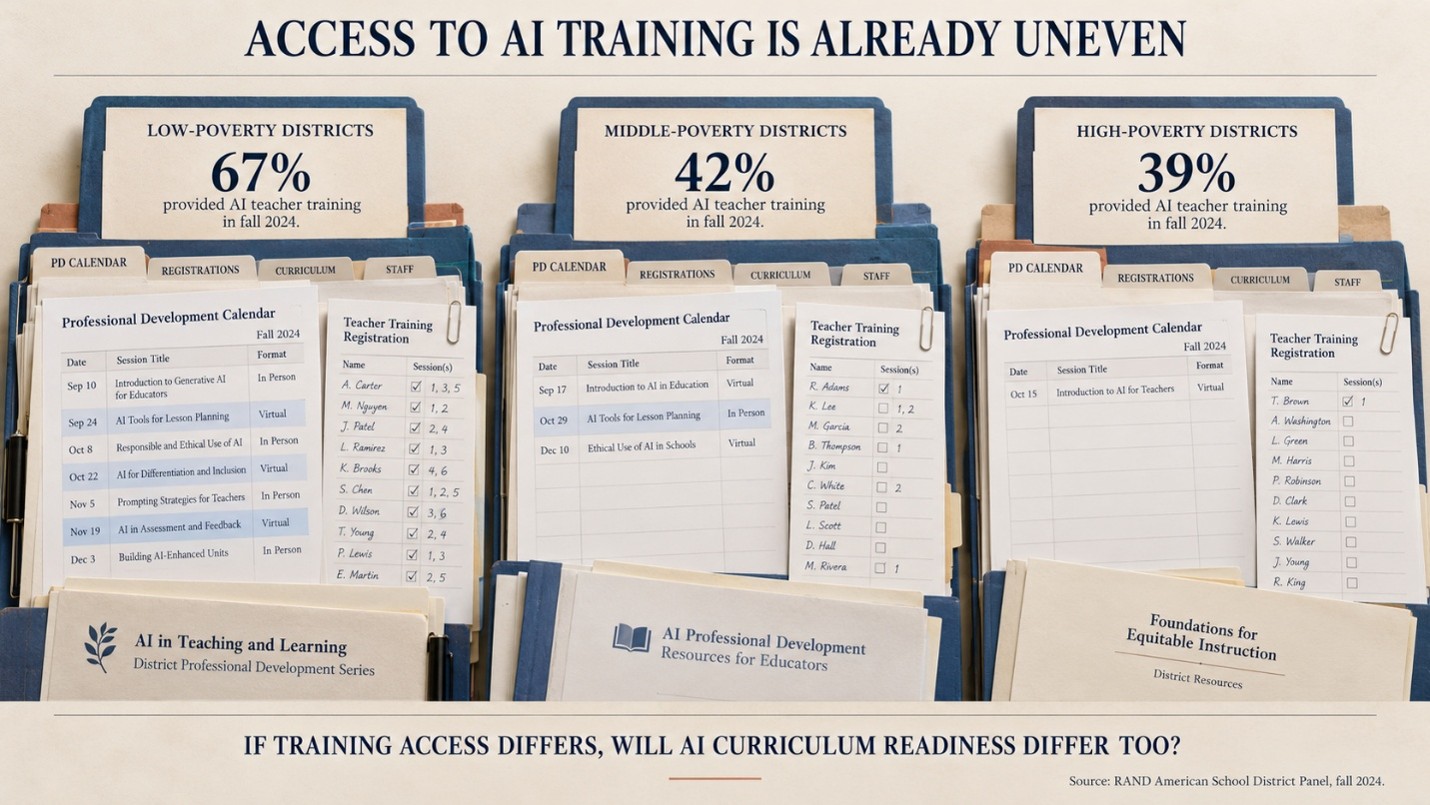
| Low-poverty districts providing training, fall 2024 | 67% |
| Middle-poverty districts providing training, fall 2024 | 42% |
| High-poverty districts providing training, fall 2024 | 39% |
Source: RAND, Diliberti, Lake & Weiner (2025). The fall 2025 figure is what districts planned, not what they delivered.
RAND also found what the training focused on. District leaders mostly used it to ease teachers’ concerns and fears about AI, to cover the basics, and to show teachers how tools like ChatGPT can help with lesson planning and differentiation. Few districts covered how students use AI. Nearly all of the training was optional.
The growth in training is real. But most of it prepares teachers to use AI in their own work. Very little prepares them to teach students how AI works. Those are two different goals, and they need different plans. (We look at this more closely in the difference between teaching with AI and teaching about it.)
Using AI and teaching AI are different skills
Using a tool well means knowing what to type and how to judge the result. Teaching a concept asks for more. The teacher has to explain the mechanism and expect the wrong ideas students will bring. When a model makes a mistake and a student asks “why did it do that?”, the teacher needs an answer.
In practice, an AI unit often lands with a science, math, technology or library media teacher, or with a computer science teacher who never studied machine learning. These are capable professionals. But a workshop on chatbot prompts does not prepare anyone to explain training data, classification or model error to twelve-year-olds.
If a teacher has been trained to use a chatbot but has never been shown how a model learns from examples, who in your building is ready to teach the lesson on training data?
What non-specialist teachers actually need
Confidence rarely comes from a single workshop. It comes from knowing what to say, what students will get wrong, and how to tell whether the lesson worked. Here is what that means in practice.
| What teachers need | Why it matters | What it looks like in practice |
| Enough depth to stay one step ahead | Students ask “why” questions. A scripted answer falls apart without some understanding behind it. | A short primer on the exact concept in the unit (training data, classification, model error), not a general AI course |
| Misconceptions mapped in advance | A non-specialist may not spot a wrong idea, especially one they half-believe themselves. | A list of likely student errors, each with a ready redirect |
| A predictable lesson structure | A familiar lesson shape lowers the load, so the teacher can focus on students’ thinking. | The same session shape every time, with clear timings |
| Quick checks during the lesson | Confidence grows when a teacher can see that students understood. | One named check per session, with a clear success criterion |
| Support for ethics discussions | Talking about bias and fairness can feel risky without guidance. | Real case studies, discussion prompts, and advice on handling disagreement |
| Rehearsal before the first lesson | Worry about the first lesson is often the biggest barrier. | A walkthrough of lesson one, and practice explaining the big idea out loud |
Two of these deserve a closer look.
Misconceptions are where non-specialists feel most exposed. A specialist hears a wrong idea and recognizes it right away. A non-specialist may not. Here is an example from the Scholario APEX AI Grade 6 Teacher Guide. Students often think a “forward pass” means running the model backwards. A teacher who has never met that confusion may not catch it in the moment. A teacher who has the redirect printed next to the lesson can handle it on the spot.
Checks matter as much as content. A teacher can’t feel confident about a lesson they can’t measure. Building small formative checks into every session gives a teacher real evidence that students understood the idea, rather than guessing from the room.
What school leaders should plan for
For principals and curriculum directors, this changes what preparing teachers should mean.
Treat teacher confidence as a readiness question, not an afterthought. Before you adopt a curriculum, ask whether the teachers who will actually teach it can explain its core ideas. That belongs in any honest assessment of readiness to teach AI as a subject.
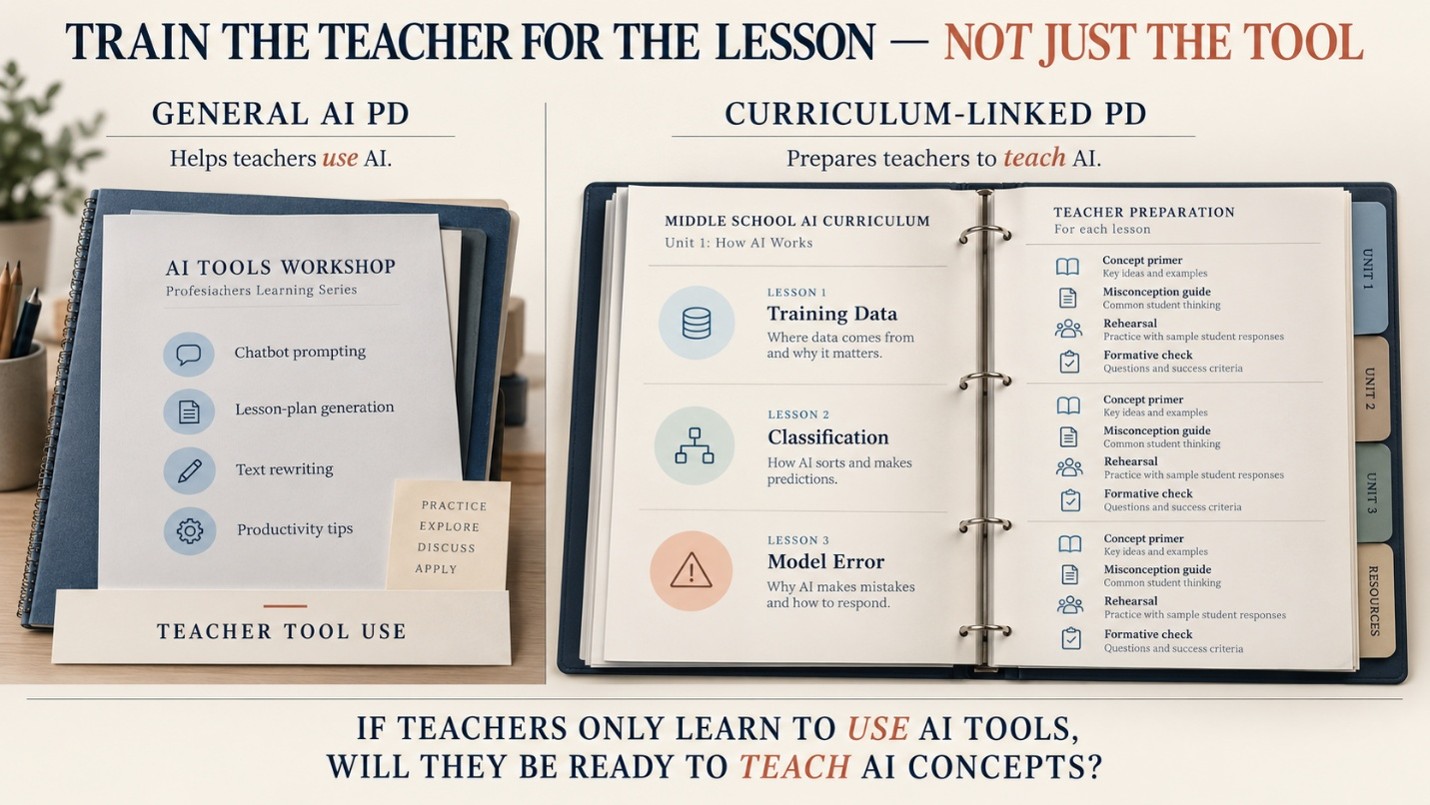
Match the training to the curriculum, not the tool. General AI workshops help with staff productivity. They don’t replace preparation for specific units. Teachers need training on what they will teach, in the order they will teach it.
Don’t leave it to opt-in. If training is optional, confidence depends on who attends. RAND’s poverty figures add an equity question here, because access to any training was already uneven across districts.
If AI training stays optional, whose students get an AI curriculum taught with confidence, and whose don’t?
Phase it. Teachers don’t need to master thirteen years of content at once. They need to be ready for their own grade, one unit at a time. A phased implementation roadmap spreads the load across staff and across years.
Name the worry openly. RAND found that district leaders saw teacher fear as something training had to address. Pretending the worry isn’t there doesn’t help. Understanding why teachers feel nervous about teaching AI is the first step to designing support that works.
The point is preparation, not expertise
Schools won’t find an AI specialist for every classroom, and they don’t need one. A non-specialist can teach AI well with the right preparation: enough understanding to stay one step ahead, the likely misconceptions in hand, a lesson structure they can trust, and a way to check that students understood.
The training numbers are rising. The next question for US schools is whether that training prepares teachers to teach AI, or only to use it.
FAQs
Q: What is AI teacher training?
A: AI teacher training is professional development that prepares teachers to work with artificial intelligence. It can mean learning to use AI tools for planning and grading, or learning to teach students how AI works. These are different goals, and schools adding an AI curriculum need the second.
Q: Do teachers need a computer science background to teach AI?
A: No. Non-specialist teachers can teach AI well with the right support: a clear grasp of each unit’s core idea, the likely student misconceptions mapped in advance, a predictable lesson structure, and quick checks to confirm understanding. The curriculum materials matter as much as the teacher’s background.
Q: How many US school districts train teachers on AI?
A: According to RAND’s 2025 report, 48% of US districts trained teachers on AI in fall 2024, up from 23% in fall 2023. Districts planned to reach 74% by fall 2025. Most of that training focused on teachers’ own use of AI tools, and nearly all of it was optional.
Q: What should AI professional development for teachers include?
A: It should include enough concept knowledge to explain each unit, the common student misconceptions with redirects, practice running a real lesson, guidance for leading ethics discussions, and ways to check student understanding. It works best when it is tied to the curriculum teachers will actually teach.
Q: How can school leaders tell whether teachers are ready to teach AI?
A: Ask teachers to explain the core idea of their first unit in plain words, and to name two mistakes students are likely to make. If they can do both and have rehearsed the first lesson, they are likely ready. If not, plan targeted preparation before launch.