

A curriculum head is drawing up next year’s timetable. AI gets one slot: a unit in Term 2. The year after, another unit, again in Term 2. On the grid it looks tidy. What is not clear is whether it is a journey or twelve separate short trips.
That is the real question behind AI curriculum timetable planning. Most schools cannot give AI a weekly lesson. So the useful question is not “is one unit enough time?” It is “will the units add up to something?”
The risk is the gap, not the hours
There are twelve months between units. Students forget vocabulary, teachers change, and each new unit quietly restarts with “What is AI?”
The arithmetic is small. Nine 40-minute sessions come to six hours of class time. Across Grades 1 to 12, that is 72 hours. With so little time, coherence has to do the work that volume cannot.
What has to be true for a once-a-year plan to work
| Condition | What it looks like | Warning sign |
| Ideas return | The same big ideas appear each year with a deeper mechanism | Units could be swapped between grades and nobody would notice |
| Units name their neighbours | Each unit states its prerequisite and points to the next | The first session re-teaches “what is AI” |
| Depth changes, not just topic | An idea moves from analogy to calculation to engineering | An older-grade lesson could be taught to a younger class |
| Ethics travels | A responsible AI question appears in every unit | Ethics sits in one unit and then disappears |
| Every year ends in something made | A model, artefact or argument the student produces | The year ends with a test only |
| The slot is protected | Fixed term, fixed time, teacher support | The unit is the first thing moved when exams press |
The second and third rows are the heart of it. What should deepen as students revisit AI goes into that in more detail. Design principles for a K-12 AI curriculum covers the wider checklist.
A worked example: one idea across seven years
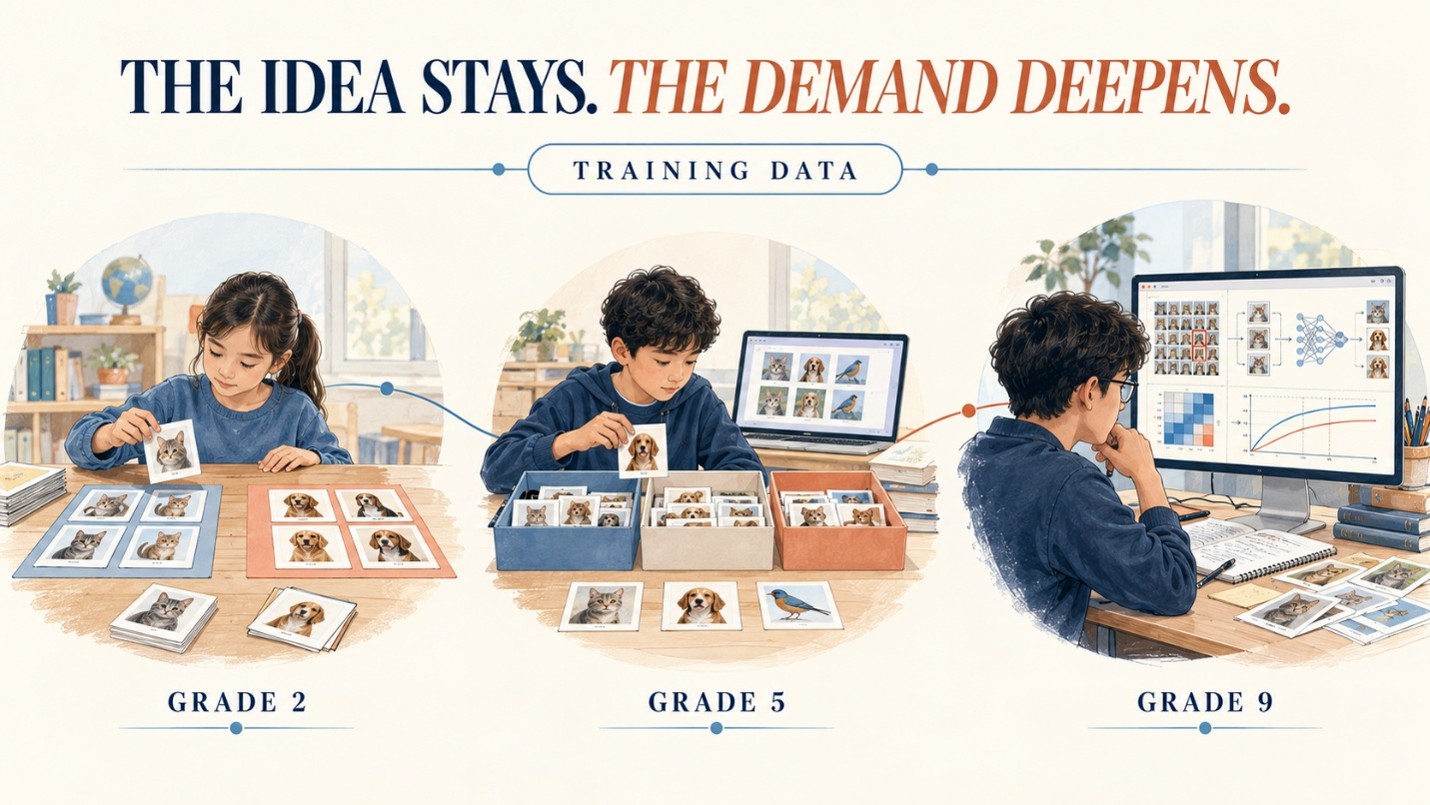
Take “training data” in APEX. In Grade 2, students meet it as a child-friendly idea. A machine gets better when it is shown many labelled examples. In Grade 5, it becomes training, validation and test splits. By Grade 9, it is dataset preparation, with class balance and augmentation for fine-tuning a MobileNet. The idea is the same, but the demand is different each time.
Five concept threads run the same way: Data & Learning, Models & Mathematics, Tools, Ethics & Society, and Communication. Every unit touches at least three of them. Units also point forward. Grade 3 closes by telling students that next year they will think about fairness.
This is a design on paper. It does not prove that students remember more after a twelve-month gap, and I have not seen independent evidence either way. Ask any programme for evidence from real classrooms, not only a scope and sequence.
Four planning moves that help
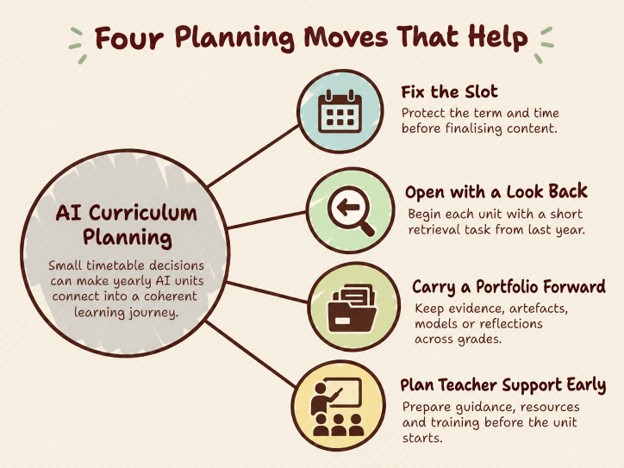
- Fix the slot before you fix the content. A protected term and time matter more than a perfect lesson list.
- Open each unit with a short look back. One retrieval task on last year’s key idea is enough.
- Carry a portfolio forward. APEX supplies capstone portfolio templates and rubrics for Grades 5–12.
- Plan teacher support early. See decisions to make before the first unit and a phased roadmap for implementing an AI curriculum.
If a Grade 10 AI lesson could comfortably be taught in Grade 6, is the curriculum actually progressing?
FAQs
How many hours does a once-a-year AI unit give?
In APEX, nine 40-minute sessions is six hours a year. Grades 1 to 12 add up to 72 hours. Kindergarten runs shorter discovery units, and I’ve left them out because the project documents don’t agree on the session counts.
Is one unit a year enough?
I can’t give you a research-backed answer. My view is that it is enough to introduce and revisit ideas, but only if the units are joined up. On its own, a single unit is too short to build depth.
We can only start in Grade 6. What about the earlier ideas?
List what earlier units would have covered, such as training data, classification and bias, and add a short bridge. Ask the provider how a mid-way start works. Because APEX units name their prerequisites, they are a good place to look.
What if we cannot fit nine sessions?
The APEX scope and sequence notes an eLearning variant with one 60-minute online session a month, ten sessions a year. Check with the provider how that maps onto your grades.