
Most AI curriculum demos go well. A chatbot answers a question in a friendly voice. An image classifier sorts cats from dogs. Someone on the review committee says, “The kids will love this.” Forty minutes later, the committee has seen a tool working. It has not seen a curriculum.
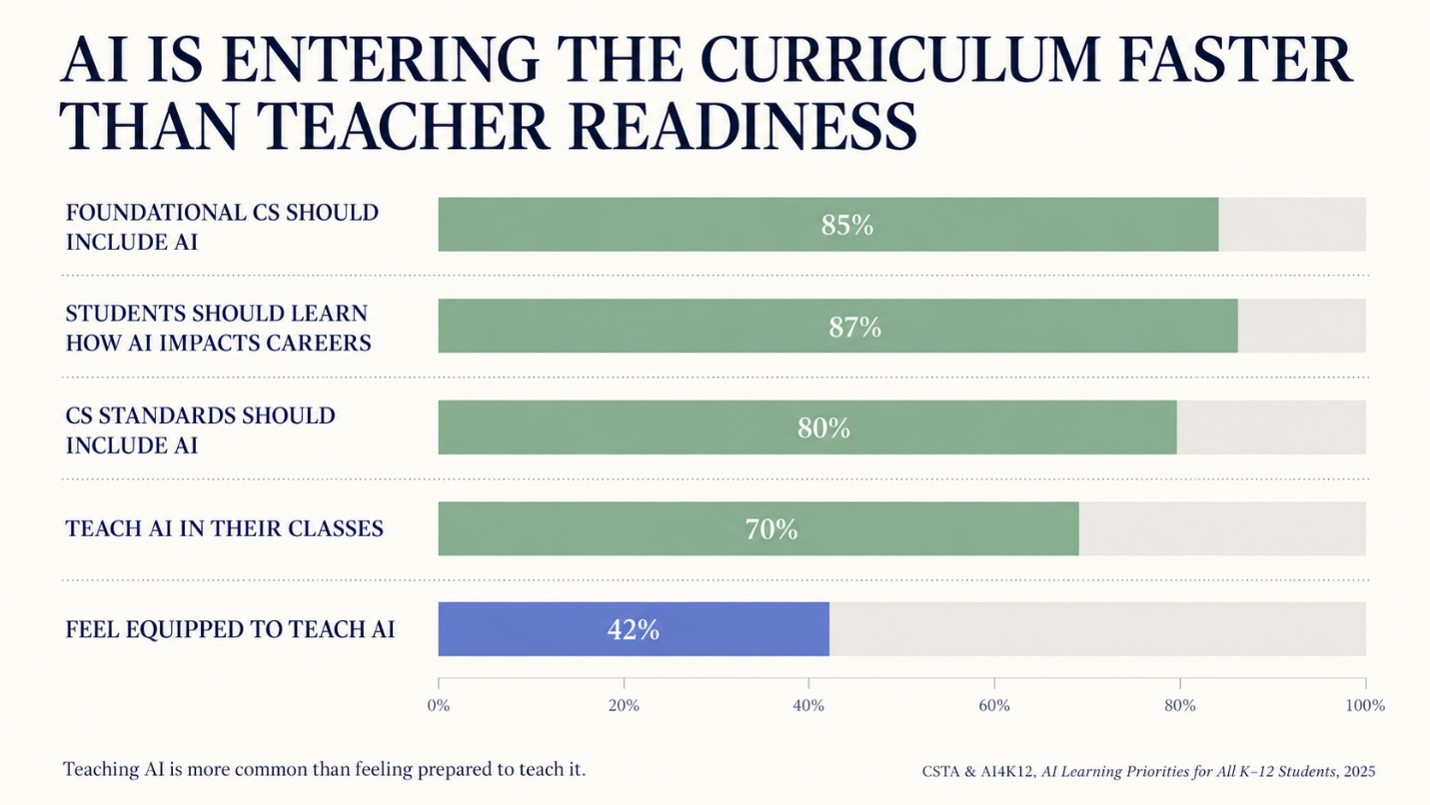
That difference matters more every term. In its 2025 national survey, RAND found that 54% of students and 53% of English language arts, math and science teachers used AI for school. That is an increase of more than 15 percentage points in one to two years. But over 80% of students said their teachers had not explicitly taught them how to use AI. Only 45% of principals reported having school or district policies on AI use (RAND, 2025).
Our reading of these numbers is simple: students are using AI faster than schools are teaching it. That creates pressure to adopt something quickly, and a rushed review is when weak programmes get through. This guide sets out AI curriculum evaluation criteria that still work when a district is under that pressure.
Why AI Curriculum Evaluation Criteria Need Their Own Checklist
The usual adoption checks still apply: cost, alignment, teacher materials and accessibility. But AI brings four problems that most curriculum rubrics were not built for:
- The tools change every few months. A lesson built around one app can be out of date before the school year ends.
- The important ideas are invisible. Students cannot see training data, model weights or prediction errors unless the curriculum makes them visible.
- Ethics is easy to bolt on. A single “AI and society” lesson can make a programme look responsible without changing what students learn.
- The standards are still settling. Vendors can claim alignment to frameworks that were never written with AI in mind.
A useful reference point is AI Learning Priorities for All K-12 Students, a 2025 report from the Computer Science Teachers Association (CSTA) and AI4K12 (CSTA & AI4K12, 2025). It groups what all students should learn into five areas:
- Humans and AI
- Representation and Reasoning
- Machine Learning
- Ethical AI System Design and Programming
- Societal Impacts of AI
The report also separates two things: creating AI, which it places inside computer science, and AI literacy, which is about using AI well. A strong programme is clear about which of these it teaches. So before any demo, the committee should agree on what an AI curriculum should teach beyond using tools.
Seven Questions to Ask Before You Adopt
| No. | Question to ask | Strong evidence | Warning sign |
| 1 | Does understanding deepen across grades? | The same concept returns each year at greater depth, and earlier units are named as prerequisites | Each grade is a standalone topic, or a later lesson could run in an earlier grade |
| 2 | Do students learn how AI works, or only how to use it? | Students sort, calculate, train, test and explain errors | Most activities are prompting a chatbot |
| 3 | Would it survive a change of tools? | Outcomes describe concepts and skills | Outcomes name specific apps or platforms |
| 4 | Where does ethics live? | Ethics appears in every grade and connects to that unit’s technical idea | One ethics unit, a poster or a pledge |
| 5 | What evidence of learning does it produce? | A formative check every session, rubrics and student-made products | Completion badges or one end-of-unit quiz |
| 6 | Can a non-specialist teacher deliver it? | Session scripts, likely misconceptions and training before the first lesson | Slides labeled “teacher-facilitated” with no guidance |
| 7 | What does “aligned” actually mean? | A unit-level crosswalk with standard codes you can check | A strip of logos with no mapping |
Does understanding deepen, or does it just repeat?
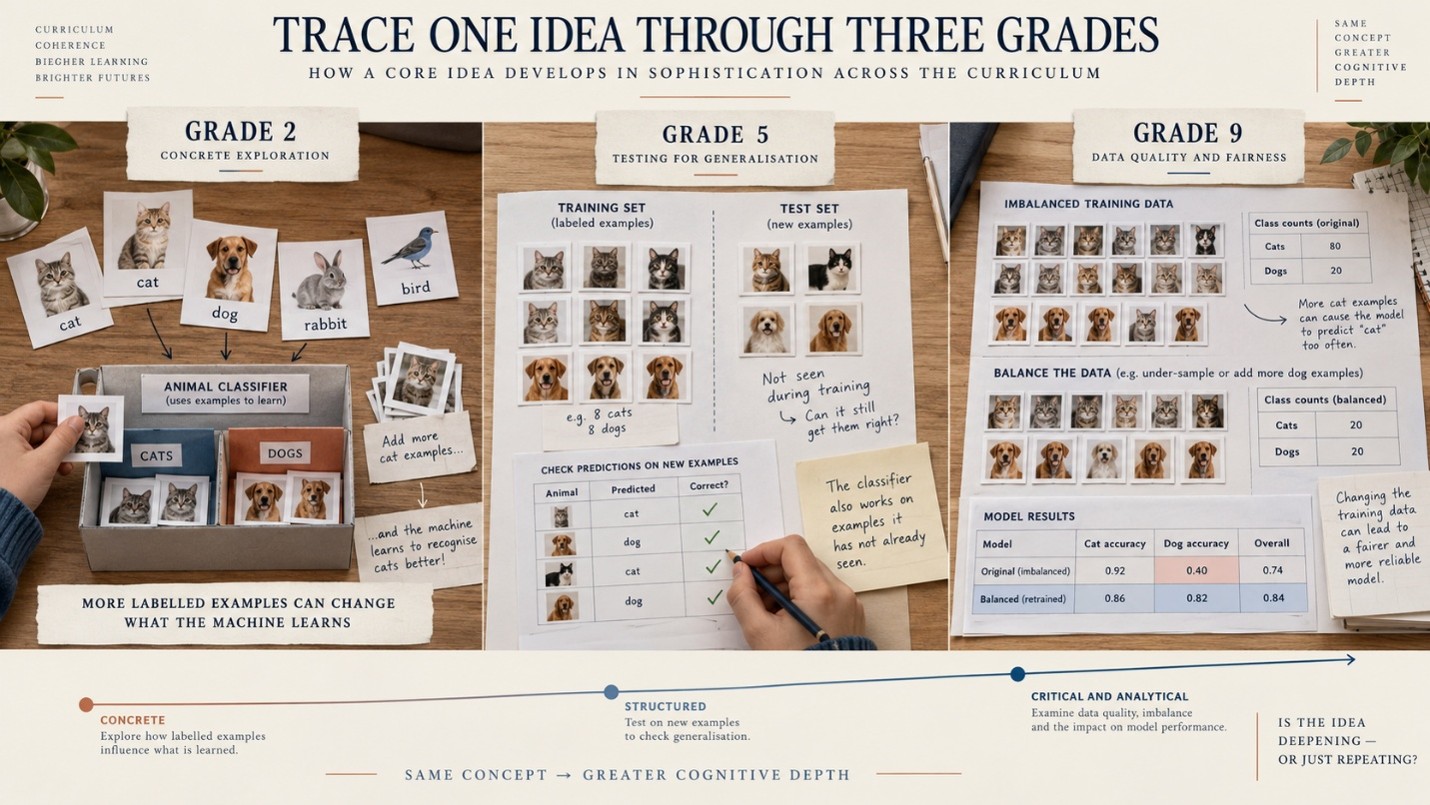
Progression is the hardest thing for a vendor to fake and the easiest for you to check. Pick one idea, such as training data, and ask to see it at three grade levels.
In a coherent K-12 AI curriculum, the idea gets harder each time:
- A second grader learns that a machine improves when it is shown more labeled examples.
- A fifth grader splits data into training and test sets.
- A ninth grader balances classes before fine-tuning a model.
It is the same idea at three levels of depth. This is one of the core design principles worth testing directly.
If a Grade 9 lesson could be taught comfortably in Grade 6, what exactly is the district paying for in the later years?
Would the curriculum survive a change of tools?
Read the learning outcomes, not the activity list. An outcome like “Use ChatGPT to generate a poem” will be out of date within a year. An outcome like “Explain why a language model can give a confident answer that is wrong” will still be true in five years.
If every tool in this curriculum disappeared next year, what would students still understand?
What does “aligned” actually mean?
A row of standards logos on a brochure is not evidence. Ask for the unit-level crosswalk, with specific codes from CSTA, ISTE, NGSS or the Common Core State Standards. Then check three or four of the mappings yourself.
Remember what alignment means: a lesson addresses a standard. It does not mean students have met or mastered that standard. Our guide to standards alignment covers this in more detail.
Can a teacher who is not an AI specialist teach it on Monday?
Most districts will not hire an AI specialist for every grade, so the teacher guide matters as much as the student material. Look for:
- session scripts
- the misconceptions students are likely to bring
- suggested ways to redirect those misconceptions
A slide deck labeled “teacher-facilitated” is not support. We cover what non-specialist teachers need in a separate article.
Run a “Three-Grade Trace” Before You Sign
This is a practical method for the review committee:
- Choose one concept, such as training data, bias, or how a model makes a prediction.
- Ask for the real student pages and teacher session plans for that concept in three grades. Overviews are not enough.
- Read them in order. Check whether the thinking gets harder and whether later grades refer back to earlier ones.
- Find the ethics moment in each grade. Check whether it is connected to the technical idea or just sits beside it.
- Ask a non-specialist teacher on the committee whether they could teach the middle session.
The trace takes about an afternoon, and it tells you more than a full product demo. Afterwards, a scoring rubric for evaluating a school AI curriculum helps turn the committee’s notes into a decision it can defend to the school board.
The Question to End Every Review With
A good AI curriculum makes difficult ideas clearer. It does not hide them behind a friendly interface. Before signing, ask one last question: will students leave this programme able to use AI, or able to understand, question and explain it? Exposure is not progression, and only one of those outcomes will still matter when today’s tools are gone.
FAQs
Q: What are the most important criteria for evaluating a school AI curriculum?
A: Look for five things: understanding that deepens across grades, lessons that teach how AI works and not only how to use tools, ethics in every grade, clear evidence of learning, and real support for non-specialist teachers. Check standards alignment at unit level, not from a logo list.
Q: What is the difference between an AI curriculum and AI tool training?
A: Tool training teaches students to operate a product. An AI curriculum teaches the ideas underneath it, such as data, models, errors and bias. That lets students judge any tool, including ones that don’t exist yet.
Q: Which US standards should a K-12 AI curriculum align with?
A: Most programmes map to the CSTA K-12 Computer Science Standards and the ISTE Standards for Students, with links to NGSS engineering design and Common Core math and ELA. Districts should also check their own state’s computer science standards and any state AI guidance.
Q: Does standards alignment mean students will master those standards?
A: No. Alignment means a lesson is mapped to a standard. Whether students meet the standard depends on teaching time, assessment and delivery. Ask vendors to show the assessment evidence behind each mapping.
Q: Can teachers without a computer science background teach an AI curriculum?
A: Yes, if the materials are built for them. Look for scripted session openings, likely misconceptions with suggested responses, and training before the first lesson.
Q: How can a district test an AI curriculum quickly before adopting it?
A: Run a three-grade trace. Pick one concept and read the real student pages and teacher plans for it in three grades. Then check whether the thinking gets harder each year and whether ethics connects to the technical content.