A second-grade teacher in a mid-sized US district has a lesson ready. Her students will train a simple image classifier and see what happens when the examples are lopsided. Then the questions start. Every student in the room is under 13. The tool asks for an account. The district’s data privacy agreement with the vendor is still with the legal team. The Chromebook cart is booked for test prep. The lesson moves to next month, and then it disappears.
Nothing in that story is about artificial intelligence. It is about logins. For many American schools, the login is where AI education quietly stalls.
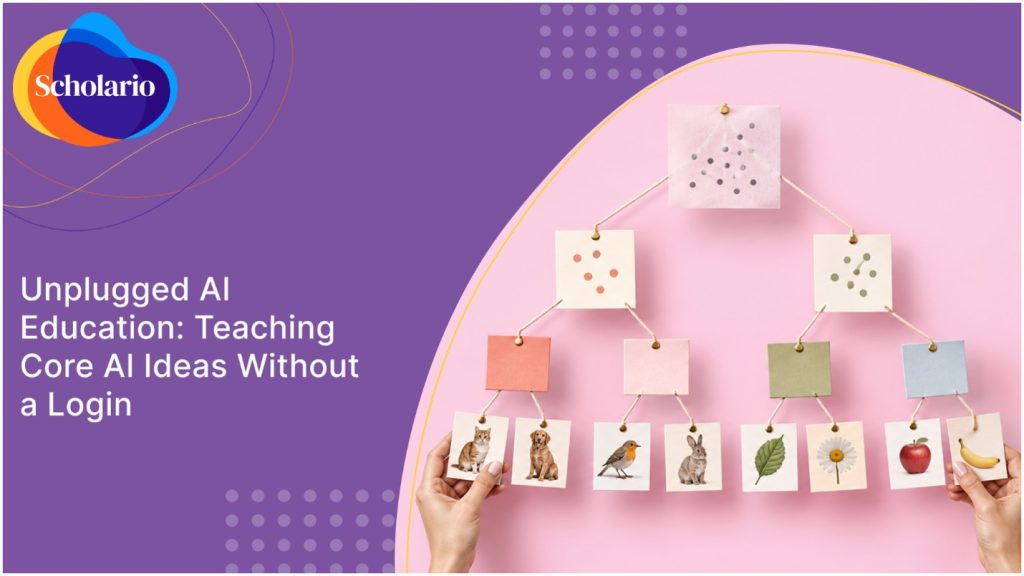
This article makes a simple case: the core ideas of AI can be taught with cards, paper, pencils and conversation. Unplugged AI education is not a budget version of the “real” lesson. Designed well, it is often the clearest way to show students how AI actually works. Designed badly, it teaches a metaphor that students later have to unlearn.
Why the Login Became the Bottleneck
US schools face a stack of access rules before a student ever opens an AI tool. The federal Children’s Online Privacy Protection Act (COPPA) limits how online services collect personal data from children under 13, and many consumer AI products set a minimum age of 13 or older in their terms. Districts also sign student data privacy agreements, follow state privacy laws, and share a limited number of devices across every subject.
None of this is a reason to delay AI education. It is a reason not to make AI understanding depend on account access.
There is also a teaching problem inside the access problem. When the first AI lesson is a tool, the lesson tends to be about the tool: where to click, what to type, what comes out. Students leave knowing how one product behaves this semester. They do not necessarily know why it behaves that way.
A login is an access decision. It should not be a learning prerequisite.
What Unplugged AI Education Teaches Well
Many central ideas in AI are about data and decisions, not software. A stack of animal cards sorted by yes/no questions is a decision tree. A classmate pretending to be a robot, learning from picture cards the class chooses, is a lesson in training data. Give that “robot” only red apples, then show it a green one, and students watch a model fail for a reason they can name.
These activities work especially well in the early grades, where AI learning through play in early years builds intuitions that later units can deepen. They also carry primary AI concepts such as classification and fairness without asking anyone to sign in.
The table below shows how common AI ideas translate into unplugged AI activities, and where a device starts to add real value.
| Core AI idea | Unplugged activity | What students should be able to explain | When a device adds real value |
| Learning vs. following rules | Sort picture cards of machines (automatic door, voice assistant, calculator) into “follows fixed rules” and “learned from examples” | Why a learning system can improve with examples and a rule-based one cannot | Rarely needed at this stage |
| Training data and labels | Students “teach” a classmate playing a robot with labeled cards, then give it a one-sided set | Why too few or one-sided examples cause mistakes | Training a real image classifier once the idea is secure |
| Classification | Build a yes/no decision tree on paper to sort animal cards, then test new cards | Which question caused a wrong answer, and how to fix it | Larger datasets where the tree is too big to draw |
| Features and representation | A face-guessing game played with tracing paper (see the research below) | Why the choice of features matters | Showing that an image is a grid of numbers |
| Neural network weights | Compute one artificial neuron’s output with pencil arithmetic | What a weight and a bias change in the output | Networks with many layers and thousands of weights |
| Fairness and bias | Role play: who is harmed when a model trained on one group is used on another | Where bias enters, and who is responsible | Real case data and model audits |
What the Research Shows, and What It Does Not
One US study shows both the promise and the risk. Researchers at North Carolina State University designed an unplugged board game called “Guess Whose Face” (Lim et al., 2024, Proceedings of AAAI-24). It teaches the “representation and reasoning” idea from the AI4K12 guidelines, a US framework developed by AAAI and CSTA. One student looks at a hidden face card and traces its facial features as points on tracing paper. Teammates then try to identify the face from those points alone. “Noise” cards add imperfect data, much like a blurry camera image.
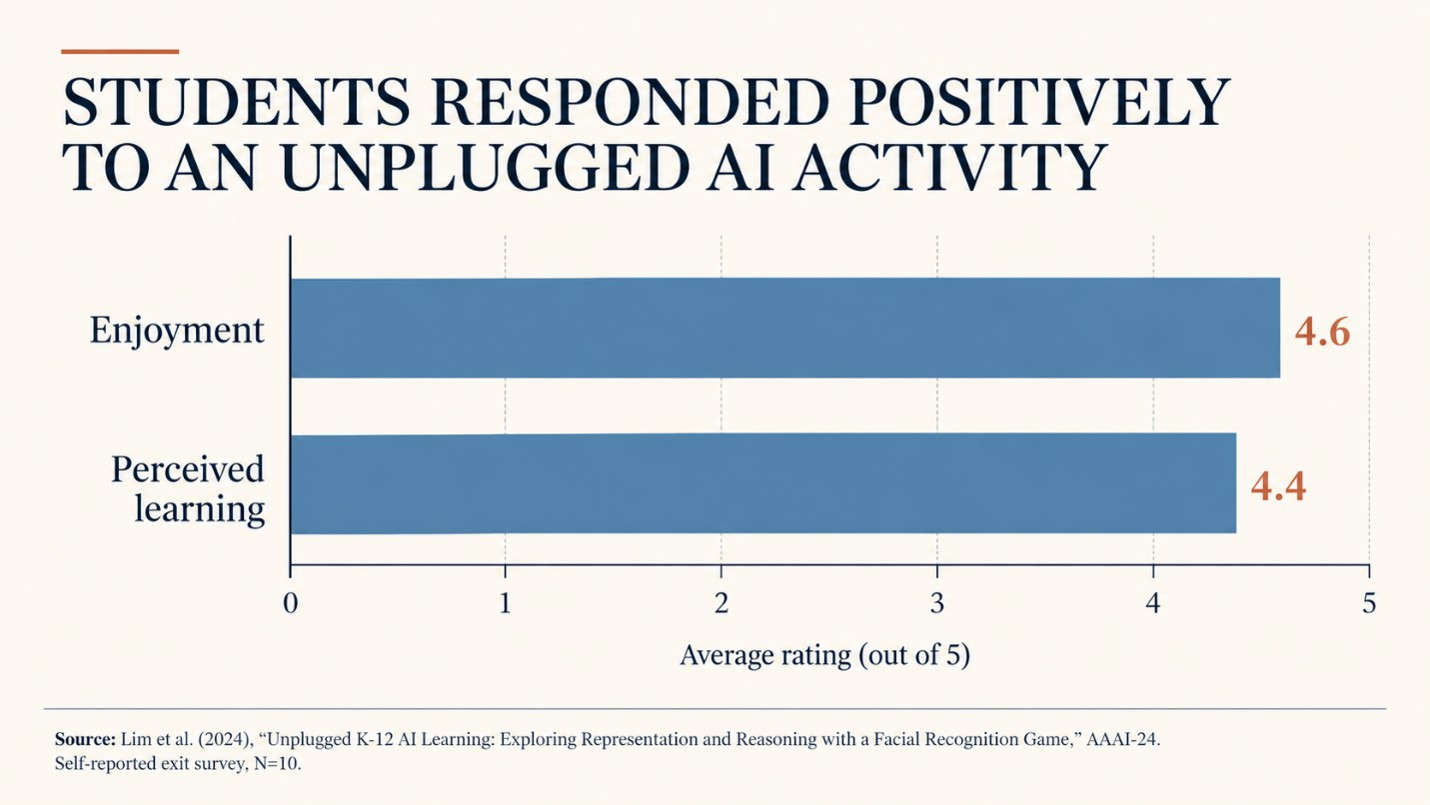
The team piloted the game with ten middle school students at a week-long summer AI camp held at a rural community center. On an exit survey, students rated their enjoyment at about 4.6 out of 5, and how much they felt they learned at about 4.4.
The more useful finding is what happened during play. Students chose very different features. Some teams could not settle on an answer even after extracting 30 to 40 features. Others identified the face from its three most distinctive ones. Without a single screen, students ran into one of the most important ideas in machine learning: which features a system relies on can matter as much as how many it has. That idea returns when students study pixels, features and computer vision.
The authors are also honest about a gap. AI systems do not “see” faces the way people do; they process images as numeric values. The game, by design, let students reason visually.
Two cautions matter here. First, this was a small pilot with self-reported ratings. It shows the approach is workable and engaging, not that it produces measurable learning gains. Second, the gap the authors name is the real design challenge for any unplugged lesson.
If an unplugged activity simplifies how AI works, who in your curriculum is responsible for correcting that simplification later?
Three Tests Before Adopting an Unplugged Activity
1. Does it model the mechanism, or only a metaphor?
“The robot’s brain remembers faces” is a metaphor. “The system compares a small set of measured features” is a mechanism. Good unplugged activities make the mechanism visible: students sort, count, compare and calculate.
2. Does it lead somewhere?
An unplugged step should connect to a later step where the same idea appears with more scale or precision. Tracing facial points on paper should later meet an image represented as a grid of numbers. A hand-calculated weighted sum should later meet a network with many layers. Without that connection, the activity is a pleasant one-off.
3. Can students show understanding without a device?
If the only evidence of learning is a screen output, the school does not know what students understand. A tested decision tree, a hand calculation, or one written sentence on why a model failed can all be assessed on paper. This is also central to accessible AI learning, because unplugged formats can lower barriers without lowering intellectual demand.
If a student can only show AI understanding while logged in to a tool, how much of that understanding belongs to the student?
When the Screen Earns Its Place
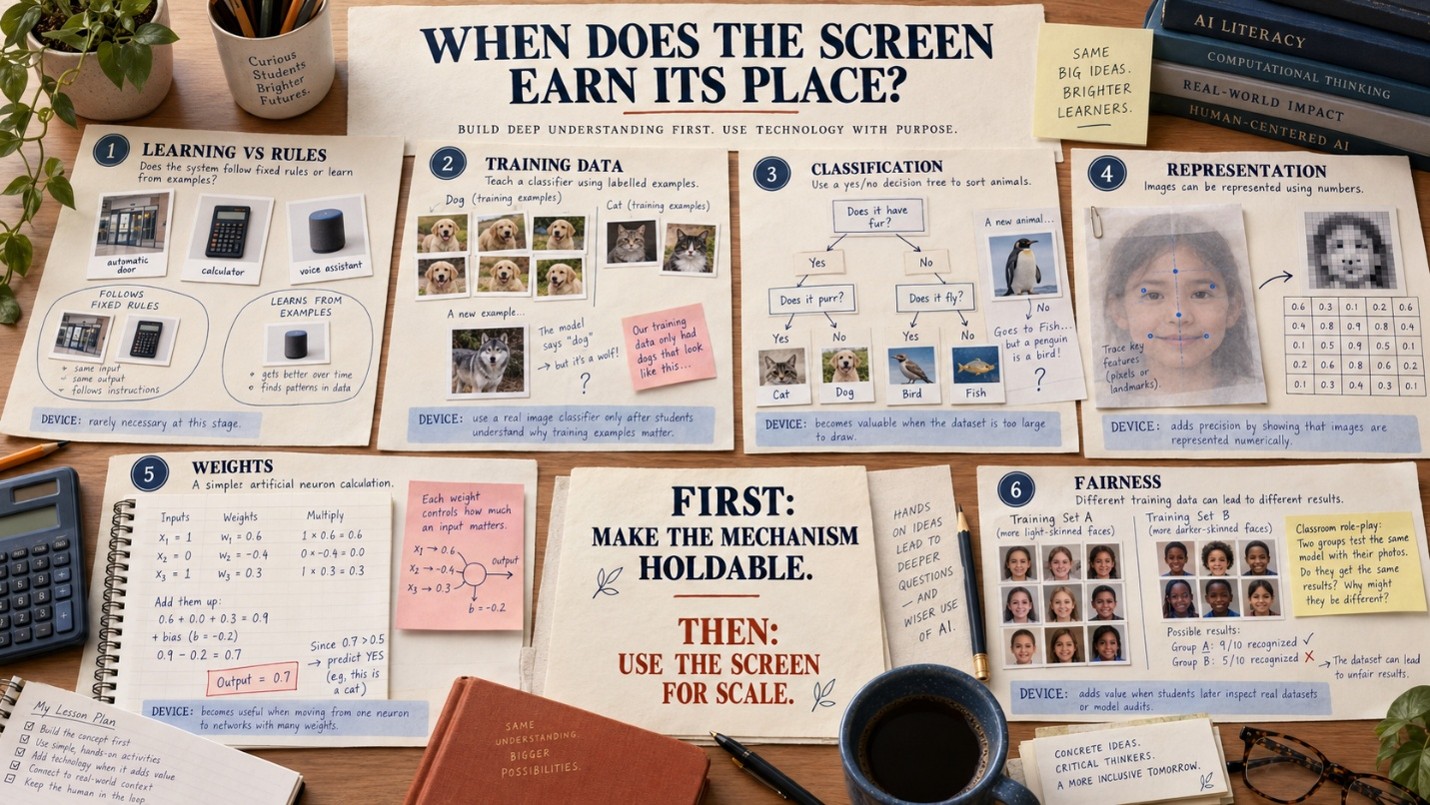
Unplugged has limits. Students cannot hand-train a model on thousands of images, watch a loss curve fall, or compare large language model outputs on paper. When scale is the point, devices are necessary.
So the planning question for district leaders is not “plugged or unplugged?” It is sequence. Which ideas should students meet first, at a scale they can hold in their hands? And when should the tool arrive? When schools work through school readiness to teach AI, device ratios and account policies belong on the list. They should shape the order of instruction. They should not decide whether students learn how AI works at all.
The Bottom Line
The core ideas of AI do not need a login. These include learning from examples, choosing features, testing for errors and asking who is affected. What they need is careful design, a clear path to the technical version of each idea, and a way to check what students understand. Schools that treat unplugged AI education as a first step rather than a fallback can start teaching AI this year, even before every privacy agreement is signed.
Frequently Asked Questions
Q: What is unplugged AI education?
A: Unplugged AI education teaches how artificial intelligence works through hands-on activities that need no computer or student account. Students sort cards, build decision trees on paper, role-play training a model, or calculate by hand. The goal is to make AI’s mechanism visible, so students understand training data, features and bias before using AI tools.
Q: Can students learn real AI concepts without computers?
A: Yes, for many core ideas. Classification, training data, labels, features, model error and fairness can all be taught with physical materials. A 2024 North Carolina State University pilot with middle school students found an unplugged AI game workable and engaging. Ideas that depend on scale, such as training on large datasets, still need devices.
Q: Which grades benefit most from unplugged AI activities?
A: Kindergarten through about Grade 5 benefit most. Many AI tools are not designed for children under 13, and young students learn well through sorting and play. Unplugged activities stay useful in middle and high school as a first step before hand calculation and coding, especially for neural networks and computer vision.
Q: Does unplugged AI education help with COPPA and student privacy?
A: It reduces the issue, because students create no accounts and share no personal data with outside services during the activity. It does not replace a district’s normal privacy review for any AI tools used later. Treat unplugged lessons as one part of a plan that also covers approved tools.
Q: How can schools assess AI learning without devices?
A: Use evidence students produce on paper or out loud, such as a decision tree they built and tested, a written reason why a model failed, or a hand calculation. Ask students to explain the mechanism, not just give the right answer. This shows what they understand, independent of any tool.