A Grade 8 class is asked to summarize a news article about a local water shortage. Two students hand in summaries of about the same quality. One wrote hers alone. The other asked a chatbot for a draft and then edited it.
Now ask both students one question:
Which sentence in your summary would you check first, and why?
The first student points to a figure she isn’t sure she copied correctly. The second student pauses. He didn’t check anything. The draft read well, so he kept it.
On paper, the two pieces of work look the same. The learning behind them is very different. That gap is where responsible classroom use of generative AI is really decided. It doesn’t depend mainly on whether the tool was allowed. It depends on whether the student can explain what the tool did and judge whether its output deserves trust.
Why AI in the Classroom Is Now a Curriculum Question
Students aren’t waiting for permission. Pew Research Center found that 26% of US teens aged 13–17 had used ChatGPT for schoolwork in 2024. That was double the 13% reported in 2023 (a survey of 1,391 teens in fall 2024). The same teens drew their own lines: 54% said using it to research new topics was acceptable, but only 18% said the same about writing essays. (Pew Research Center, 2025)
RAND’s 2025 national survey panels show how far guidance trails behind use. In early 2025, 54% of US middle and high school students said they used AI for schoolwork. More than 80% said their teachers had not explicitly taught them how to use AI for schoolwork. Only 34% of teachers reported school or district policies on AI and academic integrity. (RAND, 2025)
Taken together, these findings point to a simple conclusion. Students are already making decisions about generative AI in the classroom, and most of them are making those decisions without being taught how.
“Allowed” Is Not the Same as “Understood”
Many schools have responded to generative AI with rules: when it’s allowed, when it isn’t, and how to disclose it. Rules matter. But a rule only tells students what they may do. It doesn’t teach them to judge what the tool gives back.
That judgment depends on understanding, at least in outline, how the tool works. A large language model writes by predicting likely next pieces of text, based on patterns in the data it was trained on. It doesn’t look facts up the way students expect, and it has no built-in sense of whether a sentence is true. That’s why it can give an answer that is fluent, confident and wrong.
A student who knows this has a reason to check. A student who doesn’t has only the teacher’s instruction to check, and that instruction fades quickly when the output already sounds right.
This is the practical difference between teaching about AI and teaching with AI. Classroom use is teaching with AI. Use that students can explain needs some teaching about AI underneath it. That’s why well-designed generative AI lessons give students a working mental model of the tool before asking them to rely on it.
If a student can use a chatbot fluently but cannot say why it made an error, what exactly has that student learned?
Designing Tasks Students Can Explain and Evaluate
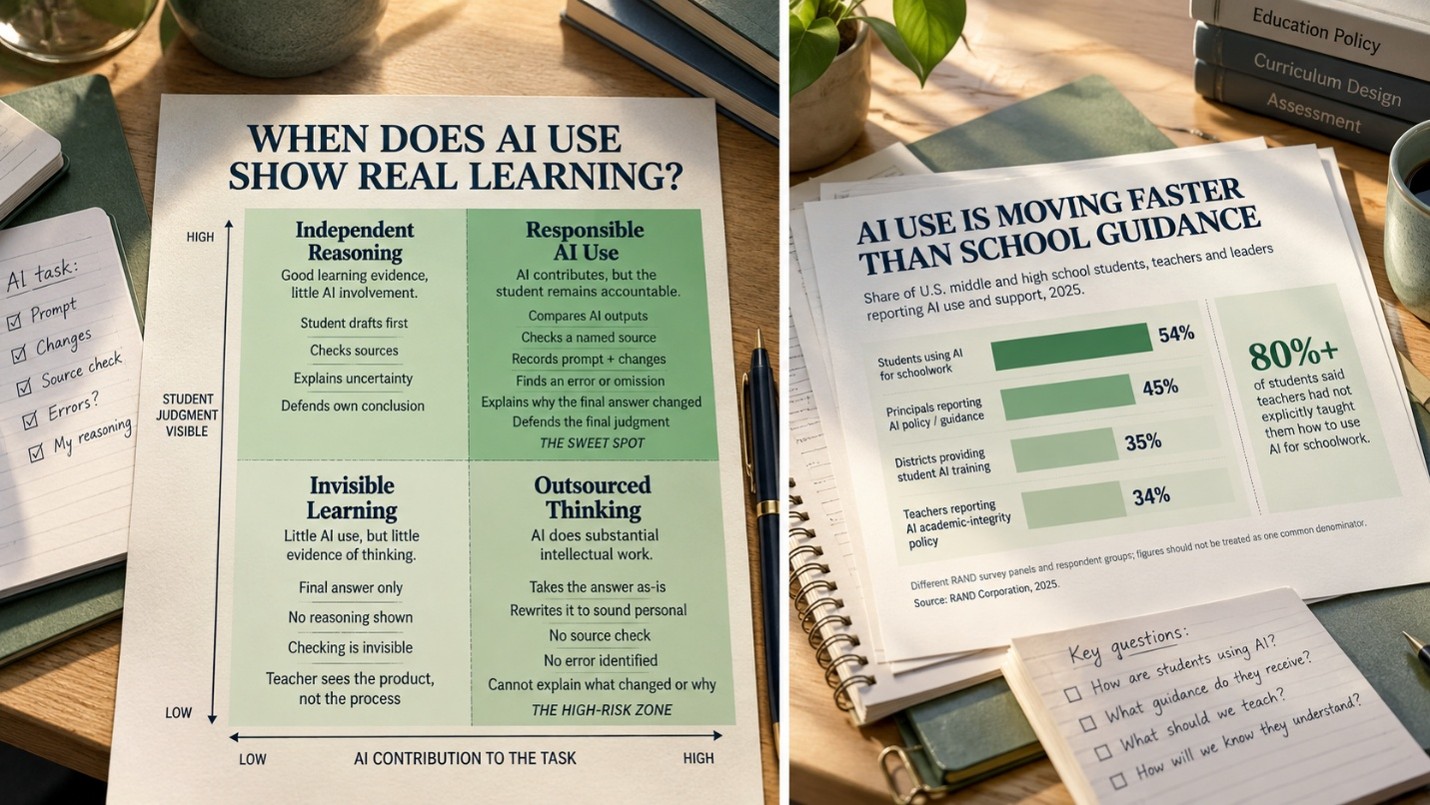
Responsible use only becomes visible when the task asks students to show their thinking about the tool, not just the finished product. The table below compares two ways of designing the same assignment.
| Design choice | AI use that hides the thinking | AI use students can explain and evaluate |
| Task goal | Produce a finished answer | Produce an answer and a judgment about the AI’s part in it |
| Role of the AI | Writes the draft | Gives one input that the student must test |
| What students submit | The final text only | The final text, the prompt used, and what they changed and why |
| Checking | Optional, and rarely visible | At least one claim checked against a named source |
| Errors | Hidden or unnoticed | Found, recorded and explained |
| Assessment focus | Quality of the output | Quality of the reasoning about the output |
| Reflection | “Did you use AI?” (yes/no) | “Where did the AI help, where did it mislead you, and how did you know?” |
Three practical moves make the right-hand column work in a real classroom:
- Compare, don’t accept. Give students two AI-generated answers to the same question and ask which is more reliable, and why. Comparing two answers makes students evaluate in a way a single answer rarely does.
- Ask for the error. Require every AI-assisted task to name one thing the tool got wrong, oversimplified or left out. If a student finds nothing, they explain how they checked.
- Assess the explanation. A short written or spoken justification of a few sentences often reveals more than the polished text does. It builds directly toward explaining an AI decision, a skill that lasts longer than any single tool.
What This Means for School and Curriculum Leaders
For leadership teams, the job shifts from policing AI use to designing for it. Four implications follow.
Policy and curriculum should point the same way. An acceptable use policy sets the boundaries. Only the curriculum can build the judgment students need inside those boundaries. Schools reviewing their academic integrity rules should also ask whether their assignments make AI use visible and explainable.
Teachers need the same clarity. Students partly learn responsible use by watching how adults use AI. It helps to define what responsible classroom use looks like for teachers, not only for students.
Expectations should grow with age. In Grade 4, explaining AI use might mean: “The tool can be wrong, so I checked with my teacher.” In Grade 11, it might mean running the same prompt several times and explaining why the outputs differ. If the expectation is the same at every age, the curriculum isn’t progressing.
Standards can guide the design. In the US, the ISTE Standards for Students (Digital Citizen) and the CSTA K–12 Computer Science Standards (Impacts of Computing) give curriculum teams a useful frame for this work. Still, mapping a lesson to a standard is a design decision. It doesn’t prove that students have mastered the standard.
If your school’s AI guidance ends at “disclose your use,” how will you know whether students understood what they disclosed?
FAQs
Q: What does responsible classroom use of generative AI mean?
A: Students can explain what an AI tool did in their work, check its output against reliable sources, and say where it helped or misled them. Being allowed to use the tool is not the same as using it responsibly.
Q: How many US students use AI for schoolwork?
A: RAND’s 2025 survey panels found that 54% of US middle and high school students used AI for schoolwork in early 2025. Pew Research Center found that 26% of teens aged 13–17 had used ChatGPT for schoolwork in 2024, up from 13% in 2023.
Q: How can teachers tell whether students understand the AI tools they use?
A: Ask students to submit their prompt, what they changed, and one error or weakness they found in the AI output. A short written or spoken explanation shows understanding far better than the final text alone.
Q: Is an AI acceptable use policy enough?
A: No. A policy sets boundaries, but it doesn’t teach judgment. Students also need lessons on how generative AI works and tasks that require them to evaluate AI output, so that responsible use becomes a skill rather than just a rule.
Q: At what age should students start evaluating AI outputs?
A: Simple habits can start in primary school, such as knowing that AI can be wrong and checking with a trusted source. Deeper evaluation fits secondary school: comparing outputs, testing prompts and explaining why a model produced an error.