
You have probably heard a small child tell a voice assistant it got something wrong. It is a tiny moment, and it holds an important idea: machines make mistakes. That is a good place for AI education in kindergarten to begin.
It is also a reminder of what this stage is not. Five-year-olds do not need neural networks, prompts or accounts. They need a few sound ideas, met through sorting, pattern games and stories, so later lessons have something to build on.
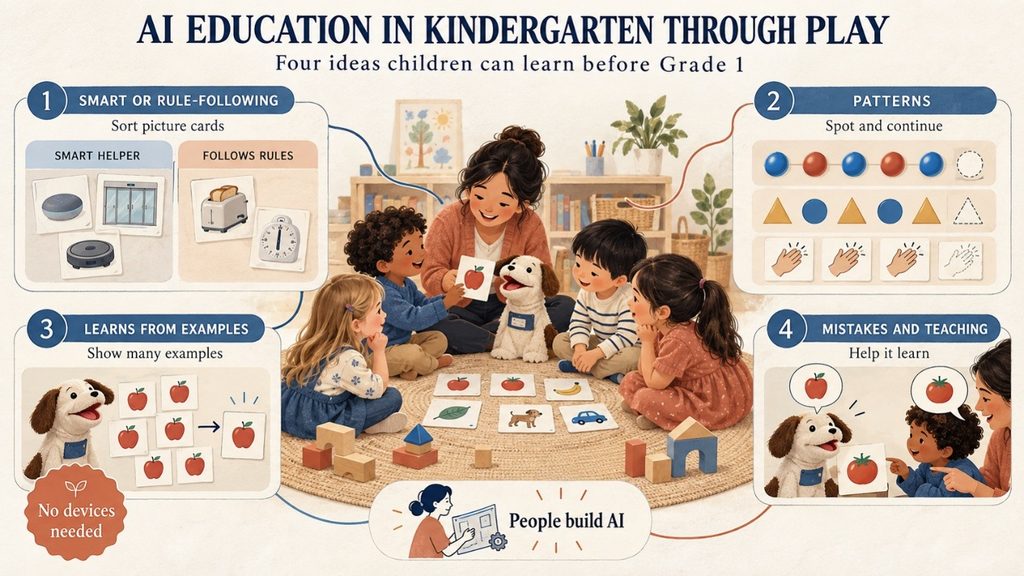
Four ideas worth teaching before Grade 1
- Some machines notice the world and respond. Others only follow rules.
- Machines can get things wrong.
- Machines get better when they see more examples.
- People build machines and teach them.
These ideas are accurate and need no technical vocabulary. They are also the early form of ideas students will meet again. “Smart or rule-following” becomes classification, “more examples” becomes training data, and “people build machines” becomes responsibility.
A simple play-based map
| Big idea | A play-based way in | What you might hear when it lands |
| Some machines notice and respond | Sort picture cards of everyday things into “smart helper” and “just follows rules” | “The door opens when it sees me.” |
| Machines find patterns | Clap, colour and sound patterns; ask the class to continue them | “It goes black, white, black, white.” |
| Machines learn from examples | Show a puppet many pictures of an apple, then a new one | “It needs to see more apples.” |
| Machines make mistakes | Let the puppet get one wrong, then help it learn | “It thought the tomato was an apple.” |
| People make AI | Ask who built the helper and who can teach it | “A person made it.” |
Why play suits the subject
Children already learn by sorting, spotting patterns and being shown examples. The comparison with how a machine is trained is loose, but it gives children a picture to hold. Nobody needs a screen for this, which is the argument for unplugged AI activities. Our recommendation is also to keep children’s personal data out of any tool at this age.
What to leave out for now
Leave out prompting, accounts, and any language that says machines “think” or “feel”. Also leave out frightening stories. Each one either needs skills young children don’t have yet or plants a wrong idea that later teachers must undo.
How would you know it worked?
Ask children to name smart machines, say one thing a smart machine can do that a regular machine cannot, and finish a pattern. Teacher observation is usually enough. The next question is whether Grade 1 builds on it. That is the kind of question covered in judging whether an AI lesson matches readiness and in the wider discussion of whether and how young children should learn about AI. The following stage is covered in primary AI understanding.
If a five-year-old can explain that a robot got it wrong because it has not seen enough examples, has she learned less about AI than a child who watched a chatbot write a poem?
FAQs
Do kindergarten children need devices to learn about AI?
No. Sorting, patterns, stories and teacher-led demonstrations cover the core ideas. Scholario APEX AI describes its kindergarten tools as play-based and teacher-demonstrated.
Isn’t AI too complex for five-year-olds?
The mechanism is. The ideas are not. Children can grasp examples, mistakes and human authorship without knowing how a model works.
How do we assess AI learning at this age?
Through observation of talk, sorting and pattern work, plus a very short visual check. Written assessment is not needed.