Ask a school what its AI programme covers in Grade 3 and again in Grade 9, and you may hear the same answer twice: AI in daily life, a little ethics, a chatbot demo. Both grades “have AI”. It is much harder to say what a Grade 9 student can do that a Grade 3 student cannot.
That gap is what AI curriculum progression is about. Many schools plan for repeat exposure and call it a spiral. A real spiral returns to the same idea, but the student arrives knowing more and leaves able to do more. This decides whether a school has a coherent AI curriculum for schools or just several separate AI lessons in different years.
Repeating a topic is not the same as deepening it
Exposure is not progression. A topic stays flat when the definition is the same each year, when only the tool changes, or when ethics is discussed as opinion every time with no new evidence. Here is a quick check. If you swap the Grade 4 and Grade 8 lessons on one topic and nobody notices, nothing deepened.
Five things that should get deeper
- The mechanism. Students first name an idea, then explain it, then calculate it, then build it.
- The evidence they use. “The robot got it wrong” becomes a confusion matrix, and later a loss curve.
- Their role. Noticing, then building, then engineering, then leading.
- The ethical stakes. A sense of fairness, then real cases, then surveillance and integrity, then governance.
- How they communicate. Drawing and telling, then explaining, then arguing, then writing policy.
Ethics is the easiest to get wrong. It should not be one unit. The case for ethics returning in every year of learning is that each return brings new mechanism to reason with.
Four threads followed across the grades
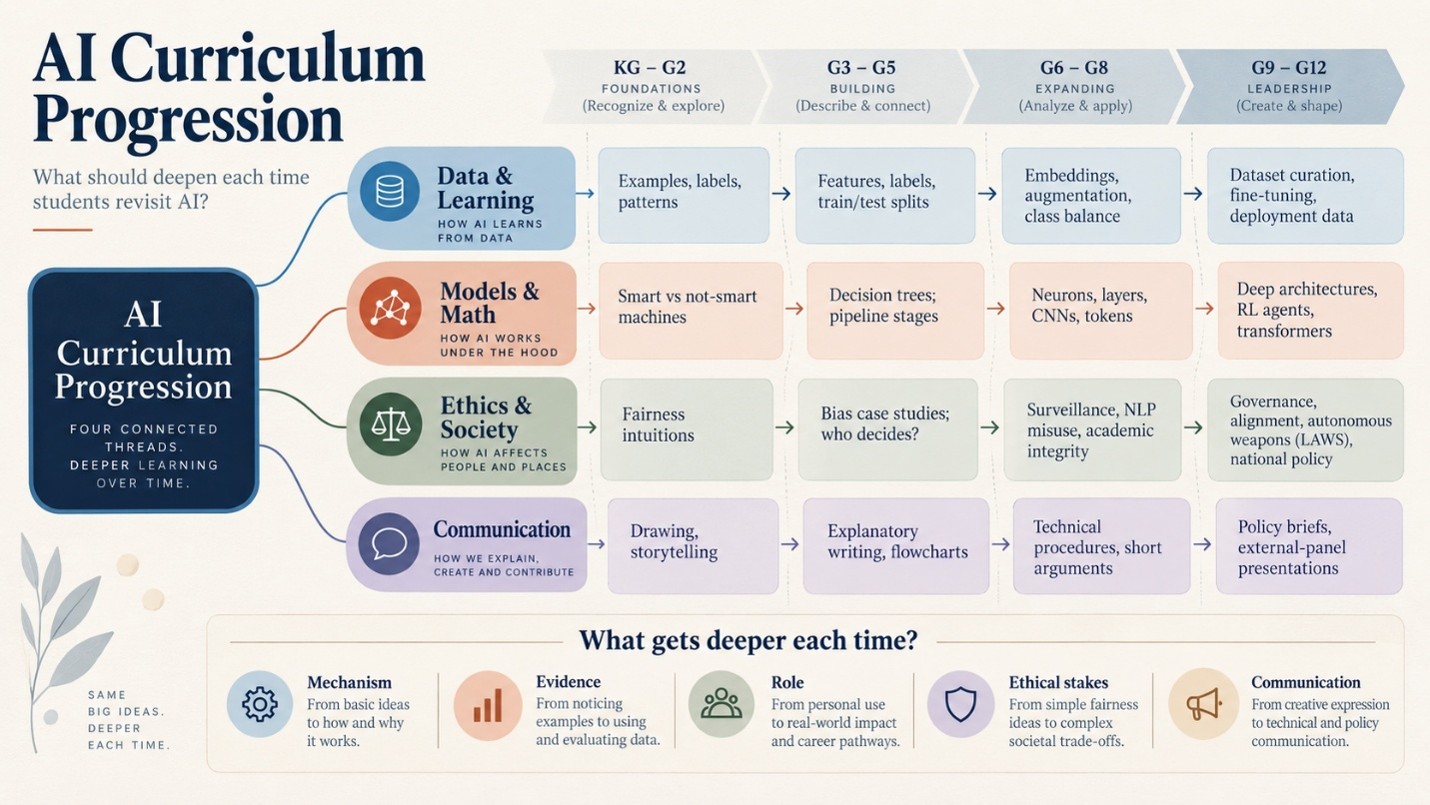
Try covering the grade labels. If you can still tell the columns apart, the progression is real.
What the international frameworks suggest
UNESCO’s AI competency framework for students (2024) has four dimensions: a human-centred mindset, ethics of AI, AI techniques and applications, and AI system design. It describes three progression levels: understand, apply and create. Our reading is that these levels describe what a learner does with an idea. That is a better test of depth than how advanced the vocabulary sounds. A lesson that keeps students at “understand” year after year is repeating. One that moves them towards “apply” and “create” is deepening.
A test leaders can run this term
Take one idea, such as training data. Put its earliest and latest lessons side by side and ask three questions.
- What can students do now that they could not before?
- What evidence do they use to judge whether a model is good?
- What went wrong last time that this lesson lets them fix?
If the answers are thin, fix the plan before adding content. Timetables matter too. A school running one AI unit a year can still be coherent, but only if each unit says what it borrows from the last and what it hands to the next. The same thinking sits behind good curriculum design principles for K-12 AI, and it works best alongside matching a lesson to students’ readiness.
If a student meets “training data” in Grade 2 and again in Grade 9, and the two lessons could be swapped without anyone noticing, what has the school paid for twice?
FAQs
How is a spiral curriculum different from repeating topics?
A spiral brings an idea back at greater depth. Repetition brings it back at the same depth. The test is whether students do something new with the idea each time.
How often should AI ideas return?
I don’t know of a research-backed number. What matters more is that each return adds mechanism, evidence or responsibility.
Can a school with a small AI programme still show progression?
Yes. Pick three or four core ideas. Write what students can do with each at three stages. Then check your lessons against that list.