An eighth grader is researching the Dust Bowl. She asks a chatbot for three sources, and it gives her three neat citations, each with an author, a title and a year. Two are real. The third book does not exist.
When her teacher points this out, she asks a fair question: “Why would it lie?”
The honest answer is that it didn’t lie. It has no idea what lying is. It produced the kind of citation that usually shows up in that kind of answer. That one idea is where generative AI literacy starts, and most students never hear it.
Why “It Just Knows” Is a Curriculum Problem
Many students meet generative AI long before any school lesson explains it. Schools have mostly responded with rules: when it’s allowed, when it isn’t, how to cite it. Rules matter. But a rule about a tool is not an understanding of the tool.
A student who thinks the chatbot “knows things” will trust it in the wrong places. A student who thinks it is “just copying the internet” will miss how it actually produces new text. Both pictures lead to poor judgement.
Using AI and understanding AI are not the same goal. Generative AI literacy in K-12 should aim for understanding. Students don’t need to build a large language model. They need a working picture of what happens between the question they type and the answer they get back.
Four Ideas That Explain How Generative AI Works
This article focuses on large language models, the systems behind chatbots. Four ideas do most of the work in explaining them.
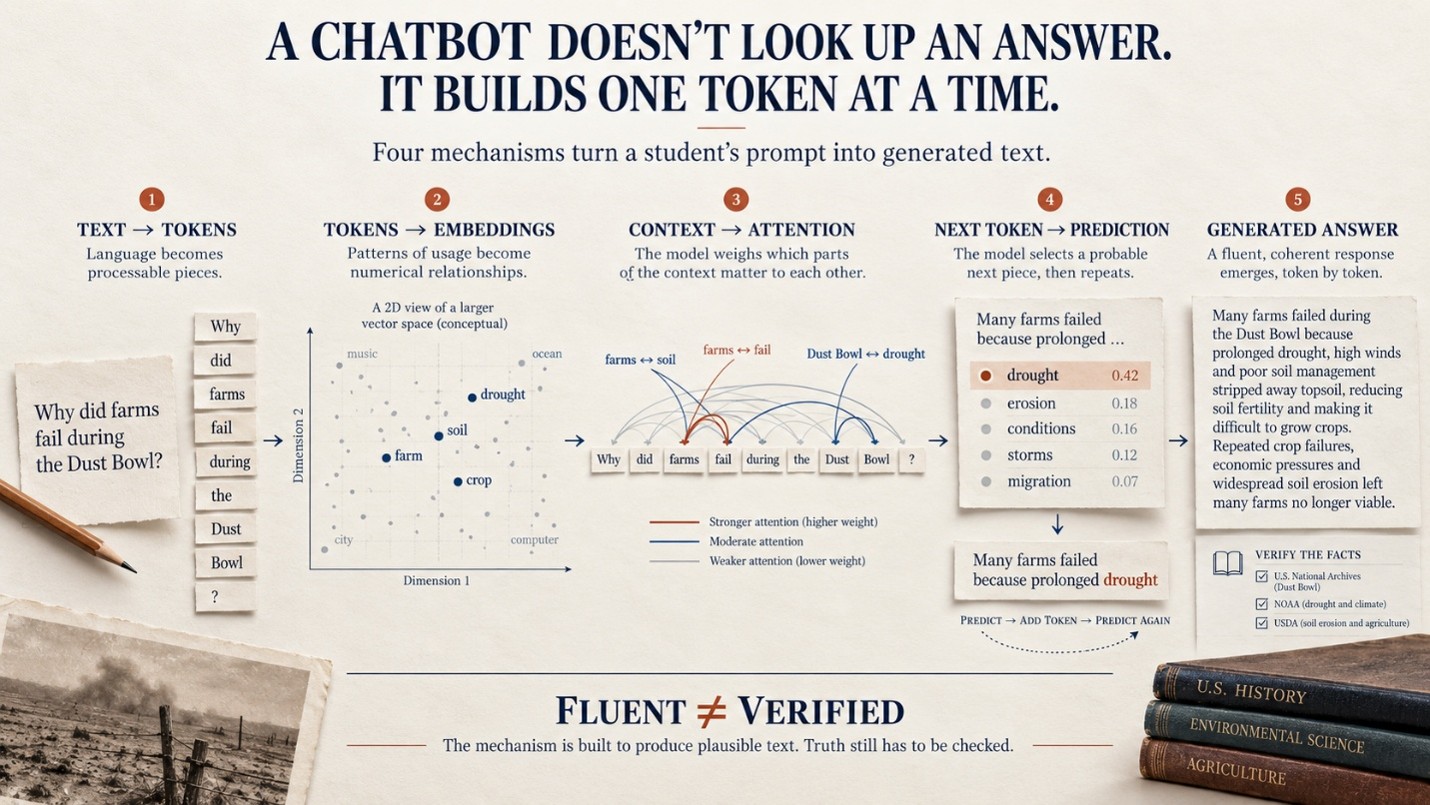
1. Text has to become numbers. A computer cannot read words. The text is first split into small pieces called tokens. A token is often a whole word and sometimes part of one. Each token is then turned into numbers. This is why students benefit from first seeing language as data. Once a sentence becomes a list of numbers, the “magic” starts to look like math.
2. Meaning is stored as position. Each token gets a list of numbers called an embedding. Words used in similar ways end up with similar numbers, close together in a mathematical space. “Teacher” sits nearer to “classroom” than to “volcano.” The model does not know what a classroom is. It knows which words tend to appear together.
3. Attention decides what matters. In the sentence “The trophy didn’t fit in the suitcase because it was too big,” what does “it” mean? Attention is the mechanism that lets a model weigh the other words in a sentence as it processes each one. Students don’t need the full math. They do need to see that the model’s sense of context comes from patterns, not from ever having held a trophy.
4. The answer is predicted, one token at a time. This is the big one. The model predicts a likely next token, adds it, and repeats. A setting called temperature controls how adventurous each choice is. Low temperature picks the most likely option. Higher temperature allows less likely ones, so the output becomes more varied and less predictable.
Put these together and the fake citation makes sense. The model was not checking a library catalog. It was building a pattern that looks like a citation. Plausible and true are different things, and the system is built for plausible.
Hallucination Is a Teaching Opportunity, Not a Glitch
“Hallucination” can sound like a rare bug. It’s better taught as a predictable result of how the system works. Once students understand prediction, they stop asking “Why did it lie?” and start asking “How would I check this?”
That change matters more than any prompting trick. It builds the habit of questioning AI-generated claims in history, science and English, not only in computer science.
If a student can write an excellent prompt but cannot explain why the answer might be wrong, what exactly have they learned?
The Foundations Start Long Before Eighth Grade
It’s tempting to treat generative AI as a stand-alone topic for older students. But these ideas rest on earlier ones.
Models learn from examples, so students should already understand why training data matters. That includes what happens when the examples are too few or one-sided. This can start in the early elementary grades with labeled pictures and simple sorting.
In middle school, students can compute a single artificial neuron by hand. That shows them neural networks are weighted sums, not digital brains. After that, a transformer is a bigger version of something they have already worked with.
High school is the place for harder questions. A model trained only to predict text knows language, but it doesn’t know what people want. Further training, such as instruction tuning and reinforcement learning from human feedback, pushes it toward helpful answers. That opens real discussion about who decides what “helpful” means.
If a high school AI lesson could be taught unchanged in sixth grade, is the curriculum really moving forward?
What This Means for Curriculum Leaders
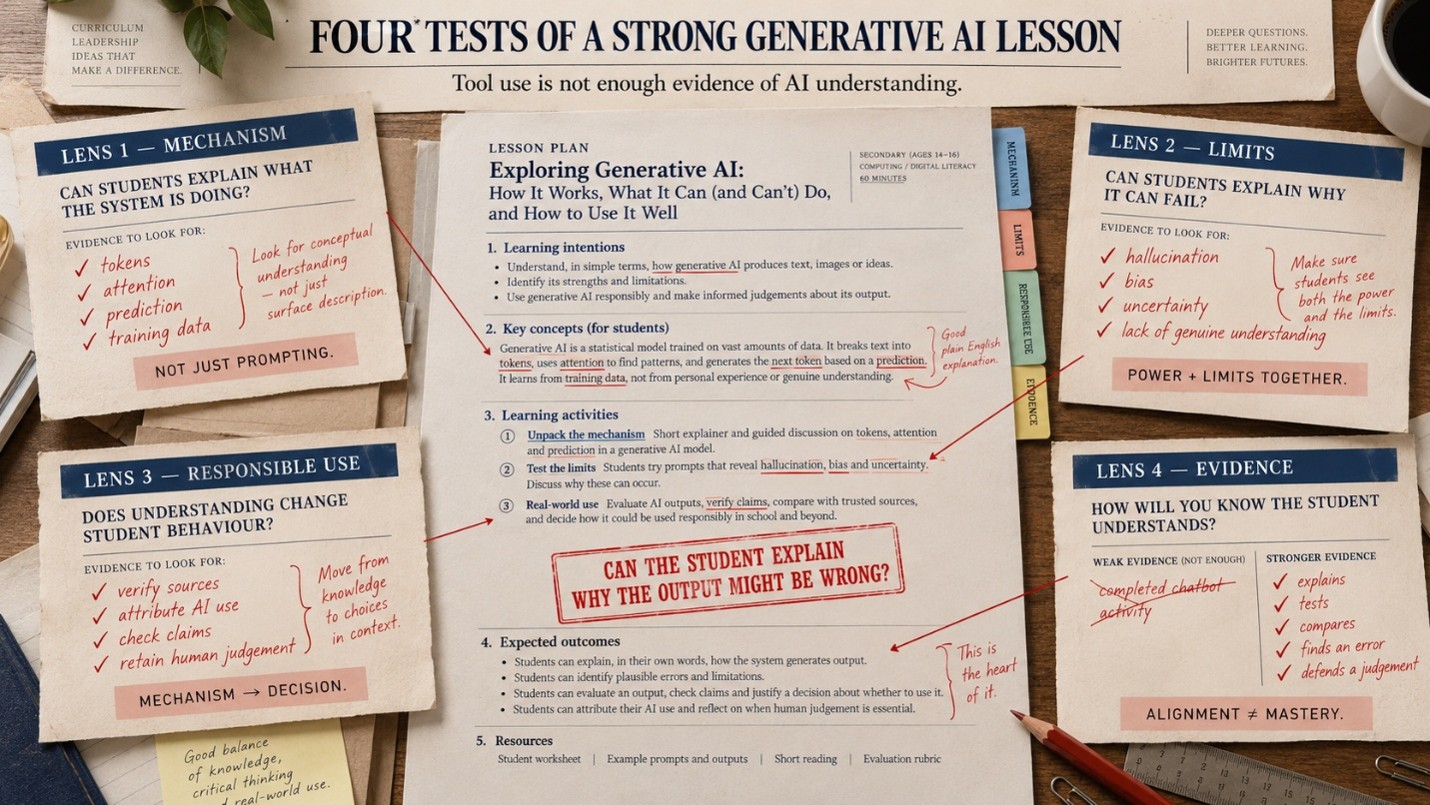
For principals, curriculum directors and heads of computer science, four checks help:
- Mechanism, not just interface. Prompting tips go out of date quickly. Understanding tokens, prediction and limits does not. Learning outcomes should still hold after the next product release.
- Limits taught with power. Hallucination, bias in training data and the lack of real understanding belong in the same unit as the capabilities, not on a separate ethics day.
- Understanding linked to responsible use. Citation and academic integrity rules make more sense when students know why AI-written text can’t stand alone as a source.
- Careful standards claims. U.S. frameworks such as the CSTA K-12 Computer Science Standards and the ISTE Standards for Students give useful anchors for computing impacts and digital citizenship. But mapping a lesson to a standard doesn’t prove students have met it. Ask how understanding is assessed.
For a closer look at lesson design, see designing generative AI lessons that build understanding rather than tool fluency alone.
Frequently Asked Questions
Q: What is generative AI literacy in K-12?
A: It means students understand how generative AI produces its output, where it fails and how to judge its answers. It goes beyond knowing how to use a chatbot. It covers tokens, prediction, limits like hallucination, and responsible use.
Q: Do students need to code to understand how generative AI works?
A: No. The core ideas can be taught with diagrams, hand calculations and visual tools. Coding can come later, when students are ready to run and change real models.
Q: At what grade should schools teach how generative AI works?
A: The foundations start in elementary school with ideas like learning from examples. The mechanism itself fits well in middle school: tokens, attention and prediction. High school can go further into how models are trained to be helpful and how they should be governed.
Q: Why does generative AI sometimes make things up?
A: A language model predicts likely words based on patterns. It doesn’t check facts against a source. So it can produce answers that sound right but are false, such as citations for books that don’t exist.
Q: Is teaching students to use AI the same as teaching them about AI?
A: No. Teaching students to use AI builds tool skills. Teaching them about AI builds understanding of how it works and when to trust it. A strong curriculum plans for both, but treats them as different goals.
Q: Which U.S. standards connect to generative AI education?
A: The CSTA K-12 Computer Science Standards and the ISTE Standards for Students are the most relevant, especially for computing impacts and digital citizenship. Common Core ELA standards on argument and evidence also connect to evaluating AI output. A mapped standard shows alignment, not mastery.