
In September, a Grade 8 student signs her school’s acceptable use policy. One line says she will “use AI tools responsibly and honestly.” In March, she hands in a history essay with three citations that a chatbot gave her. Two of the sources do not exist.
Did she break the policy? Yes. But if you ask her what she did wrong, she may not be able to tell you. She did not make up the sources herself. She trusted a tool that sounded confident. Nobody ever showed her that a language model predicts likely words, so a citation that looks right can still be a guess.
Many schools are now finding this gap. The policy told students what not to do. Nothing in the timetable taught them why.
What an AI Acceptable Use Policy Can and Cannot Do
An AI acceptable use policy for schools does important work. It sets boundaries, protects student data and tells families what to expect. It also gives staff a shared reference when something goes wrong. Every school using AI tools needs one, and writing an AI policy your school will actually use takes real effort.
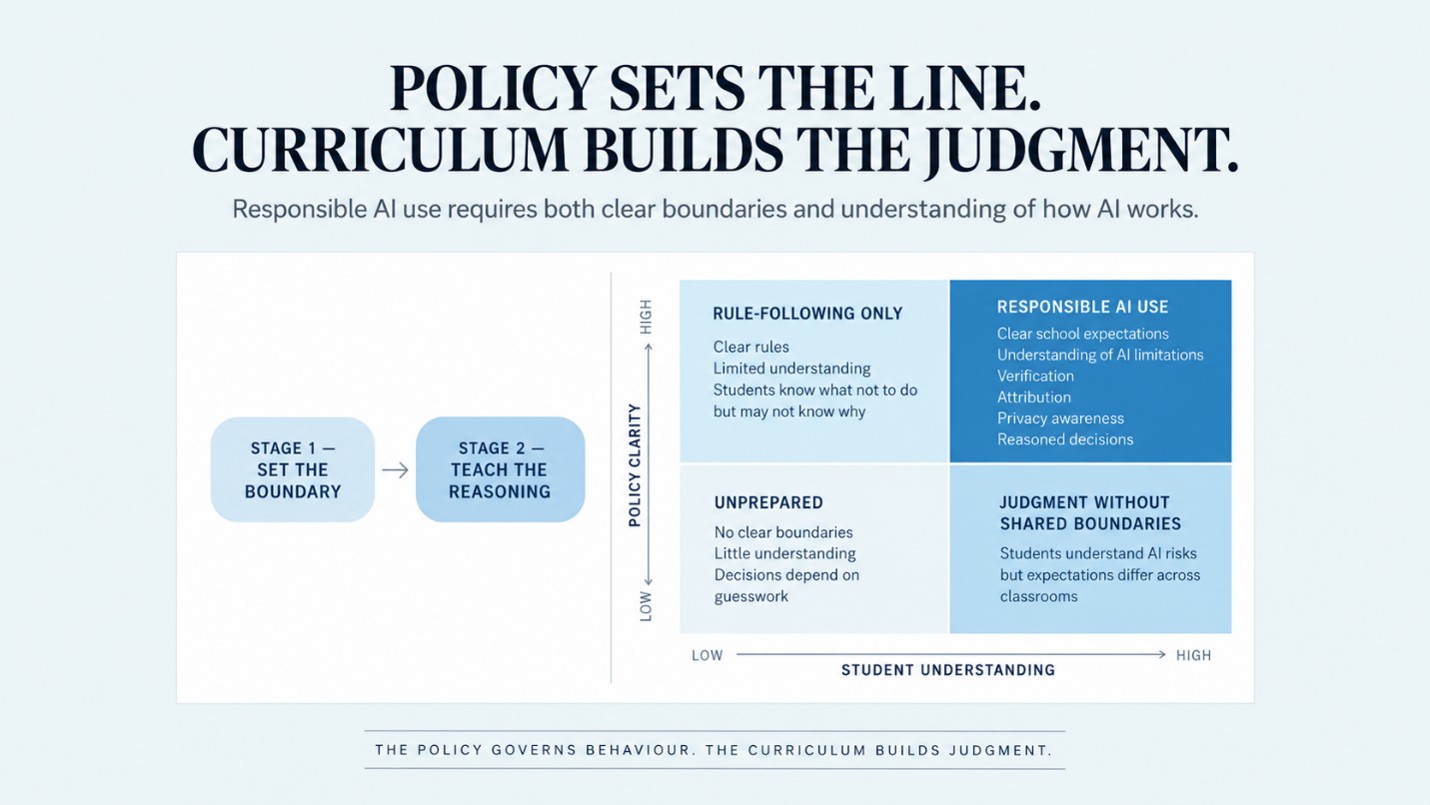
But a policy is a rules document. It acts at the moment of behavior. It cannot build the understanding a student needs to make a good decision in a situation the policy never imagined. With AI, most situations are ones the policy never imagined. New tools arrive every term, and a rule written for one chatbot rarely fits the next.
Rules show students where the line is. Understanding shows them why the line is there, and what to do when there is no line at all.
Responsible Use Depends on Knowing How AI Works
“Responsible use” sounds like an attitude. In practice, it is a set of things students need to know.
A student cannot decide whether to trust a generated answer unless she knows that language models produce plausible text, not checked facts. She cannot spot unfair outputs unless she understands that models learn from training data, and that skewed data gives skewed results. She cannot judge a face-recognition app unless she has thought about who collects the images and who agreed to it.
In each case, the “responsible” part depends on the “AI” part. That is why responsible AI education cannot live only in a policy, a one-off assembly or a digital citizenship week. It belongs in the same lessons where students learn how the technology works. It also needs to come back as their understanding grows, which is the same argument behind why AI ethics needs to return in every year of learning. It connects closely to what AI safety means in a school curriculum too.
Table 1: Policy vs Curriculum – Two Different Jobs
| Question | Acceptable use policy | Responsible use in the curriculum |
| What is it for? | Sets rules and boundaries for behaviour | Builds the understanding behind good judgement |
| When does it act? | When a student uses a tool, or after something goes wrong | Before and during use, in planned lessons |
| What does it assume? | Students already know why the rules exist | Students must learn how AI works to use it well |
| How does it handle new tools? | Often needs rewriting for each new tool | Carries over, because the concepts outlast the tools |
| How is it checked? | Compliance and incident reports | Assessment of reasoning, explanation and decisions |
| Who owns it? | Leadership, IT and safeguarding teams | Curriculum leaders and classroom teachers |
Both columns are needed. The mistake is expecting the left column to do the work of the right one.
What Responsible Use Looks Like as Students Grow
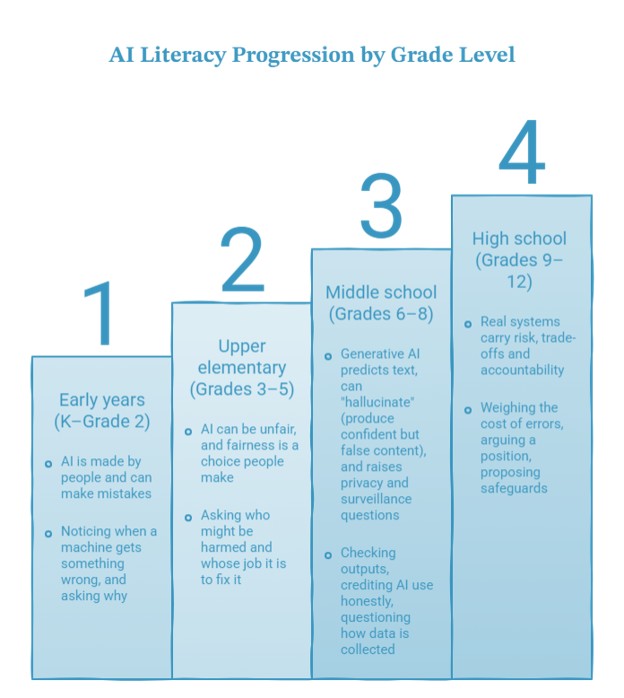
If responsible use is a set of understandings, it should progress like any other part of the curriculum. A Grade 11 student should not be having the same conversation about AI honesty as a Grade 3 student.
Table 2: A Simple Progression for a Responsible AI Use Curriculum
| Stage | What students should understand | What responsible use looks like |
| Early years (K–Grade 2) | AI is made by people and can make mistakes | Noticing when a machine gets something wrong, and asking why |
| Upper elementary (Grades 3–5) | AI can be unfair, and fairness is a choice people make | Asking who might be harmed and whose job it is to fix it |
| Middle school (Grades 6–8) | Generative AI predicts text, can “hallucinate” (produce confident but false content), and raises privacy and surveillance questions | Checking outputs, crediting AI use honestly, questioning how data is collected |
| High school (Grades 9–12) | Real systems carry risk, trade-offs and accountability | Weighing the cost of errors, arguing a position, proposing safeguards |
Each stage builds on the one before. A child who learns in Grade 1 that real people build AI is better prepared to ask, in Grade 10, who is accountable when an automated system fails.
If a student has signed the AI policy every year but has never been asked to explain why an AI tool got something wrong, what has the school actually taught them about responsible use?
What This Means for Curriculum Leaders
Make the policy and the curriculum speak the same language. If the policy asks students to “verify AI outputs,” the curriculum should teach what verifying involves and why outputs need it. The policy should point to learning, and the learning should explain the policy.
Teach responsible use inside technical lessons. The best moment to discuss hallucination is when students learn how language models generate text. The best moment to discuss surveillance is when they learn how computers see. This is also how you get classroom AI use that students can explain and evaluate, rather than use they only follow.
Assess it, don’t only discuss it. Ask students to evaluate a generated answer, explain a biased result, or defend a decision about a tool. Anything that is never assessed tends to disappear when time runs short.
Connect it to academic integrity. Many integrity problems start as gaps in understanding, not as cheating. Rethinking academic integrity policy works best when students already know what AI can and cannot do.
Use standards as planning evidence, not proof. In the US context, the ISTE Standards for Students (Digital Citizen), CASEL’s responsible decision-making competency and the CSTA K–12 standards on the impacts of computing all point in this direction. Mapping a lesson to these standards shows that responsible use is planned. On its own, it does not show that students have learned it.
Support the teachers leading these talks. Many teachers are less comfortable running an open ethical discussion than teaching a fixed fact. They need prompts, likely student responses and clear guidance, not only a statement of school values.
If your AI policy changed tomorrow, would your students’ judgement change with it, or would it stay the same because it was built on understanding?
Conclusion
An acceptable use policy tells students what the school expects. A curriculum gives them the knowledge to meet that expectation, including in situations no policy has covered yet. Schools need both. Only one of them, though, gets better as students learn more.
FAQs
What is the difference between an AI acceptable use policy and a responsible AI use curriculum?
An acceptable use policy sets rules for how students may use AI tools. A responsible AI use curriculum teaches the understanding behind those rules, such as how AI produces errors, where bias comes from and who is accountable. The policy governs behaviour; the curriculum builds judgement.
Why isn’t an acceptable use policy enough on its own?
A policy can only cover situations it anticipates, and AI tools change quickly. Students who understand how AI works can make good decisions in new situations. Students who only know the rules often can’t explain why a choice is wrong.
At what age should students start learning responsible AI use?
Students can start in the early years with simple ideas: AI is made by people and can make mistakes. Fairness and responsibility can follow in upper elementary. Hallucination, attribution and privacy fit middle school, and accountability and governance fit high school.
How can schools assess responsible AI use?
Schools can ask students to evaluate an AI-generated answer, explain why a model gave a biased result, or defend a decision about using a tool. These tasks show reasoning, not just rule-following, and can be marked with a rubric.
Which US standards relate to responsible AI use in schools?
Relevant US-based frameworks include the ISTE Standards for Students (Digital Citizen), CASEL’s responsible decision-making competency, and the CSTA K–12 standards on the impacts of computing. Mapping lessons to these standards supports planning but does not prove students have learned the skills.
Do schools need AI specialists to teach responsible AI use?
Not necessarily. Non-specialist teachers can lead this work with good support: clear lesson guidance, discussion prompts, likely student responses and training in facilitating ethical discussion.