Ask three people in a school what “AI safety” means. The safeguarding lead will talk about deepfakes and chatbots that students confide in. The head of ICT will talk about data privacy and approved tools. A Grade 11 computing teacher may talk about alignment and frontier risk. All three are right. Trouble starts when a school writes one policy or one lesson and assumes it covers all three.
What recent evidence shows
The Center for Democracy and Technology (CDT), a US non-profit, published survey results in October 2025. The nationally representative surveys ran from June to August 2025. They covered 1,030 students in grades 9–12, 806 public-school teachers in grades 6–12, and 1,018 parents. Two findings matter here:
- 86% of surveyed students had used AI in some way during the 2024–25 school year.
- 19% said they, or someone they know, had a romantic relationship with AI.
Some limits: this is US data, it is self-reported, and the second figure includes “someone they know”. CDT also reports that these risks are more common where schools use AI more widely. That is an association, not proof of cause. the survey does not tell us which curriculum works. It tells us the questions are already in students’ pockets.
Three meanings of AI safety
| Meaning | What it covers | Who leads | What the curriculum can do | Example in APEX |
| Student wellbeing | Deepfakes, chatbots as companions, data leaks | Safeguarding lead and school policy | Build awareness and the habit of asking “is this real, who made it, where does my data go?” It cannot replace safeguarding. | Grade 1: what AI cannot do. Grade 7: surveillance and consent. |
| Safe use of tools | Privacy, integrity, checking outputs | Teachers and school policy | Teach the reasons behind the rules | Grade 8: hallucination, attribution, integrity. Digital tasks: Responsible GenAI Evaluation, GenAI Policy Reflection. |
| Safety of AI systems | Reliability, misuse, alignment, governance | The curriculum itself | Make it something students learn about | Grade 10: reward hacking. Grade 11: alignment, RLHF, frontier risk. Grade 12: AI safety and policy. |
The first two are mostly handled by policy. Only the third is a subject students can study. All three need each other. See what an educational AI policy should say for the policy side.
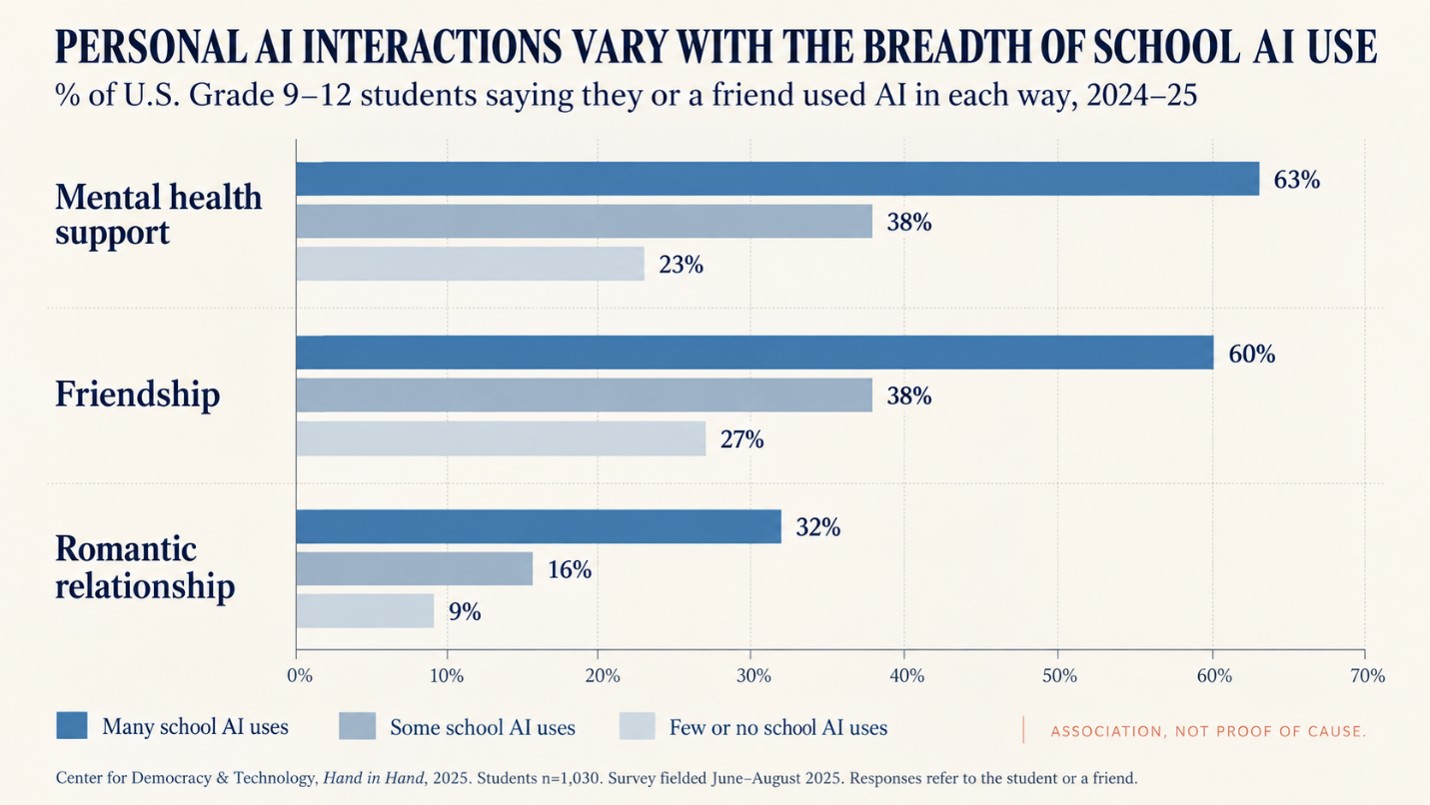
Source: CDT Polling
Start small, and start early
Safety thinking for young students begins with plain ideas: machines make mistakes, AI can’t do everything, a prediction is not a certainty. In APEX these appear in Kindergarten, Grade 1 and Grade 3. Older students then build on them with harder questions about deployment, incentives and governance. The habit of asking “how could this be wrong?” is also the base for questioning plausible AI-generated claims. And for the deepfake side, see deepfakes and AI-generated misinformation.
If a student can recite the school’s AI rules but cannot explain why a model might be confidently wrong, what will they do when a new tool arrives that the rules don’t mention?
Closing thought
“AI safety” is one phrase with three jobs. Name which one you are working on, and you will pick the right tool for it.
Where Scholario APEX AI fits
APEX teaches about AI systems and their risks, step by step. It moves from early ideas about mistakes and limits, through hallucination and reward hacking, to alignment and a Grade 11 capstone on safeguarding a UAE government language model. Its ethics thread runs through every year, as discussed in ethics across every year of learning. It is a curriculum. It is not a safeguarding system, a content filter or a data-protection policy, and schools still need those. To see how the two fit together, read about responsible use built into the curriculum. You can explore the APEX AI curriculum grade by grade to see where each safety idea appears.
FAQs
Q: Is AI safety only for secondary students?
No. The reasoning habits start early. Formal topics such as alignment and governance come later, in Grades 11 and 12 in APEX.
Q: Should safety come from policy or from the curriculum?
Both. Policy sets today’s rules. The curriculum builds the judgement students need for tools that don’t exist yet.
Q: Do the CDT figures apply to our school?
Not automatically. They are US figures from students in grades 9–12. Use them to prompt your own questions, and consider a short local student survey.