Picture a curriculum meeting in a mid-sized US district this fall. The computer science lead says AI belongs in her courses, because every AI system is built from data, algorithms and code. The English coordinator says students meet AI in their writing every week, so that is where they need to learn to judge it. The principal has a simpler question: where does it go on the timetable?
Both teachers are right, and that is why the question is harder than it looks.
Most schools treat “separate subject or part of CS?” as a scheduling problem. It is really a curriculum design problem. The answer decides who learns about AI, how deeply, and from whom.
Why Schools Are Making This Call on Their Own
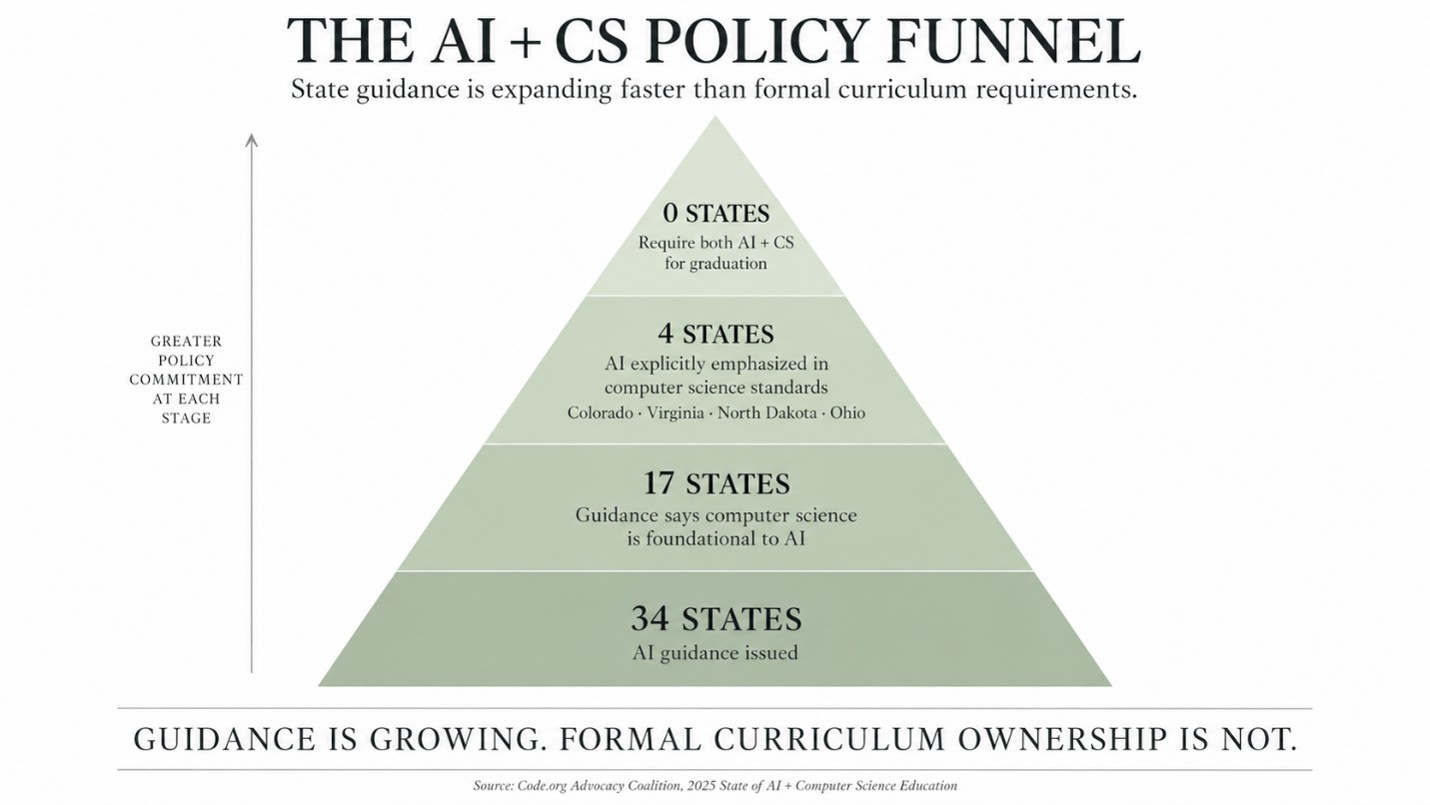
State policy has not settled the question. The 2025 State of AI from Code.org
Only four states explicitly emphasize AI within their computer science standards: Colorado, Virginia, North Dakota and Ohio.
- Of the 34 states that had issued AI guidance, 17 stated clearly that computer science is foundational to AI.
- No state required both AI and computer science for graduation.
For most districts, then, choosing between an AI curriculum and a computer science curriculum is a local decision. Many are making it without a clear model.
The Case for Keeping AI Inside Computer Science
There is a strong argument for keeping AI inside computer science. AI is not a separate science:
- A model is an algorithm.
- Training data is data.
- A neural network is code calculating weighted sums.
Students who understand abstraction, decomposition and how data is represented are far better prepared to understand how a model learns and why it fails. This is why AI literacy and computational thinking work best when they are planned together.
CS teachers largely agree. The 2025 CS Teacher Landscape survey by CSTA, the Kapor Foundation and AiiCE surveyed 2,882 PreK–12 computer science teachers across all 50 states in fall 2024:
- 81% said AI should be part of foundational CS.
- 70% said they already teach AI.
The CSTA K–12 standards also name AI directly at the upper high-school level. Standard 3B-AP-08 asks students to describe how AI drives many software and physical systems.
So a CS home brings rigor, teachers who already care, and standards that already exist.
The Case for AI as a Separate Subject
The weakness of the CS route is reach and time.
Reach. The same Code.org report found that 60% of US public high schools offered foundational computer science in 2024–25. That sounds healthy until you look at enrollment. Only about 6.1% of high school students took a foundational CS course that year, as K-12 Dive reported from the report. Many elementary and middle schools have no CS course at all.
Time. CSTA’s summary of the survey reports two findings:
- 85% of CS teachers spend less than five hours a year on AI.
- Only 42% feel equipped to teach it.
Today, “AI inside CS” often means a short unit near the end of the year.
Scope. A full AI education includes work that CS courses do not usually own:
- reasoning about error rates
- investigating bias in data
- weighing surveillance and consent
- explaining an AI decision to a non-technical audience
These skills sit as close to math, social studies and ELA as they do to programming.
A stand-alone AI course has its own risk, though. Cut off from CS foundations, it can drift into tool training: prompts, chatbots and app tours. Students leave able to use AI without knowing what it is. Closing that gap is the job of a curriculum that teaches beyond AI tool use. It is also why an AI curriculum is not a coding curriculum, even though the two share roots.
If AI lives only inside an elective that about 6% of high school students take in a given year, where is everyone else learning how AI works?
AI Curriculum vs Computer Science Curriculum: Three Models Compared
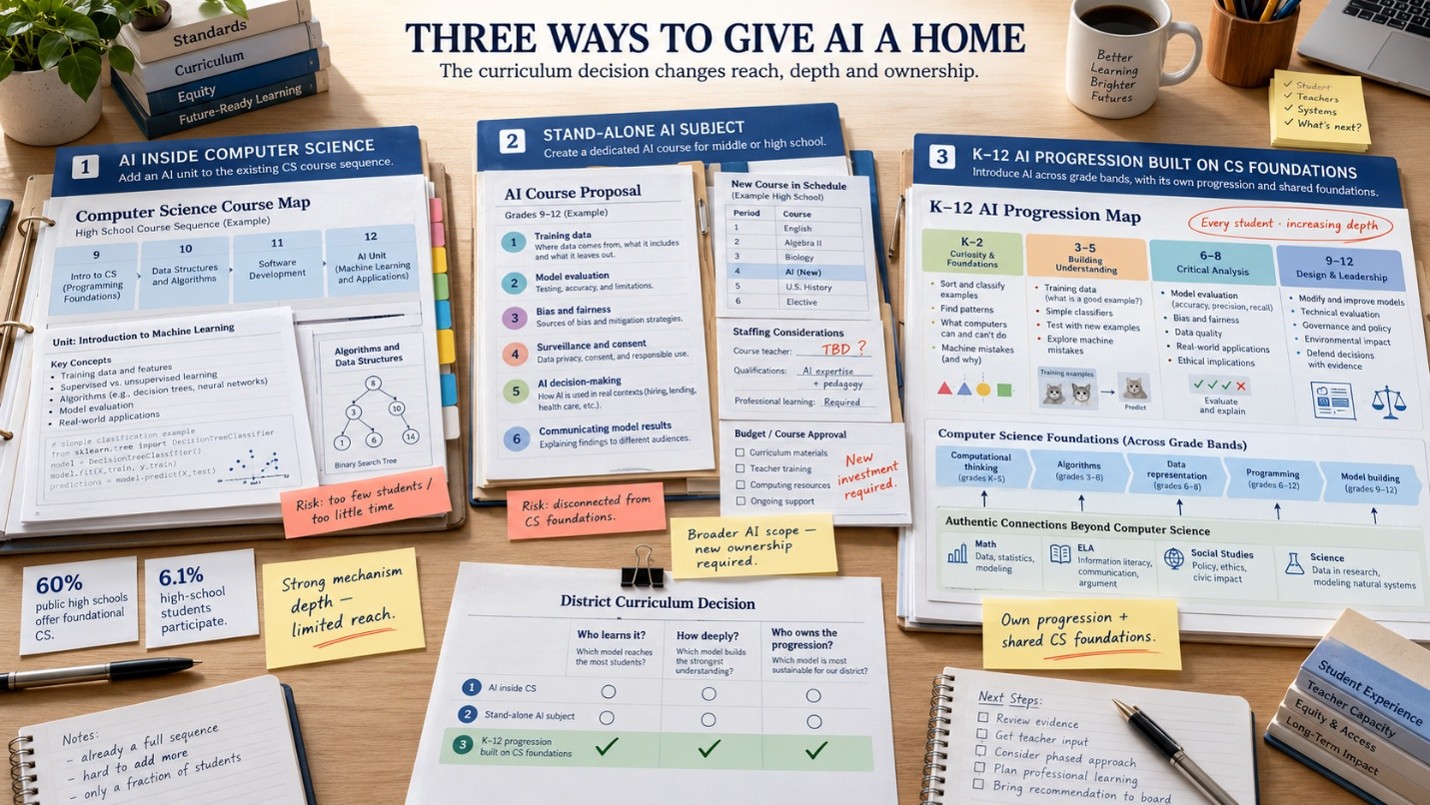
| prerequisite | AI inside CS courses | AI as a stand-alone subject | AI as its own K–12 progression, built on CS foundations |
| Who it reaches | Students who choose CS, mostly in high school | Students timetabled for the course | Every student, every year |
| Depth of mechanism | Strong on algorithms and code | Varies; risk of tool-only lessons | Builds year by year |
| Ethics and judgment | Often brief | Strong only if designed in | Returns every year at greater depth |
| Teacher demand | CS specialists only | New AI specialists | Non-specialists with strong guides; CS teachers for code-heavy grades |
| Timetable cost | Low | High | Moderate (one unit a year) |
| Main risk | AI squeezed into a few hours | Disconnected from CS | Needs clear ownership and coordination |
A Better Question: Who Owns the Progression?
The useful question is not “Where does AI sit on the timetable?” It is “Who is responsible for how students’ understanding of AI grows from kindergarten to graduation?”
Our view is that K-12 AI education needs its own outcomes and its own sequence. It should build on shared foundations with CS rather than compete with it. In practice, that means five steps:
- Write AI learning outcomes separately from CS outcomes. Then AI understanding is not measured only by whether students can code.
- Agree which ideas each subject owns. CS owns algorithms, programming and data structures. The AI strand owns training data, model evaluation, bias and governance.
- Map AI across every grade band, not only high school electives.
- Plan support for non-specialist teachers. Most classrooms will not have an AI expert, so see what non-specialist teachers need to teach AI confidently.
- Make the decision part of your whole-school AI strategy. Place it in your whole-school AI strategy, next to policy, tools and staff training.
If a student can train a model but cannot say who is harmed when it fails, has the school taught AI, or only its machinery?
The Short Answer for School Leaders
AI depends on computer science, but it is bigger than any single CS course. Treating AI as a separate subject with no CS roots produces tool users. Folding it entirely into CS electives reaches too few students, for too few hours. The strongest option is a dedicated AI progression that every student meets each year and that deliberately builds on CS foundations.
FAQs
Q: Should AI be taught as a separate subject in K–12 schools?
A: AI works best with its own K–12 learning progression and outcomes, built on computer science foundations. A fully separate course risks becoming tool training. Keeping AI only inside CS electives reaches a small share of students.
Q: Is AI part of the CSTA computer science standards?
A: Yes, but lightly. The CSTA K–12 standards name AI directly at the upper high-school level (3B-AP-08). As of December 2025, only four states explicitly emphasized AI within their CS standards: Colorado, Virginia, North Dakota and Ohio.
Q: Can elementary schools teach AI without a computer science course?
A: Yes. Young students can learn core ideas through sorting, labeling and pattern activities without any code. These ideas include how examples train a machine, why machines make mistakes, and why fairness is a human choice.
Q: Does teaching AI require coding?
A: Not at every stage. A good progression adds code gradually. It starts with no-code exploration, then moves to running existing notebooks, and finally to modifying and building models in high school.
Q: Who should teach AI if a school has no AI specialist?
A: Classroom teachers can teach AI well if they have detailed guides. These should include lesson scripts, the misconceptions to expect, and how to respond to each one. CS teachers can lead the more technical, code-heavy grades.