A class watches three slides about a face-recognition system that works worse for some people than others. Everyone agrees it is unfair. But nobody can say what data they would check first, where the error came from, or what fixing it would cost. That is the weakness of bias lessons that are stories. Students learn the conclusion, not the inquiry.
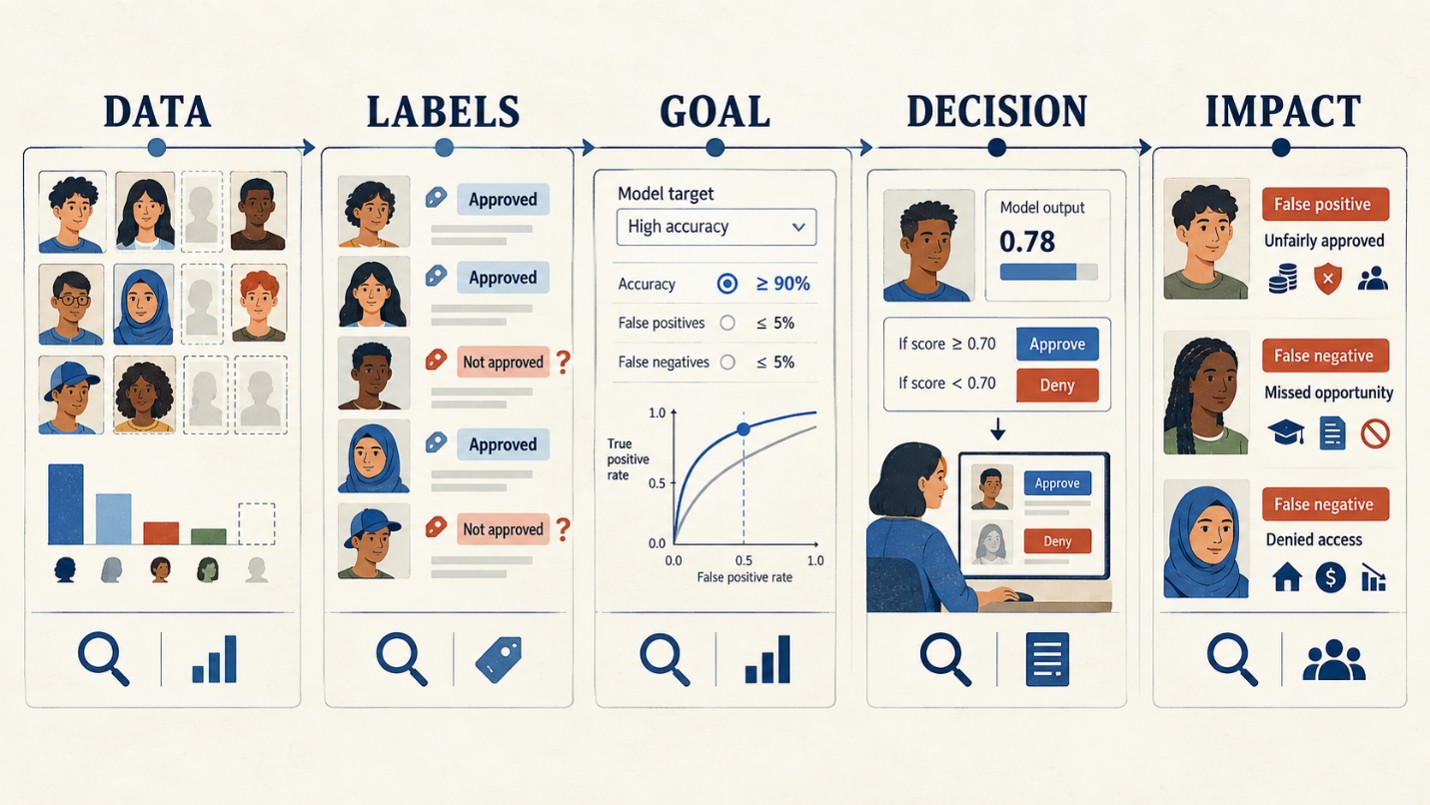
Bias is a chain, not one mistake
Unfairness can enter at several points:
- who is in the data, and who is missing
- how examples were labelled
- what the model was asked to get right
- how its output is used in a decision
- who pays when it is wrong
Each link can be investigated with small, real evidence. When students can locate the link, they stop saying “the AI is biased” and start asking better questions. For the wider picture, see explaining algorithmic bias without oversimplifying it.
Start with data students can hold
You don’t need code. Give groups twenty cards, each describing an example, and ask them to write a sorting rule. Then hand them new cards from a different group and see where the rule fails. A simple routine:
- Look at the data. Who is missing?
- Predict who the rule will fail.
- Test it on new cards.
- Count errors for each group.
- Decide what to change, and what that change costs.
This is why the examples matter in machine learning, and students discover it themselves.
Then move to decisions
Errors are not equal. Wrongly flagging someone is different from wrongly missing someone. A single accuracy number can hide the fact that one group gets most of the mistakes. A confusion matrix lets older students see this by counting each kind of error separately.
Fairness is also a choice. Two reasonable definitions of fair can disagree, so someone has to choose and explain why. Removing a sensitive column doesn’t always remove the bias either, because other columns can stand in for it.
A student who says “that’s unfair” has an opinion. A student who can say which examples were missing and what the error rate was for each group has evidence.
| What students investigate | Question they ask | How it deepens (APEX examples) |
| Who is in the data? | Who is missing? | Grade 2: training data that is too small or one-sided. Grade 5: a skewed face-recognition training set as a worked case. Grade 9: class balance and augmentation (Dataset Balance Checker). |
| What did the model decide? | Where does it get it wrong? | Grade 3: test the tree you built and find its failures. Grade 5: read a confusion matrix. |
| Who is affected? | Who is harmed, and how? | Grade 4: three case studies (facial recognition, loan approval, content recommendation) and the “Who Is Harmed” scenario activity. |
| Who pays for a mistake? | Which error costs more? | Grade 9: an ADNOC pipeline-inspection case comparing false negatives and false positives. |
| Who is responsible? | Whose job is it to fix this? | Grade 4: engineers, companies, governments and users. |
If students can name a biased system but cannot say what they would check first, what have they actually learned?
Closing thought
Give students something to investigate and they will find the bias themselves. That is worth more than any slide about it.
FAQs
Q: How early can students start?
Earlier than many schools expect, if the work is about examples and fairness, not statistics. APEX begins with one-sided training data in Grade 2. Whether your students are ready is still a local judgement.
Q: Do students need to code?
No. The steps above use cards, paper trees and simple counting. The APEX site describes Kindergarten to Grade 4 as no-code.
Q: Isn’t bias just a data problem?
Data is one link. Labels, goals, thresholds and how the result is used matter too. That is why students should investigate the whole chain.