A kindergarten class is reading about Robo, a picture-book robot. Robo looks at a tomato and calls it an apple. Nobody laughs at Robo. Instead, the teacher asks a better question: what did Robo see before that made it guess wrong?
Years later, a high school student asks almost the same question. This time it is about an image classifier she has fine-tuned on 60 photos. Why does it keep failing on one category? What was missing from the training data?
It is the same question both times, but the answer is very different. Managing that gap is the real job of age-appropriate AI education.
Why “Age-Appropriate” Often Gets Misread
When schools talk about age-appropriate AI education, they usually mean one of two things. Both cause problems.
The first is delay. AI feels technical, so it gets pushed to high school. By then, students have been using AI tools for years without any idea of how those tools work.
The second is dilution. Younger students get a friendly story: AI is a robot brain, or AI “thinks” like us. It feels kind. But later teachers then have to undo it.
A better definition is this:
Age-appropriate AI education teaches the same true ideas at every stage, at different depths, through different kinds of student work.
Simpler is fine. Wrong is not.
Here is a useful test. Is the explanation a young child hears a smaller version of the true idea, or a different idea that will need to be unlearned? “AI learns from lots of examples” grows into training data, class balance and bias. “AI has a brain” grows into nothing useful.
A question for curriculum leaders:
If the explanation a seven-year-old hears has to be unlearned at fourteen, was it age-appropriate, or just convenient?
What Research Says About AI Learning by Grade Level
In February 2025, the Computer Science Teachers Association (CSTA) and AI4K12 published AI Learning Priorities for All K-12 Students. The project was funded by the US National Science Foundation and developed by a group of teachers, researchers and curriculum developers. It organizes AI learning into five areas:
- Humans and AI
- Representation and Reasoning
- Machine Learning
- Ethical AI System Design and Programming
- Societal Impacts of AI
It then sets priorities for four grade bands: K–2, 3–5, 6–8 and 9–12.
What stands out is how the verbs change. In K–2, students work to understand that computers learn from data and patterns. By grades 3–5, they explore how the properties of training data affect a model’s output. By high school, they evaluate AI models, for example by using a model card.
The topic does not change much across the bands. What students are asked to do with it changes a lot.
That matters, because secondary students are not starting from zero. A Pew Research Center survey of 1,391 US teens aged 13–17 found:
- 26% had used ChatGPT for schoolwork, up from 13% in 2023.
- Use was higher among 11th–12th graders (31%) than 7th–8th graders (20%).
- Teens were already forming their own rules: 54% said using it for research was acceptable, but only 18% said the same about writing essays.
The survey does not say why teens hold these views. But it does show something important for planning. Many secondary students are not beginners with AI tools. They are beginners with AI understanding.
Age-Appropriate AI Education, Stage by Stage
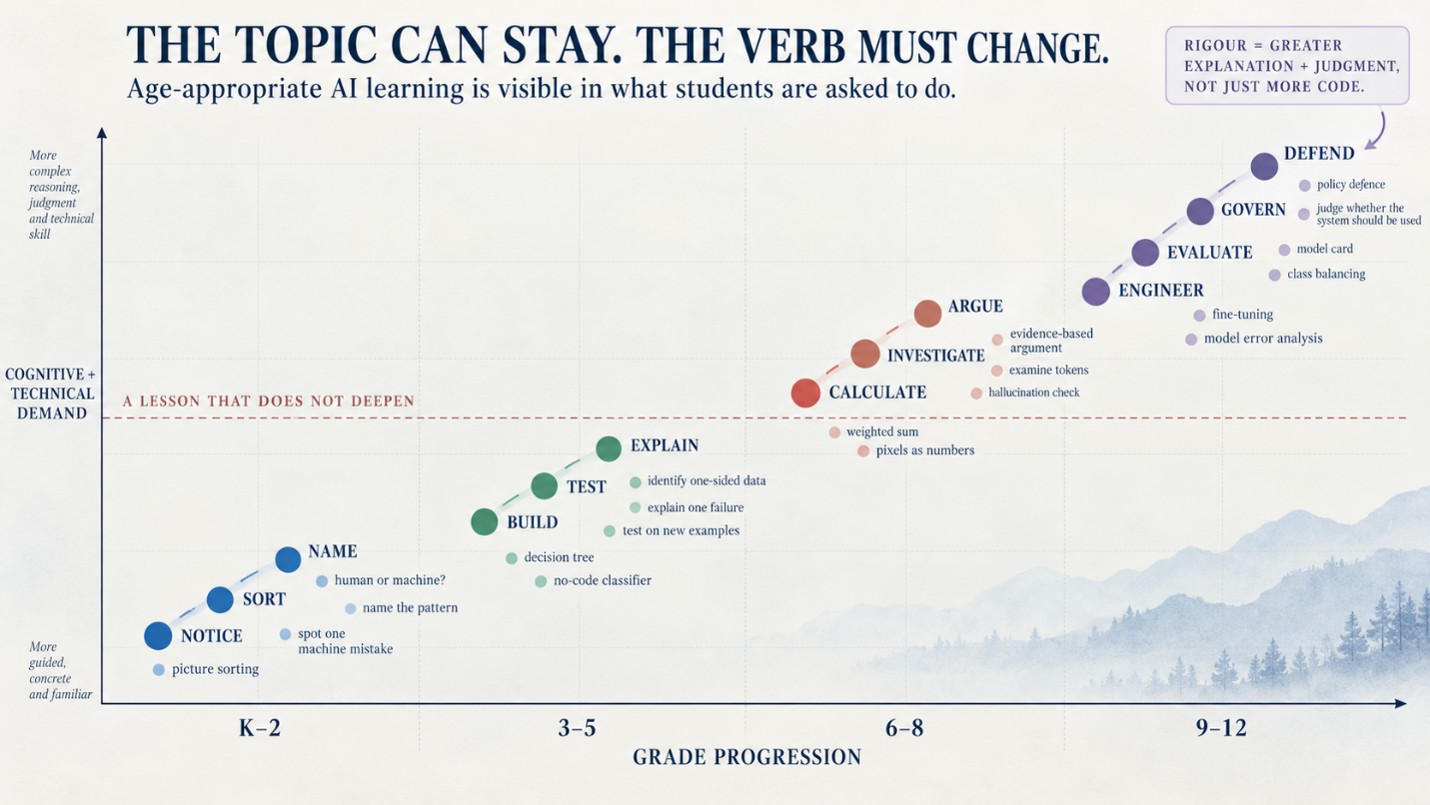
The table below shows what each stage is ready for. It is a practical guide for a K-12 AI curriculum, not a rigid rulebook.
| Stage | Students are ready to… | What it looks like in class | Watch out for |
| Early years (K–Grade 2) | Notice, sort and name. Learn that some machines learn from examples, and that people build them. | Picture sorts, storytelling, unplugged play, a story robot that makes mistakes and gets better | Framing AI as alive or magic; heavy screen time with no thinking attached |
| Upper elementary (Grades 3–5) | Build simple models, test them, and explain failures. Meet bias as a design problem. | Decision trees on paper, no-code classifiers, real bias case studies, “who is responsible?” discussions | Ethics taught as “AI is bad”; skipping why the model failed |
| Middle school (Grades 6–8) | Look inside the mechanism. Calculate, run real tools, and make short arguments. | Computing a single neuron by hand, images as pixel grids, text as tokens, hallucination and citation | Coding treated as the goal; generative AI used only as a writing shortcut |
| High school (Grades 9–12) | Engineer, evaluate and govern. Defend decisions to others. | Fine-tuning pre-trained models, reading loss curves, designing reward functions, writing and defending policy briefs | Demos presented as rigor; ethics debates with no technical grounding |
In the early years, the goal is curiosity with honest foundations. Young children can learn that machines make mistakes, and that more examples help them learn. For a closer look at this stage, see finding the right entry points for young children.
In the elementary years, students move from noticing to building. A child who builds a decision tree, tests it on four new animals and finds the one it gets wrong has learned something real about classification. This is the base for building primary AI understanding.
In middle school, the mechanism becomes visible. A neural network stops being a mystery once a student has calculated a weighted sum by hand. This is also the right age to discuss hallucination and academic integrity, because many students are already using these tools.
In high school, students should evaluate, not just experience. That shift is what moving secondary AI learning from demonstrations to evaluation is about.
One Idea, Four Depths
The clearest way to judge age-appropriateness is to follow one idea across the years. Training data is a good example.
The Scholario APEX AI curriculum shows how this can work:
- Kindergarten: Robo learns better after seeing more pictures.
- Grade 2: A story character looks at her training data to find out why her robot made a mistake.
- Grade 4: One-sided data becomes one of the main explanations for algorithmic bias.
- Grade 5: Students split data into training, validation and test sets.
- Grade 9: Students deal with class balance and data augmentation while fine-tuning a model.
None of these steps needs to be unlearned. Each one adds depth to the last. This is what what should deepen as students revisit AI means in practice.
A second question to consider:
If a Grade 10 AI lesson could be taught unchanged in Grade 6, what are the extra four years actually adding?
What Curriculum Leaders Should Check
Before adopting or designing a K-12 AI curriculum, ask five questions:
- Does the early explanation grow, or does it need to be unlearned later?
- Does the student’s work change in kind (sort → build → calculate → defend), or only the topic?
- Is coding staged honestly? Very young students do not need code to learn core AI ideas.
- Does ethics deepen alongside technical understanding, rather than staying at “is AI good or bad?”
- Does assessment change with age, from observation, to build-and-test, to written argument and defense?
For a practical method to apply these checks to a single lesson, see judging whether a lesson matches students’ readiness.
Frequently Asked Questions
What is age-appropriate AI education?
Age-appropriate AI education teaches students true ideas about AI at a depth that fits their stage of development. Young children learn that machines learn from examples, while high school students evaluate and design AI systems. The idea stays accurate at every stage. Only the depth and the kind of student work change.
At what age should students start learning about AI?
Students can start learning basic AI ideas in kindergarten. CSTA and AI4K12’s 2025 priorities include a K–2 band focused on understanding that computers learn from data and patterns. At this age, the learning is play-based and usually needs no screens or code.
Do young children need to use AI tools to learn about AI?
No. Core ideas such as patterns, examples, mistakes and fairness can be taught through sorting, stories and unplugged activities. Hands-on tools become more useful in upper elementary and middle school, when students can build and test simple models.
How is AI education different in middle school and high school?
Middle school AI education focuses on understanding how AI works on the inside, for example calculating a neuron’s output or seeing an image as a grid of numbers. High school AI education focuses on engineering and evaluation, such as fine-tuning models, judging their errors and arguing about governance. Middle school explains the mechanism. High school puts it to work and judges it.
How can a school tell whether an AI lesson is too advanced or too simple?
Check two things: whether the explanation will need to be unlearned later, and whether the student task matches the stage (sorting, building, calculating or defending). If a lesson could move several grades up or down without any change, it is probably not matched to its age group.
Does age-appropriate AI education connect to US standards?
Yes. CSTA and AI4K12 published grade-band AI learning priorities for K–12 in 2025, and frameworks such as ISTE and CSTA’s K–12 CS standards also apply. A curriculum being mapped to a standard is not the same as students mastering it. Schools should look for evidence in student work.