Picture a curriculum committee at the end of a long planning day. A one-page AI literacy framework is on the screen. The verbs are good: understand, evaluate, use responsibly. Everyone agrees with it. Then someone asks a simple question: “So what does a Grade 4 student actually do in October?”
Nobody can answer.
This gap is common. Many schools now have an AI literacy statement. Far fewer have an AI literacy curriculum framework for schools: something a teacher can plan from, students can progress through, and leaders can check. This article sets out what belongs in one.
Why schools need a framework now
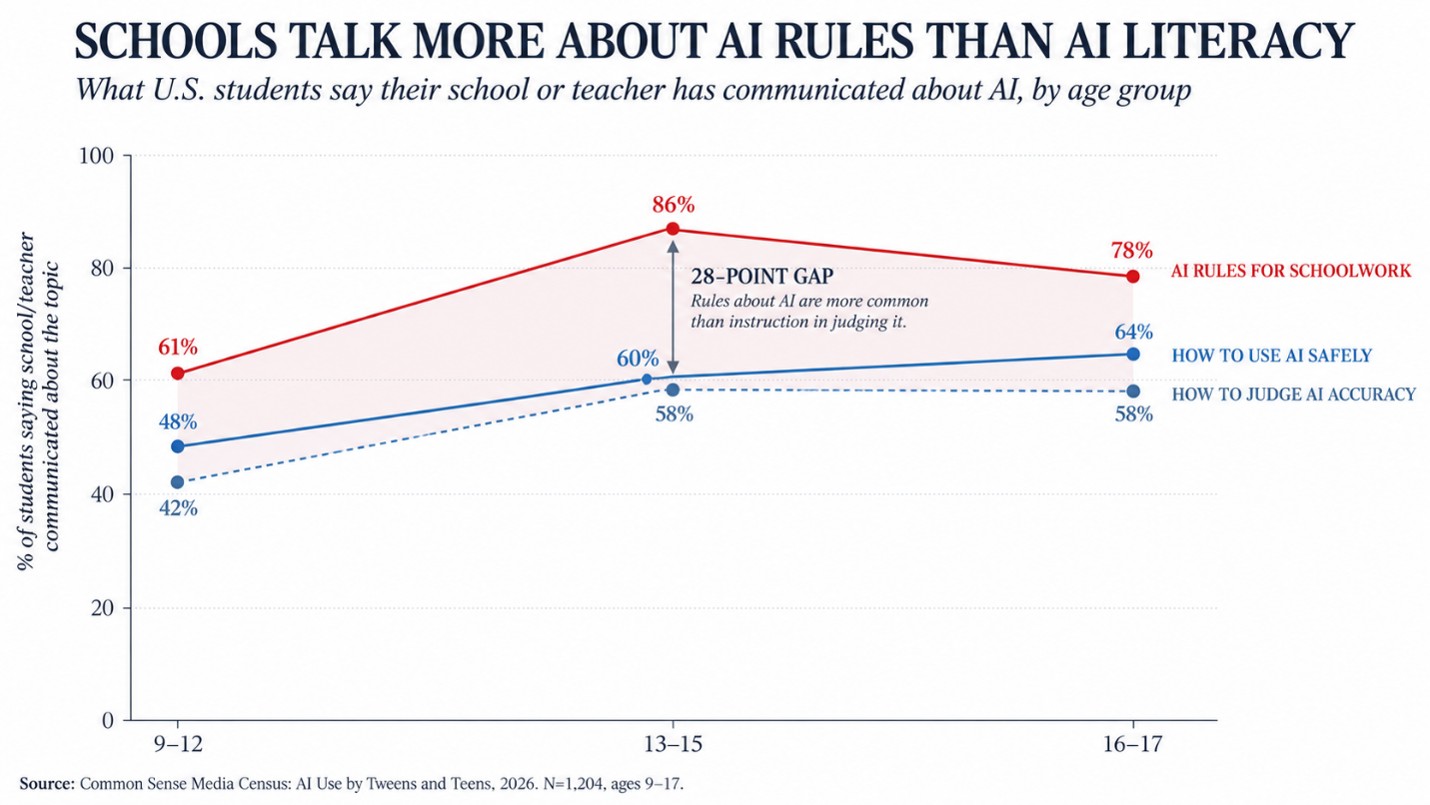
Students are not waiting for schools to decide. RAND ran nationally representative surveys of US schools in 2025. In them, 54% of students and 53% of English language arts, math and science teachers said they used AI for school. More than 80% of students said their teachers had not explicitly taught them how to use AI. Only 45% of principals reported having school or district policies or guidance on AI use (RAND, 2025).
RAND measured use and guidance, not understanding. Even so, the pattern is clear: in US schools, AI use is moving faster than AI teaching. A framework is how a school decides what students should understand about AI, not only what they are allowed to do with it.
A framework is not a topic list
The weakest frameworks are lists: chatbots, prompting, deepfakes, bias. Each item matters. But a list does not tell you what comes first, what comes back later, or how the Grade 10 version should differ from the Grade 6 version.
A useful K-12 AI literacy framework does four jobs:
- It names a small set of ideas that last.
- It shows how those ideas deepen over the years.
- It describes what students can do at each stage.
- It makes clear how the school will know whether students have learned it.
US research supports this. In February 2025, the Computer Science Teachers Association (CSTA) and AI4K12 brought together 57 teachers, researchers, administrators and curriculum developers at Carnegie Mellon University. Their goal was to agree on AI learning priorities for all K-12 students. Their report groups the priorities into five categories:
- Humans and AI
- Representation and Reasoning
- Machine Learning
- Ethical AI System Design and Programming
- Societal Impacts of AI
The priorities are organised by grade band (K–2, 3–5, 6–8, 9–12). They are meant to guide the next revision of the CSTA K-12 standards (CSTA & AI4K12, 2025).
Notice what is missing from those categories: tool names. That choice is deliberate. Tools change every year. An idea like “models learn patterns from data” does not.
The blueprint: six layers an AI literacy curriculum framework for schools needs
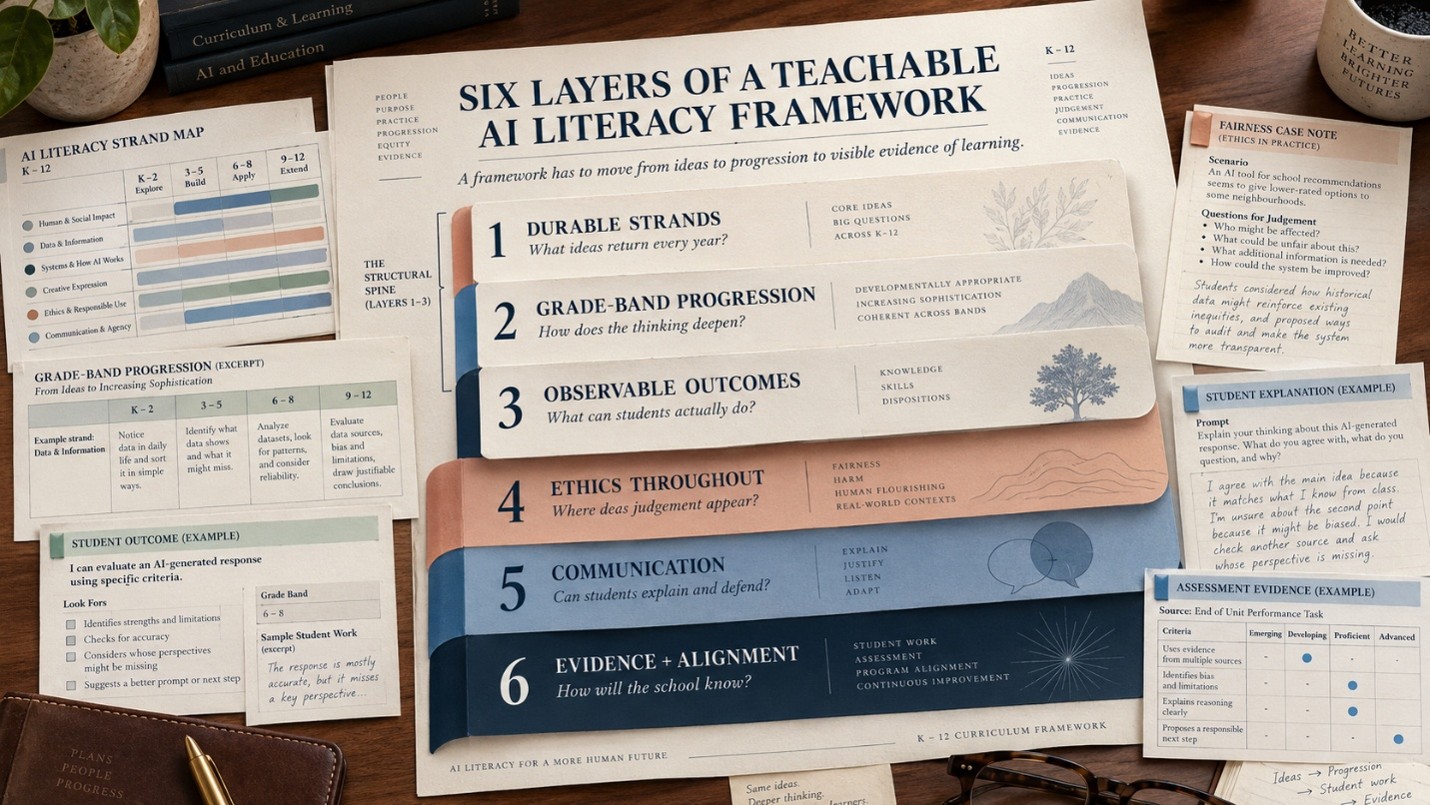
| Layer | Question it answers | Weak version | Strong version |
| 1. Durable strands | Which ideas run through every year? | A list of current tools and trends | 4–6 strands (e.g. data, models, ethics and society) that return every year |
| 2. Grade-band progression | What gets deeper, and how? | The same topic repeated with harder words | Each band adds a new level of mechanism, evidence or judgement |
| 3. Observable outcomes | What can students do at the end of each band? | “Students will understand AI” | “Students can explain why a model got an example wrong, using its training data” |
| 4. Ethics in every strand | Where does responsible AI live? | One ethics unit, usually in middle school | Fairness, limits and responsibility revisited in every band |
| 5. Communication | Can students explain AI to others? | Not mentioned | Explaining and arguing about AI decisions, building to written briefs in high school |
| 6. Evidence and alignment | How will the school know? | Standards codes listed next to lesson titles | Assessment tasks for each band, plus a crosswalk that separates alignment from mastery |
Layers 1–3 are the spine of the curriculum. Strands without progression lead to repetition. Progression without observable outcomes gives you a confident document and unclear classrooms. Most frameworks are really tested at Layer 3: they have to state, in plain terms, what students should be able to do after an AI literacy programme. Some schools write this layer as a competency framework for student AI literacy. That works well, as long as each competency describes a performance a teacher can observe.
Layers 4 and 5 are the ones most often left out. If ethics appears in only one unit, students learn that ethics is a topic rather than a habit. Communication is missing even more often, even though it may be the best window into understanding. A student who can explain why an AI system made a decision has shown more than a student who can only operate the system.
Layer 6 keeps the framework honest. The CSTA and AI4K12 report is careful on this point: its priorities are not standards. Schools need the same care. If a lesson is mapped to a standard, that does not mean students have met the standard. A good crosswalk shows which standards a curriculum can be measured against and keeps three things separate: alignment, instruction and assessed mastery.
What “deepening” looks like in practice
Take one idea, training data, and follow it across the years:
- K–2: AI learns from examples, and people choose those examples.
- 3–5: Labelled data, training sets and test sets. A model can fail when its examples are one-sided.
- 6–8: How the make-up of a dataset affects accuracy and bias. Reading a model’s results from a confusion matrix.
- 9–12: Curating, balancing and documenting a dataset for a real model, then judging whether the model is fit to deploy.
The idea stays the same. Three things change: the mechanism students can see, the evidence they can use, and the judgement they are asked to make.
If a Grade 10 outcome in your framework could easily be taught in Grade 6, is the framework actually progressing?
Do not let AI literacy disappear into digital literacy
Many schools put AI under digital citizenship. The two do overlap: online safety, checking sources and privacy belong in both. But AI literacy also asks students to understand how systems learn, predict and fail. That calls for its own strands. It is worth being clear about how AI literacy differs from digital literacy before you decide where AI literacy will sit in your curriculum.
From document to timetable
A framework only matters once it reaches a timetable. Before you adopt one, ask three questions:
- How many hours a year does each band get?
- Who will teach it?
- What will a non-specialist teacher need in front of them on Monday morning?
Turning a framework into a teachable programme is where good intentions usually meet real limits on staffing and time.
If students already use AI every week, but no strand in your framework asks them to explain how it works, what is the framework actually guiding?
FAQs
Q1. What is a K-12 AI literacy framework?
A K-12 AI literacy framework is a structured plan for what students should understand about artificial intelligence and be able to do with it, from Kindergarten to Grade 12. A strong framework has lasting strands, a grade-band progression, observable outcomes, ethics in every year, and clear assessment evidence.
Q2. What should an AI literacy curriculum framework for schools include?
It should include six layers: durable strands (such as data, models, and ethics and society); a progression across grade bands; observable learning outcomes; responsible AI in every band; communication skills; and assessment evidence with a standards crosswalk that separates alignment from mastery.
Q3. How is an AI literacy framework different from AI standards?
A framework sets out the ideas, progression and outcomes a school plans to teach. Standards are formal benchmarks used for accountability. In the US, the 2025 CSTA and AI4K12 AI learning priorities are explicitly not standards; they are intended to guide the next revision of the CSTA K-12 standards.
Q4. At what age should AI literacy start?
The CSTA and AI4K12 priorities start in grades K–2. At that age, the focus is on simple ideas: AI is made by people, it learns from examples, and it can make mistakes. Coding and technical models come later, once students have the right foundations.
Q5. Should an AI literacy framework name specific AI tools?
Generally no. Tools change quickly, so frameworks should be built around lasting ideas, such as how models learn from data. Specific tools belong in lesson plans and resource lists, where they can be updated each year without rewriting the framework.
Q6. How can a school tell whether its AI literacy framework is working?
Check whether outcomes are observable and get harder with each grade band. Check whether each band has assessment tasks, not just standards codes. Finally, ask students to explain why an AI system produced a result. Their explanations are often the clearest evidence of real understanding.