
Picture a senior showcase in late spring. A student presents an image classifier that sorts recyclables. The slide says 94% accuracy, and the room is impressed. Then a panel member asks a simple question: “Which items does it get wrong, and who pays for those mistakes?”
The student goes quiet. The model works, but the student cannot explain its errors or say whether 94% is good enough for a real recycling plant.
That silence is the problem this article is about. A capstone is supposed to show what years of learning have added up to. In AI education, that means two things together: understanding how a system works, and judging whether and how it should be used. An AI capstone curriculum that checks only one of these is not finished.
Why the capstone matters more now
Students are not waiting for schools to introduce them to AI. A Pew Research Center survey of 1,458 US teens aged 13–17 found that 54% have used AI chatbots for help with school work. One in ten said they use chatbots for all or most of their school work.
Schools are not keeping pace. A RAND report, based on nationally representative US surveys from the 2024–25 school year, found that only 35% of district leaders said they provide students with AI training. More than 80% of students said their teachers had not explicitly taught them how to use AI.
These studies measure use and guidance, not understanding. Still, they point to a clear gap: students use AI widely, while few schools deliberately build understanding of it. A capstone is one of the few places where a school can check, in public and in depth, whether that understanding exists.
What a capstone is actually for
In many schools, the senior capstone is a showcase: a project, a poster and a presentation. In an AI curriculum, it should be more than that. It should be evidence that the whole learning progression worked.
That evidence has two halves.
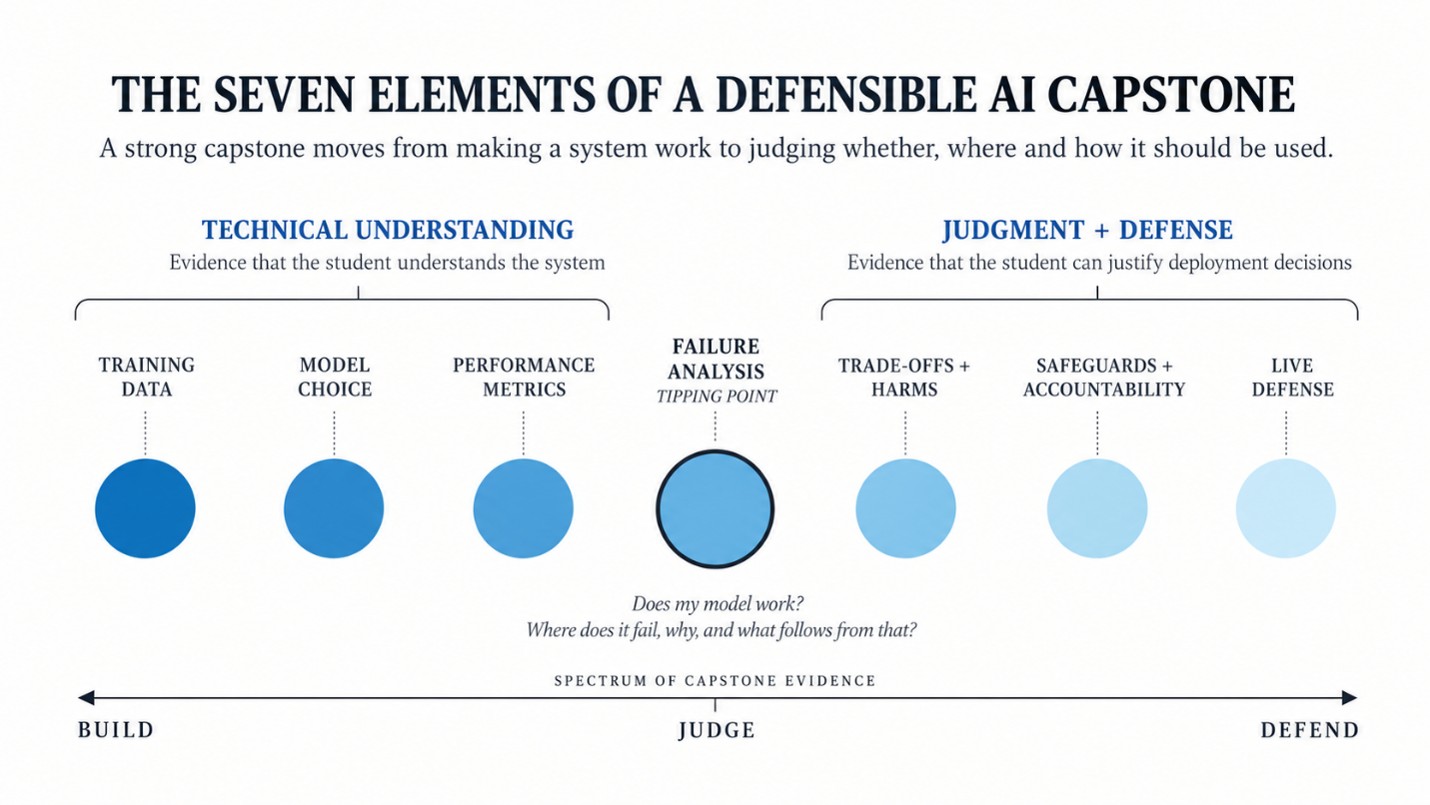
Technical understanding. Can the student explain how the model learns, what the metrics mean and why it fails? A student who reports accuracy should also be able to say what a false negative is and when it matters more than a false positive.
Judgment. Can the student decide whether the system should be used, for whom and with what safeguards? Who is accountable if it causes harm?
Most capstones assess one half well and the other half barely. That is where the design work begins.
Three capstone designs that miss the point
The demo capstone. The student builds something impressive with an AI tool but cannot explain what happens inside it. It shows tool use, not understanding.
The essay capstone. The student writes a thoughtful opinion piece on AI ethics with no technical grounding. Fairness gets discussed in general terms, without reference to data, error rates or design choices.
The one-off capstone. The project appears in senior year with nothing leading up to it. Students meet complex ideas for the first time while also being assessed on them. Capstones work best when earlier grades have already moved students from demonstrations to evaluation.
Design principles for a stronger AI capstone curriculum
1. Put a technical claim and a judgment claim in the same piece of work.
Don’t split the capstone into a “build” part and a separate “ethics” reflection. Ask students to make linked claims instead. For example: “My model’s recall for hazardous items is 81%. For a recycling plant, that miss rate is too high, so I recommend human review for this category.” The judgment only makes sense because of the technical evidence.
2. Make students defend their work, not just present it.
A presentation can be rehearsed. A live question cannot. When students face questions from people who did not help build the project, the gap between using AI and understanding it shows quickly. This is why explaining an AI decision deserves practice long before senior year.
3. Assess across dimensions, not with one grade.
A single score hides too much. A strong rubric looks separately at technical accuracy, design thinking (including documented failures and trade-offs), ethical reasoning and communication. This kind of rubric helps a school tell whether students truly understand AI rather than rewarding a polished slide deck.
4. Reward documented failure.
Real AI work is iterative. If the rubric rewards only a working final model, students will hide what went wrong. If it rewards clear evidence of testing, failing and revising, students learn how engineers actually work.
5. Build the capstone years before senior year.
The best capstones gather earlier work: a confusion matrix from middle school, a model evaluation from Grade 9, a short argument about deployment risk from Grade 10. By senior year, students are combining skills they already have, not learning everything at once.
6. Treat US standards as design evidence, not badges.
A well-designed capstone can map to CSTA Level 3B, NGSS HS-ETS1.C (evaluating a solution against criteria and trade-offs), and Common Core W.11-12.1 (writing arguments) and SL.11-12.4 (presenting information). Mapping a project to a standard shows that the standard is addressed. It does not show that every student has mastered it. Curriculum leaders should ask for both the mapping and the evidence. Clear learning outcomes for an AI literacy program make that evidence easier to collect.
Here is the question to sit with:
If a student can fine-tune a model but cannot say who should be accountable when it fails, what exactly has the capstone certified?
What this means for curriculum leaders
Before approving a capstone design, ask a few plain questions. Which earlier units feed into it? Who evaluates it, and are any evaluators from outside the classroom? Does the rubric score judgment as seriously as technical work? What happens when a student’s model performs badly but their analysis of why is excellent?
And one more:
If a student who joined the program last month could complete the capstone just as well as one who has been in it for six years, is it really a capstone?
FAQs
What is an AI capstone project in high school?
It is a final, extended project in which students show that they understand how AI systems work and can judge their use. A strong one asks students to build or evaluate a model, explain its errors, weigh its risks and defend their conclusions to an audience.
How is an AI capstone different from a coding project?
A coding project mainly checks whether the program works. An AI capstone also checks whether the student understands the data, the metrics and the limits of the model, and whether they can argue responsibly about deploying it. Writing code may be part of it, but it is not the whole goal.
How should schools assess an AI capstone?
Use a rubric with separate dimensions: technical accuracy, design thinking, ethical reasoning and communication. Include live questioning, ideally from evaluators outside the classroom, and give credit for clearly documented testing and failure, not just a working final product.
Which US standards can an AI capstone align with?
Common choices are CSTA Level 3B for computer science, NGSS HS-ETS1.C for engineering design trade-offs, and Common Core W.11-12.1, W.11-12.7 and SL.11-12.4 for argument, research and presentation. Alignment shows that a standard is addressed, not that students have mastered it.
When should students start preparing for an AI capstone?
Ideally years before senior year. Skills like reading a confusion matrix, evaluating a model and writing a short argument about AI risk should build through middle and early high school, so the capstone combines skills students already have.