
Picture a familiar district timeline. In the fall, the school board approves an AI acceptable use policy. Over winter break, the technology office signs a license for an AI writing assistant. In January, teachers get a professional development day on prompting. By spring, the district can say it has a school AI strategy.
Meanwhile, an eighth grader has been using a chatbot for homework since September. She knows how to get an answer out of it. She does not know why the answer is sometimes confidently wrong, where the system learned its patterns, or what her school’s policy actually expects of her.
Each part of that plan made sense. The part that was missing was what students should learn about AI.
The gap shows up in the national data
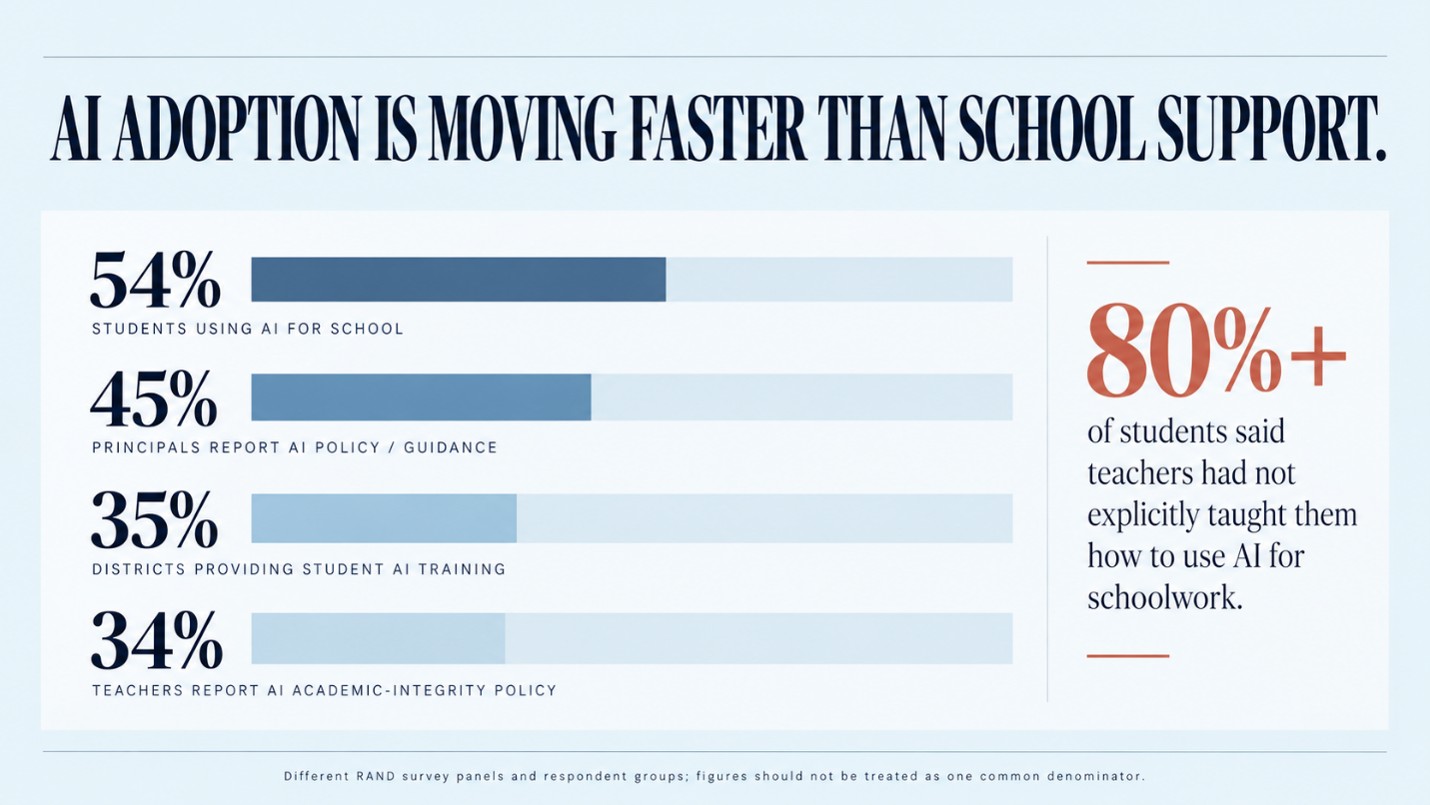
The RAND Corporation’s 2025 survey panels give a clear picture. In early 2025, 54% of US students said they used AI for school. That is more than 15 percentage points higher than in earlier surveys. More than 80% of students said their teachers had not explicitly taught them how to use AI for schoolwork. Only 35% of district leaders said they had given students any AI training. And 45% of principals reported having a school or district policy or guidance on AI.
A Gallup and Walton Family Foundation survey of 2,232 US public K-12 teachers (March–April 2025) found that 60% had used AI tools during the 2024–25 school year. But just 19% said their school had an AI policy.
The two surveys asked different people slightly different questions, so the numbers can’t be compared directly. Read together, though, they suggest something leaders should take seriously. A policy can exist in the district office and still be invisible in the classroom.
Most strategies are built around tools and rules
Look at a typical AI strategy for schools and you’ll usually find the same parts: data privacy, vendor vetting, acceptable use, academic integrity and time-saving tools for staff. All of them are necessary.
But every one of those parts is about managing AI. None of them is about understanding it. A student can follow every rule in the handbook and still believe a chatbot “looks things up” or “knows” the answer.
Using AI and understanding AI are different educational goals. A strategy that only covers the first will produce students who are compliant but confused.
Three layers, one strategy
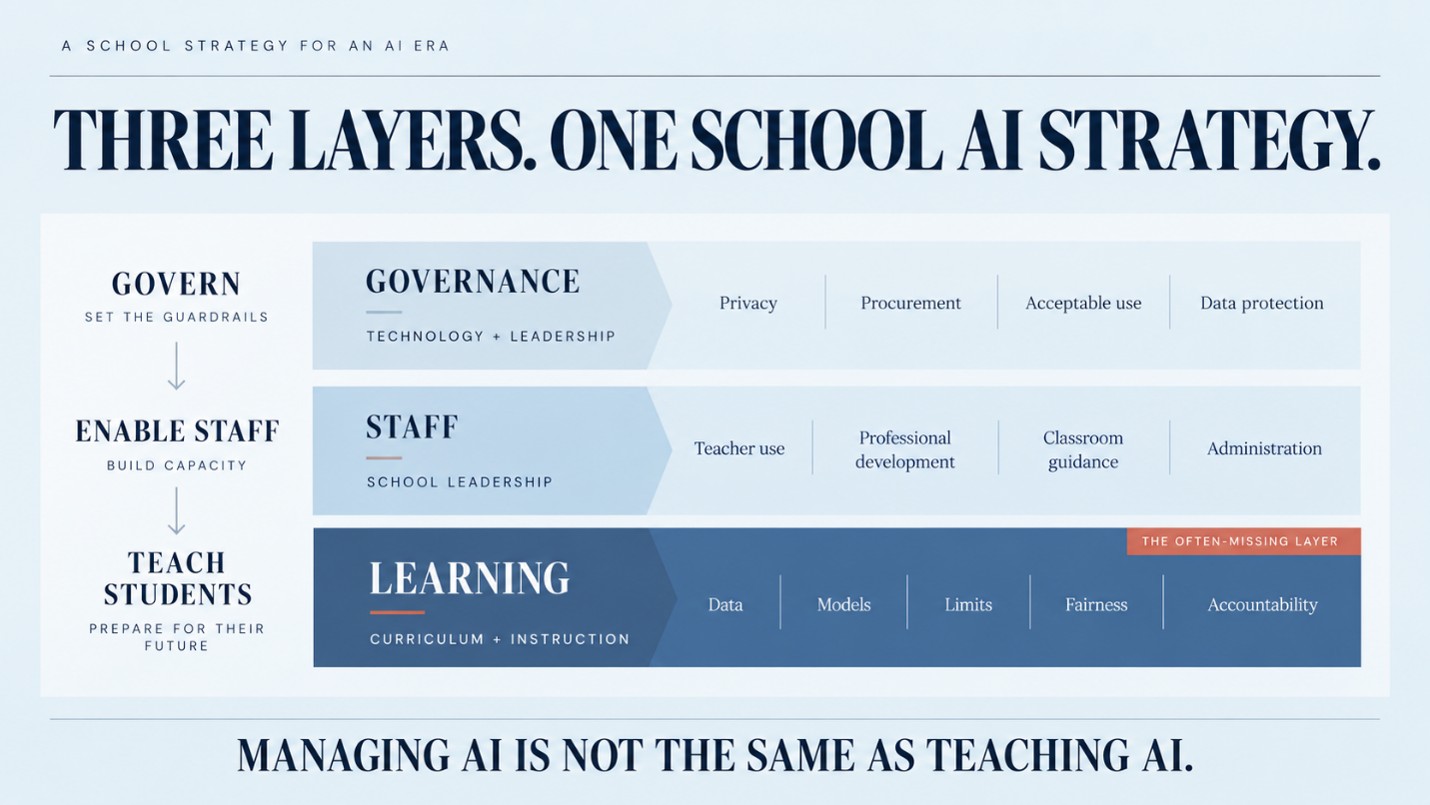
It helps to think of a whole-school AI strategy as having three layers.
The governance layer decides who approves tools, how student data is protected and what the policy says. The staff layer covers how teachers and administrators use AI in their own work, and the training they need. The learning layer sets out what students learn about AI, grade by grade.
The first two layers almost always have an owner, often a chief technology officer or an assistant superintendent. The third layer often doesn’t. It ends up as a one-off assembly, a single elective, or an assumption that “the computer science teacher covers that.”
Why your policy depends on your curriculum
AI policies use words like “responsible,” “appropriate,” “verify the output” and “disclose AI use.” Those words only mean something if students have learned what they refer to.
To verify an output, a student needs to know that a language model predicts likely text. It does not retrieve facts. To question whether a tool is fair, a student needs to know that models learn from examples and pick up the gaps in those examples. RAND’s own recommendation points the same way: guidance should show how AI can support learning rather than replace it, with clear examples of acceptable and unacceptable use. That is teaching work, not only policy work.
This is why writing an AI policy schools will use is closely tied to what the curriculum teaches.
If your AI policy asks students to use AI responsibly, where in the curriculum do they learn what “responsible” means?
Where AI education should sit
Ownership. Student AI learning belongs with academic leadership: the curriculum and instruction office, or a curriculum director. The technology office should be a close partner. It should not be the only owner.
Placement. Schools need to decide whether AI learning is a separate subject or part of computer science, or a thread across several subjects. Any of these models can work, as long as it has three things: a clear progression, protected time in the schedule and a named owner.
Capacity. Most schools don’t have an AI specialist on staff. So checking readiness to teach AI as a subject means asking whether non-specialist teachers will have materials they can teach from with confidence.
Standards. US frameworks already give schools a starting point. The CSTA K-12 Computer Science Standards and the ISTE Standards for Students both include ideas that AI learning can connect to. Mapping AI units to them makes AI learning part of the academic plan. Keep in mind that mapping a lesson to a standard shows alignment. It does not show that students have mastered it.
If AI education sits only with the technology office, who is accountable for whether students actually understand it?
Questions to settle before next school year
Before the next budget cycle, leadership teams should be able to answer five questions:
- Who owns student AI learning?
- What should a 3rd grader, a 7th grader and an 11th grader each understand about AI?
- Where does that time come from in the schedule?
- Does the AI policy refer to what is actually taught?
- How will you know it’s working?
Guidance at the state and federal level keeps changing. Understanding where AI education policy is heading matters. But a strategy built on lasting ideas (data, models, limits, fairness and accountability) will hold up longer than one built around the latest tool.
FAQs
What is a whole-school AI strategy?
It is a plan that covers three things: how AI is governed (policy, privacy, procurement), how staff use it, and what students learn about it. Many schools have the first two and leave out the third.
Where should AI education sit in a school AI strategy?
It should be the learning layer of the strategy, owned by academic leadership. It needs a clear K-12 progression and protected time in the schedule. It should not sit only with the IT department.
Is an AI acceptable use policy enough to teach students about AI?
No. A policy sets rules, but students also need to understand how AI works. To follow rules like “verify AI output,” they need to know why AI can be wrong. That understanding comes from the curriculum.
Who should own AI education in a school district?
Usually the curriculum and instruction office or a curriculum director, working closely with the technology team. The key is to have one named owner who is accountable for what students learn.
Which US standards can schools map AI learning to?
CSTA’s high school standard 3B-AP-08 asks students to describe how artificial intelligence drives many software and physical systems. The ISTE Standards for Students, NGSS engineering design, Common Core and CASEL can also anchor AI units in an academic plan.