

Picture a ninth-grade class that spends a period learning to write better prompts. By the bell, most students can coax a tidier paragraph out of a chatbot. Then one student asks why the same prompt gave a different answer the second time. Nobody knows, and the lesson has no way to find out.
That gap is where a good generative AI curriculum starts. Prompting is useful, but it is the surface of the tool. Students who learn only the surface cannot judge what comes back.
Students are using AI faster than schools are teaching it
The useful recent U.S. evidence is RAND’s 2025 national survey report. It found that 54 percent of students and 53 percent of English language arts, math and science teachers said they used AI for school in 2025. But only 35 percent of district leaders said they provided students with any training on AI, and over 80 percent of students said teachers had not explicitly taught them how to use AI for schoolwork.
when guidance is this thin, the fastest fix is a prompting workshop. It is cheap and easy to show. But RAND measured guidance on using AI, not whether students understand how these systems work. That gap is our inference, not a RAND finding.
What students need to understand about the machine
A chatbot does not look up an answer. It splits text into small pieces called tokens, turns them into numbers, and predicts which piece is likely to come next, over and over. That one idea explains why answers vary, why a fluent paragraph can hold a false claim, and why the examples a model learned from shape what it says. The full picture is covered in how generative AI actually works. Once students see language as data, they stop treating the output as a verdict.
Prompting-only lessons vs. understanding-first lessons
| Lesson element | Prompting-only | Understanding-first |
| Main goal | Get a better output | Explain why the output looks the way it does |
| Core activity | Rewrite the prompt until it works | Run the same prompt several times, then trace the variation to how the model works |
| When the answer is wrong | Try another prompt | Look for a cause: gaps in training data, a confident guess, a missing source |
| Evidence of learning | A polished result | A written explanation and a decision to trust or reject the output |
| Shelf life | Ends when the tool changes | Holds when the tool changes |
A four-step lesson shape for classrooms
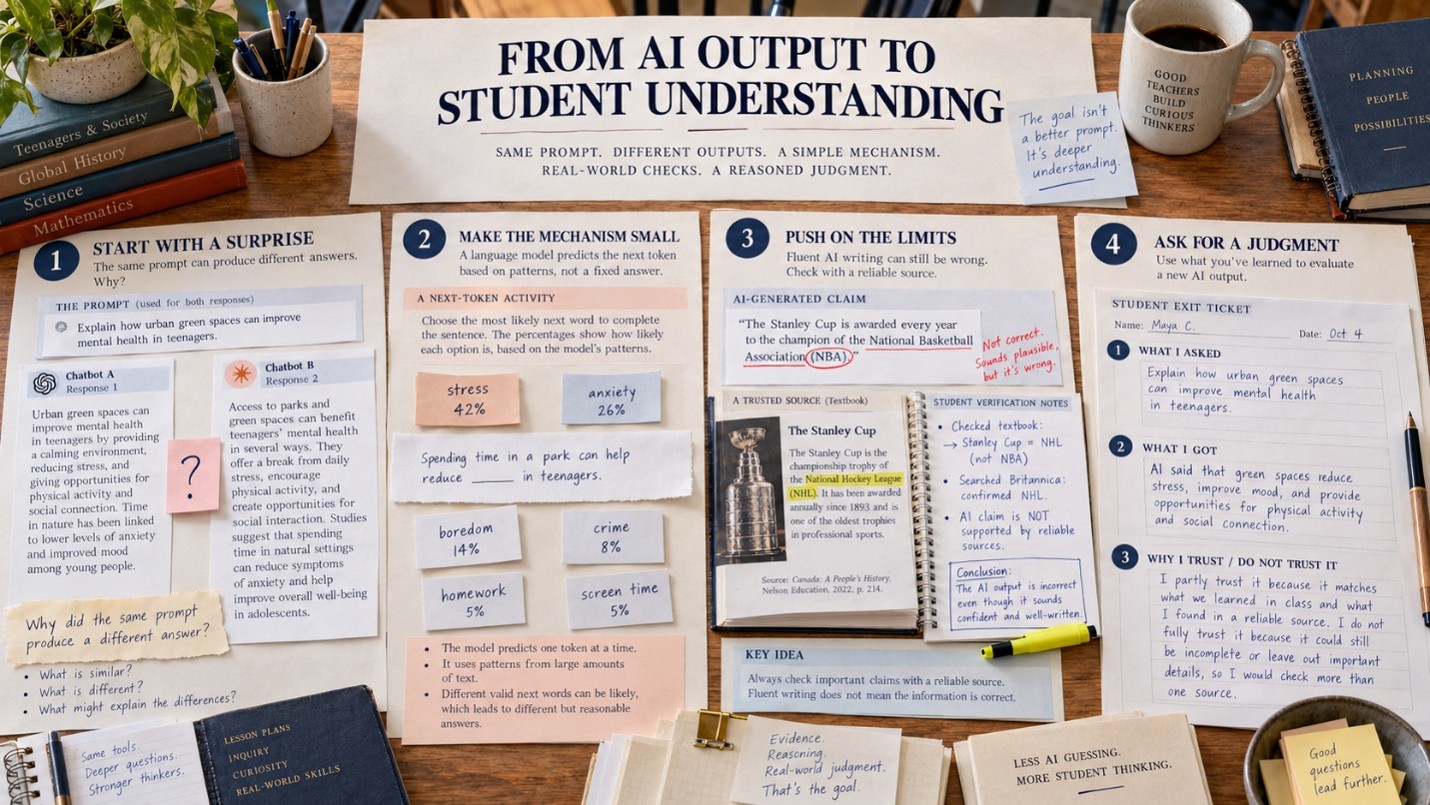
- Start with a surprise. Run one prompt twice and show both answers. Ask students to predict why they differ before you explain anything.
- Make the mechanism small. Predict the next word in a short sentence from a handful of examples. This works on paper, so every student can take part, with or without a device.
- Push on the limits. Give students AI-written claims to check against reliable sources. Let them find an error, then ask where it might have come from.
- Ask for a judgment. End with a short written note: what I asked, what I got, and why I trust it or do not.
Each step teaches something a prompt cannot, and together they make responsible use concrete. For the classroom side, see classroom AI use that students can explain and evaluate. Keep the two goals apart in planning too, because teaching about AI and teaching with AI need different lesson plans.
Two questions are worth raising in your next curriculum meeting.
If the tool changed next semester, would this lesson still make sense?
If students can get a good answer from a chatbot but cannot explain why it sometimes fails, what have they actually learned?
What curriculum leaders should check
- Teacher support. Most teachers are not AI specialists. Look for scripts, expected misconceptions and ready answers, not only a webinar.
- Assessment. Mark the explanation, not only the output.
- Standards. CSTA, ISTE and CCSS can help you check coverage. A lesson mapped to a standard does not show that students have met it.
- Sequence. One generative AI lesson is an event. Ideas such as training data and bias need to return in later years.
FAQs
What should a generative AI curriculum teach besides prompting?
How these systems work (tokens, patterns learned from training data, next-word prediction), where they fail (hallucination, bias), how to check outputs, and how to explain a decision to trust or reject a result. Prompting can sit inside that.
Which grade should schools start teaching how generative AI works?
Schools usually decide this locally, and readiness varies. A sensible path is to introduce learning from examples and mistakes early, then teach tokens and probability once students are ready for the reading and math involved. APEX AI places its generative AI unit in Grade 8.
How can teachers tell whether students understand generative AI?
Ask for more than output. Have students predict how an answer might change, find an error in an AI-written claim, and explain in writing why they would or would not trust it. Their reasoning is the evidence.
Is prompt writing still worth teaching?
Yes, as one short skill. Teach it after students know why outputs vary, so they can tell good prompting from guesswork.