
“A neural network works like the human brain.” It is the most common sentence in AI education, and it does a quiet kind of harm. It sounds like an explanation, so students stop asking. Nothing in it tells them what the network actually does.
A better start is a network so small you can hold it in your head.
One neuron, worked by hand
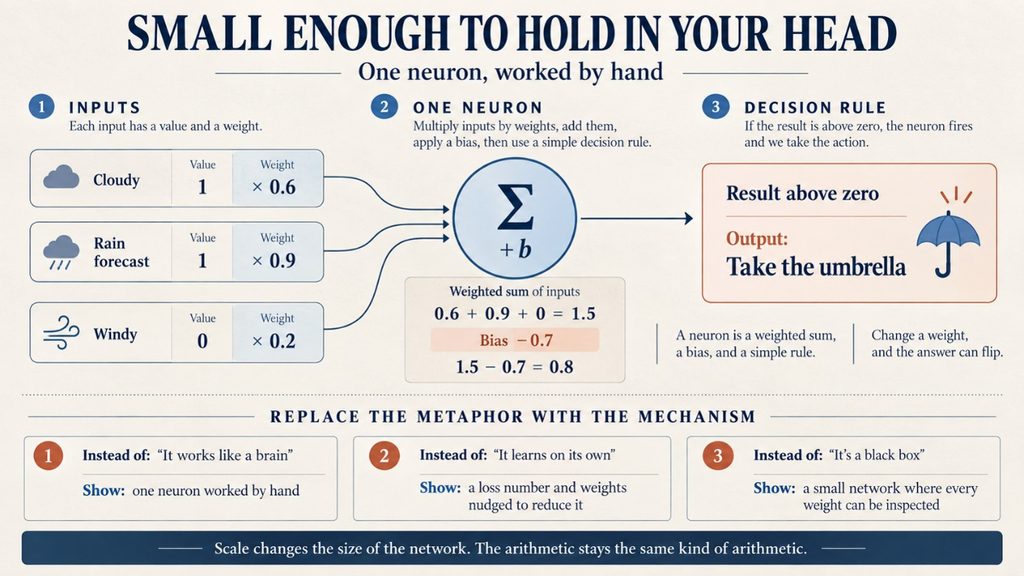
Suppose a tiny model decides whether to take an umbrella. It looks at three yes/no inputs. Each input has a weight, which is how much it matters.
- Cloudy: 1 (yes), weight 0.6
- Forecast says rain: 1 (yes), weight 0.9
- Windy: 0 (no), weight 0.2
- Bias: −0.7
Multiply each input by its weight and add them up: 0.6 + 0.9 + 0 = 1.5. Add the bias: 1.5 − 0.7 = 0.8. Because the result is above zero, the answer is “take the umbrella.”
That is a whole neuron: a weighted sum, a bias, and a simple rule that decides what to pass on. Now let students change a weight and watch the answer flip. They have just seen what “learning” changes.
Stack many of these in layers and you have the building block of much larger systems. The size is different. The arithmetic is the same kind of arithmetic.
Replace the metaphor with the mechanism
| Common line | What it hides | What to show instead |
| “It works like a brain” | That each unit is just arithmetic | One neuron worked by hand |
| “It learns on its own” | That something measures how wrong it is | A loss number, and weights nudged to reduce it |
| “It’s a black box” | That small networks can be fully inspected | A network where students see every weight |
This table is our teaching frame. It does not need advanced maths. It needs the patience to let students calculate.
Something to think about:
If a student can recite “input, hidden, output” but cannot work out what one neuron does with three numbers, have they learned a mechanism or a vocabulary list?
Be honest about the level
Explainable does not mean students build large networks. A good school programme says plainly what students do at each stage. At the middle-school stage, “run and read” is a sensible target: open a prepared notebook, change a value, read what happens. Being clear about this also protects the curriculum from over-promising, which connects to why training examples matter and the later move into language as data and how generative AI works.
FAQs
Do students need calculus to understand this?
Not for the forward pass. Multiplying, adding and comparing to zero is enough. APEX Grade 6 treats backpropagation as a concept, not as calculus.
Is the brain analogy wrong?
It is incomplete. The Grade 6 unit covers biological versus artificial neurons as a topic, so the analogy is used, but compared rather than relied on.
Will students write code?
Not from scratch at this stage. According to the documents, Grades 6 to 8 are “run and read,” and code writing comes in Grades 9 to 12.
What if our teachers are not AI specialists?
The Teacher Guides include an opening script, board content and expected student responses for each session. The programme also lists eleven teacher onboarding modules.