A Grade 9 teacher uploads a photo, and an image classifier labels it correctly in under a second. The class is impressed. Then one student asks, “How do we know that wasn’t luck?”
That question is where a secondary school AI curriculum starts to earn its place on the timetable. Many programmes never reach it. They stay at the demo, because a demo is easy to run and easy to enjoy.
Why demonstrations run out of teaching value
Demos are a good way in. They make a hidden idea visible, and they show younger students that AI is real. But by the secondary years, most students already use AI every day. Another “look, it works” moment adds little.
What they usually cannot do is say how well a system works, for whom, and what happens when it fails. Using AI and understanding AI are not the same educational goal. Evaluation is where the gap shows.
What evaluation looks like in a classroom
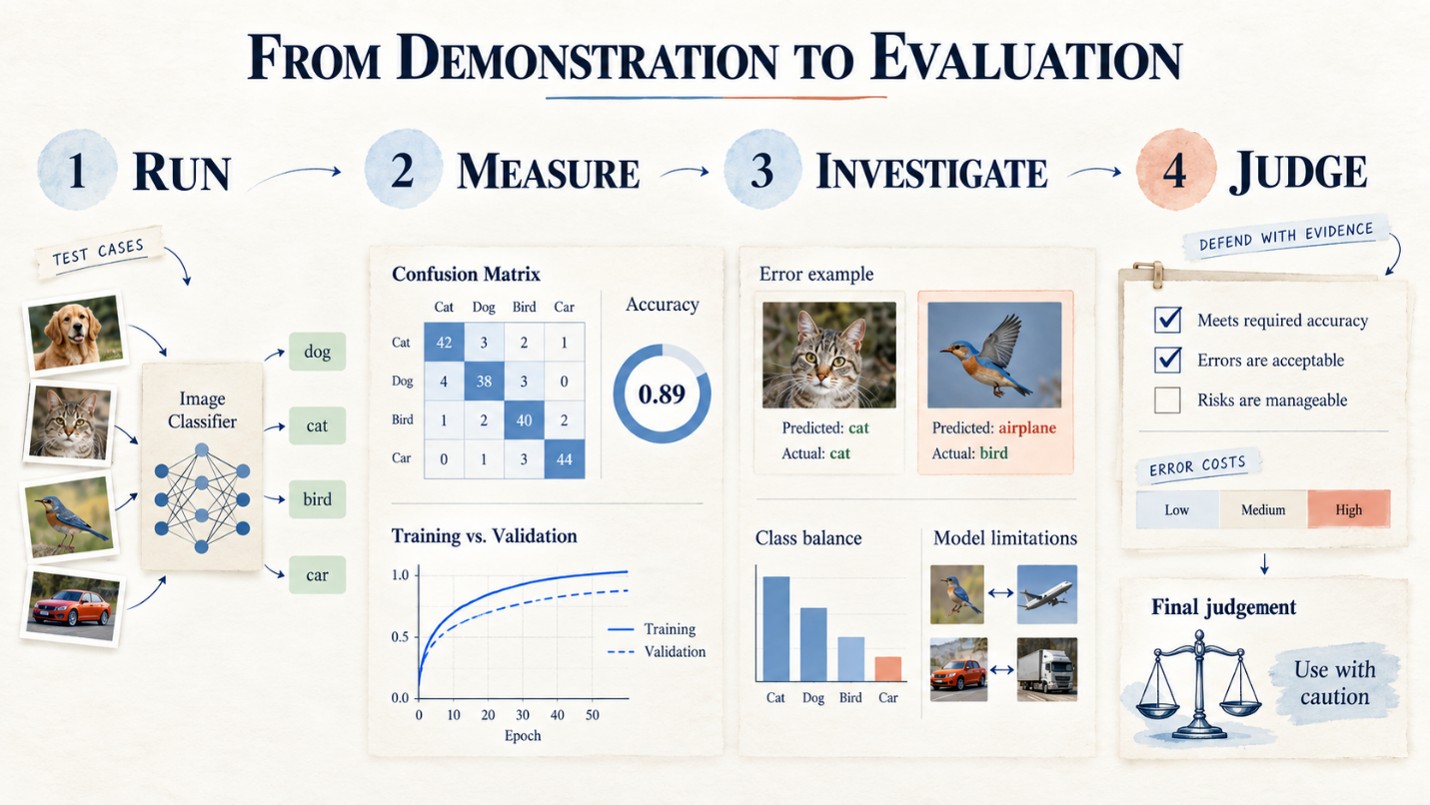
Evaluation means students collect evidence about how a system behaves, then make a judgement they can defend. The easiest way to see the shift is to compare what students do in a demonstration with what they do in an evaluation.
In a demonstration, students notice that the model gets most answers right. In an evaluation, they ask what that accuracy number hides, and they read a confusion matrix to find out. In a demonstration, they hear that models learn from examples. In an evaluation, they check whether those examples were balanced. When a model makes a mistake, a demonstration lets students call it a glitch. An evaluation asks them to sort the errors by type and decide which kind costs more.
The same change happens with training and claims. Students who only watch a model train do not learn much from it. Students who evaluate it read the training and validation curves and look for overfitting. In a demonstration, students may accept that “the model understands”. In an evaluation, they decide what evidence would support that claim or reject it. Ethics changes too. Instead of a separate lesson, students weigh the cost of an error on real people in the same lesson where they study the maths.
None of this needs advanced coding, because a confusion matrix can be filled in by hand. It does need a curriculum that asks the question at every stage. That is easier when students start from primary foundations in smart machines and fairness. It also helps to teach neural networks through small models before asking students to judge bigger systems. The confusion matrix is the tool that makes the judging concrete.
How one programme spreads evaluation across the years
In Scholario APEX AI, students first calculate accuracy from a confusion matrix in Grade 5, alongside precision, recall and overfitting. By Grade 9 they plot and read training and validation loss curves. They also work through an ADNOC pipeline-inspection case, where a false negative and a false positive carry very different costs. Marking follows the same path. In Grades 6–8, hand calculations are marked for method as well as answer. In Grades 9–12, students produce and defend their work.
Five questions to ask when you review a secondary AI programme
- When do students first judge a model, rather than just run it?
- Do they meet false positives and false negatives in a human setting, not only as formulas?
- Is the method marked, or only the final answer?
- Does any task ask students to defend a position with evidence?
- Does evaluation return in later grades with more at stake?
If students can run a model but cannot say what evidence would show it is wrong, what have they learned?
Judgement also needs a place to show itself. An AI capstone that connects technical understanding and judgement is one option. The evidence behind it is covered in telling whether students understand AI.
FAQs
When should students start evaluating AI models?
There is no single agreed age I can point to. Simple versions can start early, such as testing a decision tree and finding where it fails. Formal measures like accuracy, precision and recall need some number sense, so many programmes place them around Grade 5 or later. In APEX, accuracy from a confusion matrix arrives in Grade 5.
Do students need to code to evaluate a model?
No. Confusion matrices and loss curves can be read and discussed without writing code. In APEX the coding load rises slowly. There is no code up to Grade 4, no-code tools in Grade 5, run-and-read notebooks in Grades 6–8, and modify-and-build in Grades 9–12.
How is evaluation different from an ethics lesson?
Ethics asks who is affected. Evaluation gives students the evidence to answer. Taught apart, students argue from opinion. Taught together, they can say what a false negative costs and who pays for it.