Many primary AI lessons reach fairness early because it feels relevant and safe. Ask a Grade 4 class whether an AI can be unfair and most will say yes. Ask why, and you can get silence, or a guess that the robot is “mean”.
The reason is order. Fairness is a conclusion about how a system treats people. To reach it, children first need to know what the system was shown and how it decides. A primary school AI curriculum has to build that ground before the fairness unit asks children to stand on it.
Four steps that lead to fairness
Grades 1–4 in Scholario APEX AI
| Grade | Big idea | What students do | What it gives the fairness unit |
| 1 | AI is a machine that learns from examples, and real people build it | Define AI in their own words; sort AI from not-AI; name one thing AI cannot do | Someone made this, so someone is responsible |
| 2 | AI improves when shown many labelled examples | Explain training data; train a simple classifier with teacher guidance; find one reason a model fails | Examples shape results |
| 3 | Computers classify with a chain of yes/no questions | Build a decision tree for animals, test four new animals, find which question caused the error | Prediction is not certainty, and errors have causes |
| 4 | Fairness is a design choice people must make | Study three real cases; explain one cause of bias; propose one fix | The pieces come together |
Each step gives the fairness unit something to use. The Grade 2 step is the one that matters most for reasoning about bias, because it shows why training examples matter in machine learning. By Grade 4, “unfair” is no longer a feeling. It can be traced to what a model was shown.
Real cases, and someone responsible
Grade 4 works three documented cases: facial recognition, loan approval and content recommendation. It asks who is responsible: engineers, companies, governments or users. Fairness is set up first as a decision people make, before any AI is discussed. For classroom versions of this kind of work, see investigating AI bias through data and decisions.
What the international frameworks say
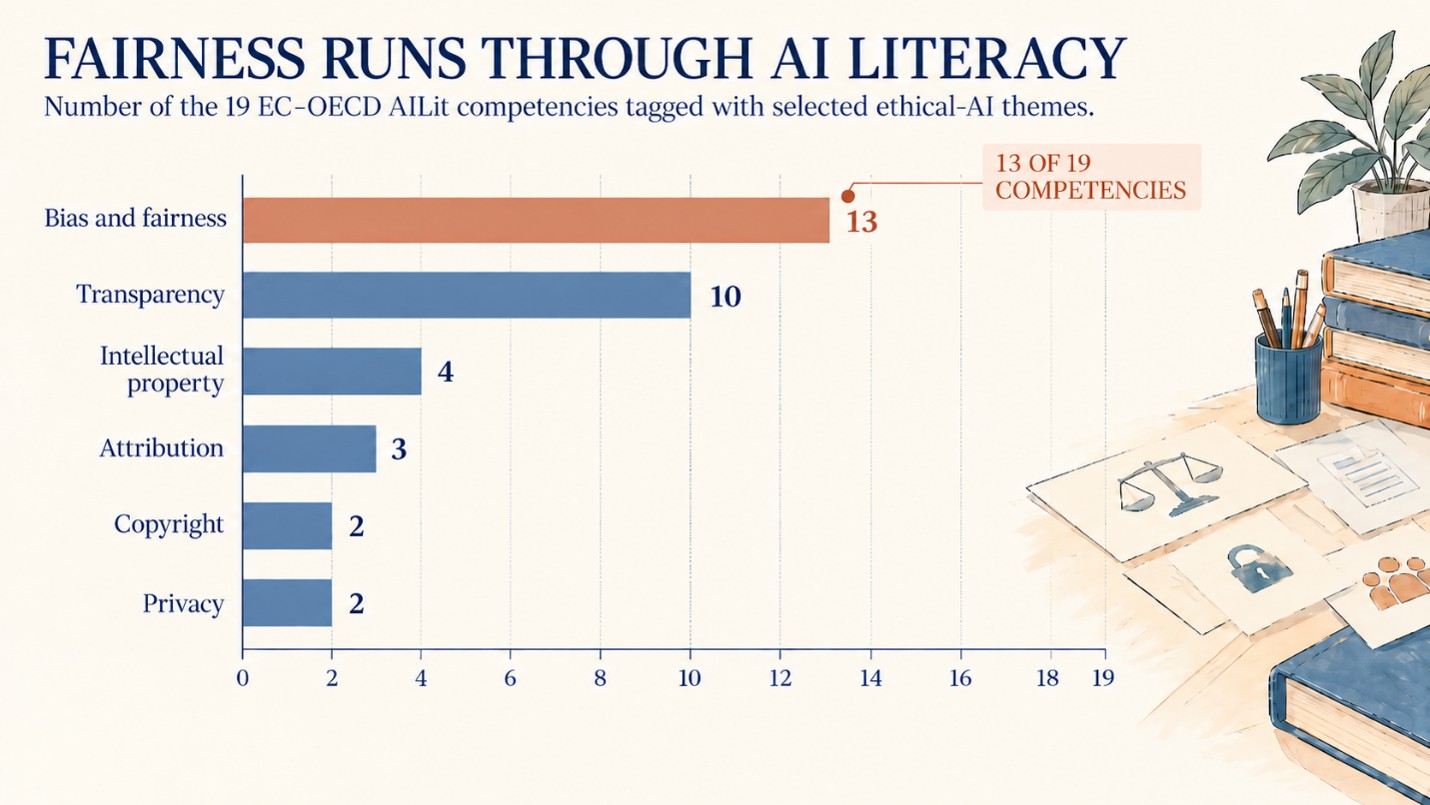
In June 2026 the European Commission and the OECD launched the AI Literacy (AILit) Framework for primary and secondary education. It has four domains: Engage with AI, Create with AI, Manage AI and Shape AI. It sets out 19 competences across knowledge, skills and attitudes. It is designed to complement the PISA 2029 Media and AI Literacy assessment.
Our interpretation is that the primary years are where “shape” begins. Children who learn that an AI was designed by people, trained on chosen examples, and can be changed have taken the first step towards seeing AI as something people can shape. That is our reading, not the framework’s wording.
What leaders should check
- Does the fairness unit come after students have met training data?
- Are the cases real rather than hypothetical?
- Is responsibility named?
- What do students make? (Grade 4 ends with a session called “Our classroom AI promise”.)
- Can students meet the core ideas without needing to log in? In Scholario APEX AI, KG to Grade 4 uses no code: unplugged sorting, drawing, role play and browser interactives. See teaching core AI ideas without logging in.
The stages on either side are worth reading with this one: what kindergarten children can learn about AI through play and moving secondary AI learning from demonstrations to evaluation.
If a Grade 4 student can define bias but cannot say which examples a model was shown, have they learned about fairness or only its vocabulary?
FAQs
When should primary students learn about AI bias?
After they have met training data. In Scholario APEX AI, fairness comes in Grade 4, two years after Grade 2 introduces training data. I don’t know of a single universal age, so check this against your own students and context.
Do primary students need to code?
Not in this design. Scholario APEX AI uses no code from KG to Grade 4. Grade 5 uses no-code tools such as Teachable Machine.
Is Grade 1 too early to define AI?
Not if the definition is age-appropriate. Scholario APEX AI uses an analogy to how a child learns what a cat is, and it teaches what AI cannot do in the same unit.