
A school adopts an AI literacy framework in September. By November, teachers are asking the same question: “What do I teach on Monday?”
A framework can be a few pages long. A timetable cannot. The work between the two is where many AI plans slow down.
What a framework does, and what it leaves out
A framework describes what students should know, do and value. It rarely says when to teach each idea, how to teach it, what materials to use or how to check learning. A programme has to add those parts.
Start with the competences. A framework lists them broadly, so the programme has to turn them into a grade-by-grade sequence. Ask what comes before and after each idea. The same goes for learning outcomes: a programme needs lessons with time and materials, so teachers know what happens in each one. Ethics and attitudes are often stated as aims. The programme should give them real cases and discussion prompts, so students have a place to practise judgement.
The remaining gaps are about proof and people. A framework sets expectations, but a programme must decide how it will know students reached them, which means assessment and evidence. It also has to support the teacher, and the test is simple: can a non-specialist teach it? Finally, if the programme links lessons to standards, it should be clear whether it is claiming alignment or mastery. A mapping shows where a lesson connects to a standard. Mastery needs evidence from student work.
Six steps from framework to programme
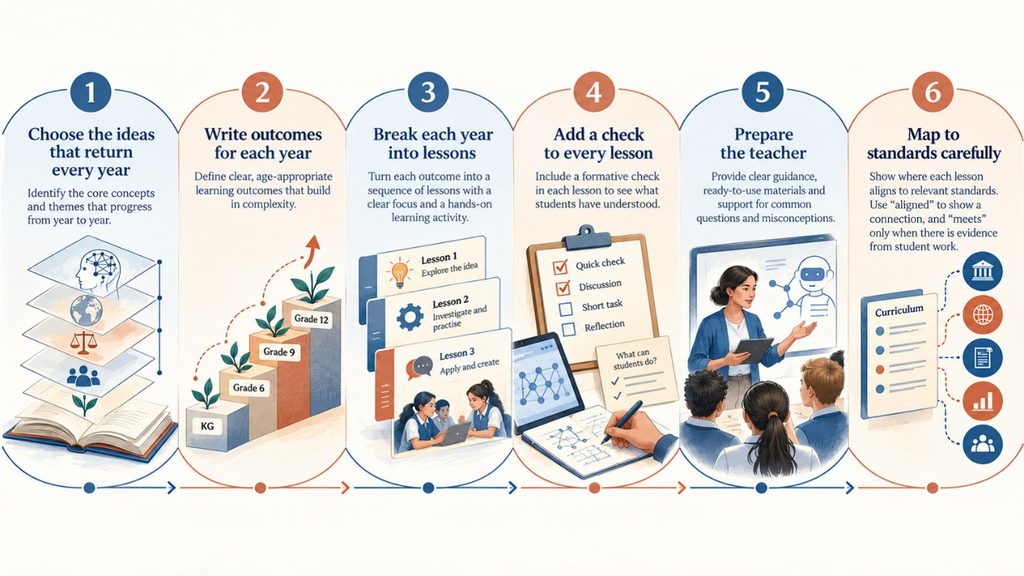
- Choose the ideas that return every year. These become your threads. If they appear once, you have a topic, not a progression. See what belongs in a K-12 AI literacy framework.
- Write outcomes for each year. Each should make sense only at that level. Avoid naming tools. Read learning outcomes that survive changes in tools.
- Break each year into lessons. One core idea and one thing students do in each.
- Add a check to every lesson. Do not leave assessment to the end of the unit. A useful guide is what students should be able to do.
- Prepare the teacher. Scripts, common misconceptions and answers save teachers time.
- Map to standards carefully. Say “aligned” when a lesson connects to a standard. Do not say students “meet” it unless you have assessed that. See standards a curriculum can be measured against.
If a framework cannot tell a teacher what to do on Monday morning, who is meant to translate it?
For the competency layer, see a competency framework for student AI literacy.
FAQs
What is the difference between an AI literacy framework and a curriculum?
A framework sets the aims and the range of competences. A curriculum turns those aims into a sequence of units and lessons, with materials and assessment.
Where should a school start?
We suggest starting with one grade band. Map your framework to a few lessons, teach them, and see where teachers get stuck. Then extend.
Can we adopt an existing programme instead of writing our own?
Yes. Use the table above as a check. Ask whether the programme supplies the sequence, the lessons, the teacher support and the evidence, and whether it fits your framework.
Is mapping to standards the same as students meeting them?
No. A mapping shows where a lesson connects to a standard. Meeting a standard needs evidence from student work.