

Why Explaining an AI Decision Belongs in the K–12 Curriculum
A seventh grader runs a photo through an image classifier for a science project. It labels her dog as a wolf. The class laughs. She tries another photo, the label comes out right, and the lesson moves on.
Nobody asks the useful question: why did the model say “wolf” in the first place?
It could have been the snowy background, or the angle of the photo. It could have been that most of the wolf photos the model learned from were taken in snow. A student who can talk through those possibilities has learned something real about AI. A student who just tries another photo has learned how to get a better result. Those are two different things, and many schools are mostly teaching the second one.
Students Use AI to Explain Things. Few Are Asked to Explain AI.
American students already lean on AI for explanations. RAND ran a nationally representative survey of 1,214 young people aged 12 to 29. The share using AI for homework rose from 48% in May 2025 to 62% by December 2025. The most common use was getting “better explanations of assignments,” reported by 38% of students. In the same survey, 67% of students agreed that the more students use AI for schoolwork, the more it will harm their critical thinking skills (RAND, March 2026).
An earlier RAND study fills in the rest of the picture. In 2025, 54% of US students said they used AI for school. Yet more than 80% said their teachers had not explicitly taught them how to use AI for schoolwork (RAND, September 2025).
Put those two findings side by side. Students ask AI to explain things to them every day. Few are taught how AI works, and fewer still are asked to explain an AI’s output in their own words. The explanation goes only one way. That gap is what this article is about.
What “Explaining an AI Decision” Actually Means
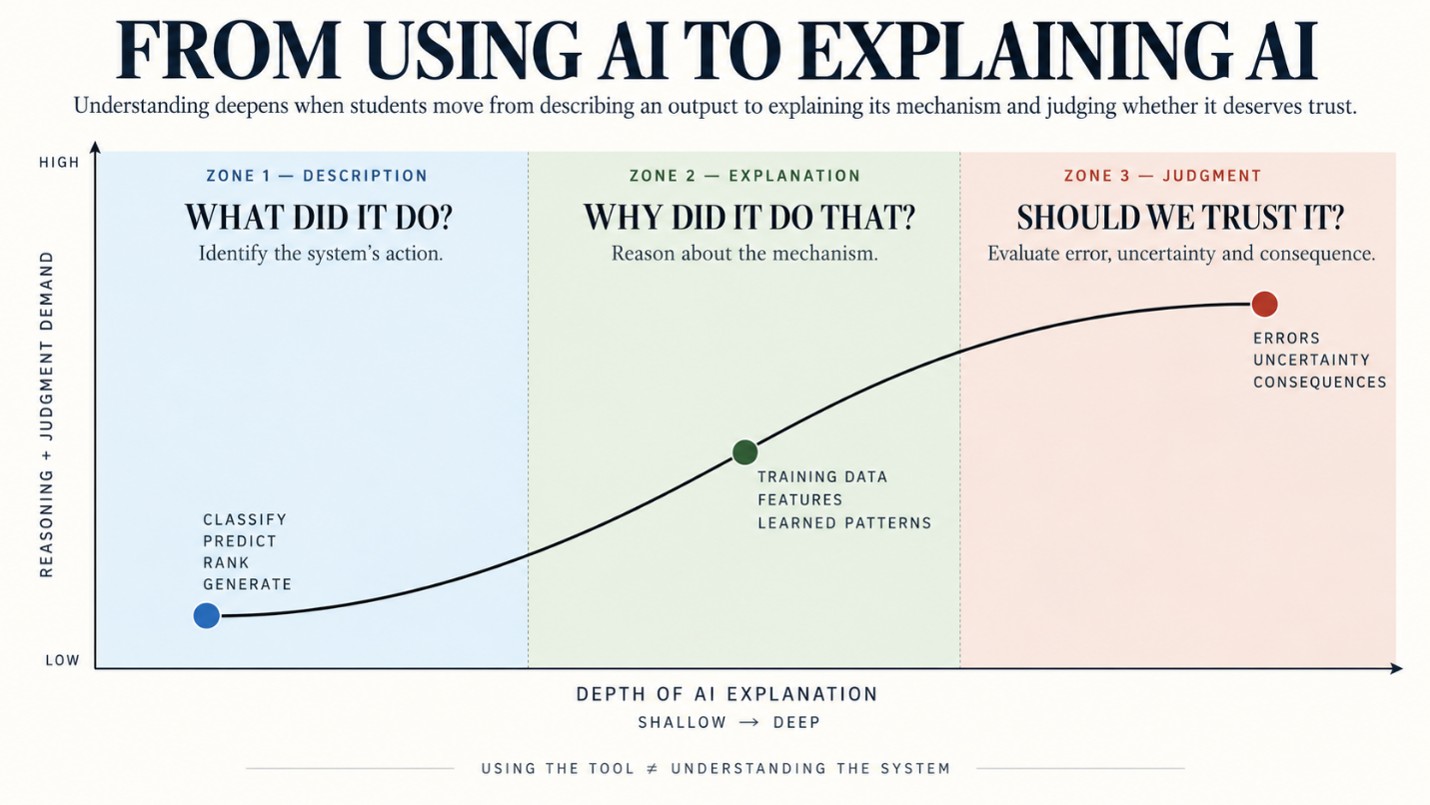
Explaining an AI decision is different from describing what a tool does. “It recognizes dogs” is a description. A real explanation answers three harder questions.
What did the system do? This sounds basic, but it needs precision. Did the model classify, predict, rank or generate? A spam filter sorting email and a chatbot writing a paragraph are doing very different jobs.
Why did it produce this output? Here students need the mechanism. A machine learning model makes decisions from patterns in the examples it was trained on. If most training photos of wolves had snow in them, the model may have learned “snow” instead of “wolf.” A student who can say that is reasoning about data, features and training rather than guessing.
Should we trust it? Every model makes errors, and some errors cost more than others. Students who learn to read what a confusion matrix reveals about AI decisions can see that a model with high overall accuracy may still miss the cases that matter most.
A student who can answer all three questions understands the system. A student who can answer only the first knows the tool’s name.
Why Explanation Is Strong Evidence of Understanding
Curriculum leaders often ask how they can know whether students really understand AI. Explanation is one of the clearest answers.
A multiple-choice question can show that a student recognizes the term “training data.” It cannot show whether that student would think of training data when a model fails in front of them. Asking a student to explain one specific wrong output tests whether the idea is usable or only memorized.
This matters more as AI tools improve. A tool that rarely makes mistakes gives students fewer moments to wonder why. Teaching explanation on purpose keeps reasoning in the lesson even when the output looks right.
If a student can get a perfect answer from an AI system but cannot explain why the system might have gotten it wrong, what has the school actually taught them?
Explanation also builds habits students need well beyond AI class: weighing evidence, naming uncertainty, and telling a claim apart from its cause. These are the critical thinking skills students will need most. Explaining an AI decision gives students a concrete way to practice them again and again.
How AI Communication Skills Should Grow From Kindergarten to Grade 12
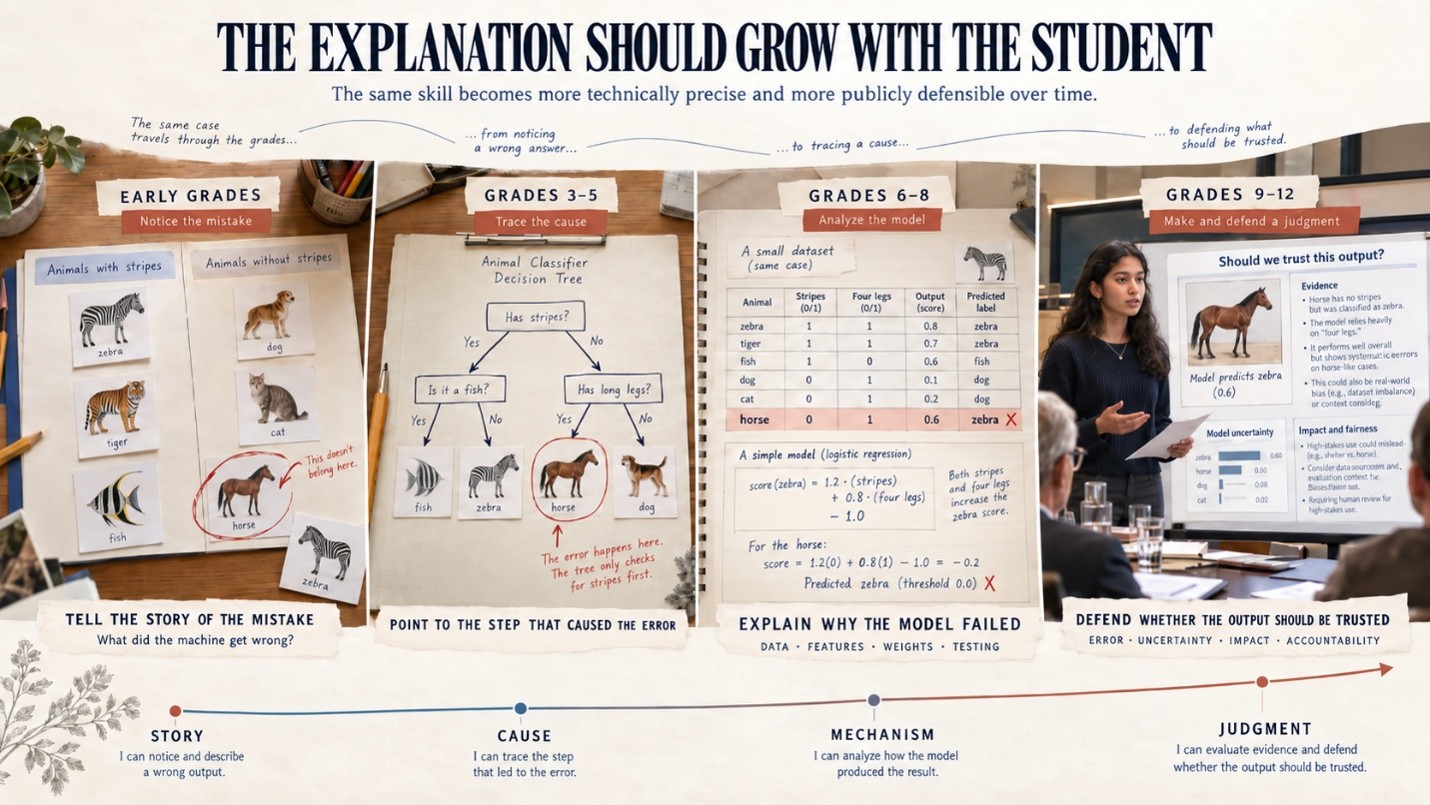
Explanation is not a single lesson. It is a skill that should get harder every year.
In the early grades, children can tell the story of a machine mistake: a smart speaker mishears a word, or a sorting game puts a tomato with the apples. They can draw what the machine “saw” and say what it needed to see more of.
In upper elementary, students can build something simple, like a decision tree, test it, and point to the step that caused a wrong answer. Short explanatory writing and flowcharts fit well at this stage.
In middle school, students can work with real models and real numbers. They can explain why a model that memorized its training data does badly on new data, or what a single weight in a neural network does. They can also write short arguments backed by evidence.
In high school, the audience changes. Students should explain AI decisions to people who will push back. That means writing recommendations, presenting them, and answering hard questions about transparency and accountability. A well-designed AI capstone is the natural end point, because it asks students to bring technical understanding and judgment together in front of a real audience.
The test for progression is simple. If a Grade 12 explanation task could easily be done in Grade 6, the skill is not developing.
What This Means for Curriculum Leaders
Standards already value explanation. The Common Core ELA standards, which many states use or have adapted, ask students to write informative texts, build arguments with evidence, and present findings clearly. The NGSS science and engineering practices include constructing explanations and engaging in argument from evidence. CSTA’s K–12 Computer Science Standards ask high school students to describe how artificial intelligence drives many software and physical systems (3B-AP-08).
What these standards do not do is tell schools to apply explanation to AI. That is a curriculum design choice. A few practical questions can guide it:
- Does every AI unit include at least one task where students explain a specific model output, instead of only describing the tool?
- Are students explaining failures as well as successes?
- Do the depth of the explanation and the audience for it grow from grade to grade?
- Do rubrics reward reasoning about data and mechanism, or only correct answers?
Keep in mind that mapping a lesson to a standard is not the same as students mastering it. Evidence of explanation collected over time is what shows real progress.
It also helps to link explanation with how students use AI every day. Teaching students to collaborate with AI works best when they can question a tool’s output instead of simply accepting it.
If your AI program assesses what students can build but never what they can explain, how will students defend their own work when someone asks why?
A Closing Thought
AI will keep getting better at explaining things to students, and that is useful. A curriculum should also make sure students can explain AI back: what it did, why it did it, and whether its output deserves trust. That skill does not appear on its own after a few chatbot activities. It has to be planned, taught and assessed year after year.
FAQs
Q: What does it mean to explain an AI decision?
A: It means describing what an AI system did, why it produced that output, and whether the output can be trusted. A good explanation refers to the training data, the features the model may have used, and the kinds of errors it can make.
Q: Why should explaining AI decisions be part of the K–12 curriculum?
A: Students already use AI widely, but using a tool does not show they understand it. Explanation shows whether students can reason about how AI works. It also builds critical thinking and communication skills that carry across subjects.
Q: At what age can students start explaining AI decisions?
A: Students can start in the early grades. Young children can describe a machine mistake and say what the machine needed to learn. The depth grows over time, up to written arguments and formal presentations in high school.
Q: How can schools assess AI communication skills?
A: Ask students to explain a specific model output, especially a wrong one. Use rubrics that reward reasoning about data, mechanism and error, not just correct answers. Collect this evidence across the year, not only in one end-of-unit test.
Q: Which US standards support teaching students to explain AI?
A: Common Core ELA writing and speaking standards, the NGSS practices of constructing explanations and arguing from evidence, and CSTA’s high school standard 3B-AP-08 on how AI drives software and physical systems all support this work. Schools still need to design AI tasks that put these skills to use.
Q: Is explaining an AI decision the same as explainable AI (XAI)?
A: No. Explainable AI is a research field focused on building AI systems whose decisions people can interpret. In school, the goal is for students to reason about why a model behaved the way it did. High school students may meet XAI ideas as part of learning about transparency and accountability.